Startup Stories from the Hub of Entrepreneurship


Summer 2026






Startup
Stories
Story by John Crawford
Photos by Nic Czarnecki
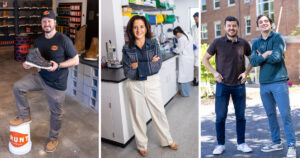
Babson ranks No. 1 among colleges for the largest share of alumni who are founders or entrepreneurs. This is a snapshot of three ventures, all in various stages of their development, launched by Babson entrepreneurs. While their paths may be different, they share many of the hallmarks of the entrepreneurial journey: the pivots and surprises, the worries and long days, the setbacks and glorious successes. They also share something else, namely the lessons they learned at Babson.
Eric Girouard ’08 believes that everyone has their own version of the American dream.
For Girouard, the founder and CEO of Brunt Workwear, a popular seller of boots and apparel, the American dream is defined by autonomy. Girouard didn’t want a career spent punching a clock. Like numerous entrepreneurs before him, he relished independence.
That wasn’t an option for his father. To support Girouard and his sisters as they grew up, their dad held down two jobs. At night, on second or third shift, he worked on an assembly line machining airplane parts. In the morning, he went to work at his friend’s roofing company.
Girouard pursued a different path. “From a young age, I wanted to control my own destiny,” he says. “I think of entrepreneurship as freedom.”
Of course, earning that freedom isn’t easy. It takes hard work. And guts. And a little luck. Girouard launched Brunt in 2020 during the heart of the pandemic. He and his team of three worked in his home garage, leaving the doors open for ventilation. An old cornhole board served as Girouard’s desk.
It was an uncertain time to build a business. One of Brunt’s lead investors told Girouard to forget about the venture altogether. “We had no idea what the future held,” Girouard says. It was also a time of growing family obligations. Girouard and his wife, Sarah Girouard ’07, cared for Maverick, their rumbunctious toddler stuck at home because COVID-19 closed his daycare, while awaiting the arrival of their second child. Jagger was born in October, one month after Brunt was officially launched. “It was a wild time we had to navigate together,” Sarah says.
Brunt entered a market paralyzed by the pandemic, with competitors lacking inventory and laying off employees. In that chaotic environment, Brunt gained a foothold and hasn’t looked back. Today, the company is sold in 2,000 retail stores and employs 125 people. It’s expected to earn $300 million in sales this year. “It’s been incredible watching Eric build this,” Sarah says.
As the longtime leader in entrepreneurship education, Babson ranks No. 1 among colleges for the largest share of alumni who are founders or entrepreneurs, according to a 2025 LinkedIn survey.
That means a slew of Babson alumni (and students), inspired by the College’s courses and supported by its network and resources, have taken the leap into business creation. While their trajectories are all different, they commonly share many of the hallmarks of the entrepreneurial journey: the pivots and surprises, the worries and long days, the setbacks and glorious successes.
This is a snapshot of three ventures. All are in various stages of launching and growing a business, from the heights of Brunt, which has found a loyal following and is still ascending, to ventures in their formative days, those early chapters filled with promise but with much grinding and scraping ahead.
“From a young age, I wanted to control my own destiny. I think of entrepreneurship as freedom.”
— Eric Girouard ’08, CEO and founder of Brunt Workwear
Early Stage: An Initial Pivot
In its beginning stages, a startup can experience more than a few twists and turns. The four Babson entrepreneurs behind Go Revo are in the middle of that turbulence now as they grapple with a frequent question among early startups: What happens when an original approach might not work?
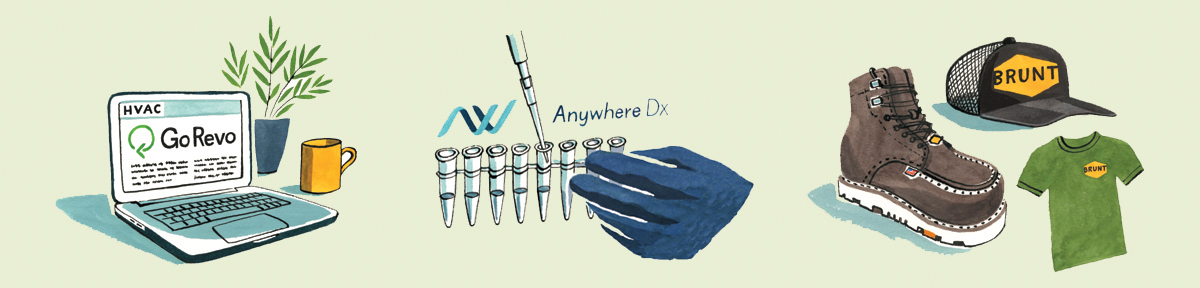
The mission of Go Revo, which the entrepreneurs began to work on in January, is to help home service providers, such as roofers, plumbers, or HVAC technicians, with the ongoing challenge of finding customers. Too often, these providers are reliant on costly (and not always effective) leads to identify customers, an expense that eats into their profits and is typically passed on to consumers.
“These businesses are pillars of everyday life and the economy, yet the people doing the work aren’t the ones capturing the majority of the value being created,” says Nicolas Munoz MBA’26, Go Revo’s chief innovation officer. “The reason is that getting customers has simply become too expensive.”
As entrepreneurs, the Go Revo team empathizes with home service providers. “A lot of these operators built something from nothing, which is a story I know well,” says Roberto Castro MBA’28, Go Revo’s chief business development officer. In Miami, where all four of the Babson entrepreneurs are based and have attended (or will attend) Babson’s MBA program there, many immigrants perform these home services. They work hard and are good at what they do, but they also represent small, overworked independent businesses who might not have the time to improve how their ventures operate.
Startup
Stories
We’ve started a new series on Babson Thought & Action highlighting ventures created by Babson alumni and student entrepreneurs.
Nominate your venture at
news@babson.edu.
To help, Go Revo first focused on providers’ online presences, seeking to make sure they’re properly optimized for search by generative artificial intelligence tools such as ChatGPT. Armed with better search results in an increasingly popular way that customers look for services, providers wouldn’t need to rely so much on costly leads.
Mere months into Go Revo’s existence, though, that initial plan ran smack into hard reality. Optimizing for AI search is tricky, and tech giants are already crowding the space. These facts forced the Go Revo team’s hand. Like so many other entrepreneurs have done, they needed to pivot. The startup’s big-picture aim of helping service providers remained, but the team required a new way to get there. “The North Star is solving a problem for these businesses,” says Alejandro Mejia Nauffal MBA’27, Go Revo’s AI engineer.
The venture pondered where and how to pivot in the first weeks of this year’s Summer Venture Program (SVP), an accelerator run by Babson’s Arthur M. Blank Center for Entrepreneurship in which teams of undergraduate and graduate students hone their startups for 10 weeks. Go Revo was one of 13 participating teams this summer, their ventures representing a wide range of industries, from sustainability to tech to consumer goods.
“The excitement of building something and creating value—through Babson, I realized it’s more possible than I initially thought.”
— Rodrigo Vogeler MBA’27, head of go to market and co-founder of Go Revo
SVP’s advisors helped to ease the uncertainty the Go Revo team members felt as they turned away from their focus on AI search. Such pivots, the team has come to realize, are part of the process. “You feel like it is lost work, but it’s not lost work,” says Rodrigo Vogeler MBA’27, Go Revo’s head of go to market. “It is time used to point you in the right direction.”
For Go Revo’s next direction, the team still plans to use AI but in a different way. Go Revo now aims to help providers target former customers, who are an often-underutilized resource. AI can identify former customers who may need future services, such as maintenance or updated systems. “We’re using AI to send them back to the customers they already have instead of buying new ones,” Castro says.
With that critical pivot, the entrepreneurial story of Go Revo continues. “I can’t wait to see what happens next,” Mejia Nauffal says. “It’s like a little adventure. It’s like you’re starting to read a book or watch a movie.”
Babson makes for the ideal place for that movie to play out. “The excitement of building something and creating value—through Babson, I realized it’s more possible than I initially thought,” Vogeler says.
Mid-Stage: Steady Progress
Those summers spent at Babson can leave a lasting influence on an entrepreneur. Five summers earlier, Nathalya Mamane MBA’21 participated in Babson’s Summer Catalyst, an accelerator program that basically served as an online version of SVP during the pandemic.
It was a meaningful experience, so much so that she volunteers for SVP today, serving on a mock board that advises one of the SVP’s current startups. “I am always available to help students,” she says.
Most significantly, the business idea she was working on five years earlier is still a concern now. “I am so committed to this mission,” she says. “I can’t let it go. I live and breathe it every day.”
That mission centers around developing at-home diagnostic testing, with a particular focus on creating a test for strep throat. That ailment, so common among children, can result in missed days at work and school, as parents need to take their kids to the doctor for a diagnosis. As a mom of four, the inconvenience of a strep-throat diagnosis was something Mamane knew all too well. “This came out of a personal pain point,” she says.
“I am so committed to this mission. I can’t let it go. I live and breathe it every day.” — Nathalya Mamane MBA’21, CEO and co-founder of Anywhere Dx
When Mamane started at Babson, she wasn’t new to entrepreneurship, having run her own successful event-planning business for years, but launching a venture in health care was something else entirely. “The pivot was huge,” she says. “I didn’t know anything about science. I had to learn what I wanted to accomplish with zero knowledge.”
That outsider perspective isn’t entirely a drawback, says Dr. Michael Mina, an expert on public health and home diagnostics. “She is bringing with her the voice of the patient, the voice of the parent,” he says. “It is a refreshing perspective in biotech.”
Mamane’s venture has gone by several names since the Summer Catalyst five years ago. Last year, it reorganized under a new name, Anywhere Dx, and Mamane recruited Mina as a co-founder and chief science officer. Mamane serves as CEO. “She is a force of nature. She keeps us all moving forward,” Mina says. “If I’m going to found a company, this is the type of person I want to do it with.”
Mamane admits, though, that the process of moving forward is a slow one. The work is hard. The wins can be small. Investment in diagnostics has cooled since the pandemic, when at-home COVID-19 tests were so badly needed. There’s also the matter of gender, which Mamane doesn’t like to linger on as an excuse but can’t ignore. “The reality is women get underfunded. You’re dealing with that,” she says. “When you come into this space, it is very male dominated.”
Why is Babson
No. 1 for
Entrepreneurship?
Still, progress is being made. Now finishing up a prototype of its at-home strep test, Anywhere Dx is planning to submit what is known as a Q-Sub to the Food and Drug Administration, a process that allows medical device developers to solicit preliminary feedback from the agency. “I am very eager to have this first milestone done,” Mamane says. Ultimately, Anywhere Dx hopes to offer tests for a number of illnesses beyond strep, including sexually transmitted infections and urinary tract infections. “Strep is our beachhead,” Mamane says. “It is the largest market. From there, we would customize it.”
When she thinks about her work, Mamane often is reminded of her grandmother, who devoted herself to the poor and sick and essentially started what is the equivalent of the Red Cross in her native Morocco. Medals that were awarded to her hang on the wall of Mamane’s home office in Newton, Massachusetts. “She is a huge inspiration to me,” Mamane says. “When things get tough, I look at the medals as a reminder to not give up.”
Mamane also feels grateful to have the support of her husband and four adult children. “My kids are so incredibly proud of me,” she says. “They talk about me as if I’m this superstar mom.”
Late Stage: Sustained Success
Brunt may be an established company, much further along in its entrepreneurial journey than Go Revo or Anywhere Dx, but like those ventures and countless others, it began with an idea.
Girouard grew up in Bristol, Connecticut, in a blue-collar neighborhood filled with nurses, hairstylists, janitors, and electricians. Inspired by his dad and childhood friends, many of whom are now employed in the trades, Girouard was driven to create a brand for working people like them.
Pursuing this idea was not without risk for Girouard, for it meant stepping away from a successful business. He was serving as a co-founder of Trade Coffee, an online marketplace for craft coffee, as his workwear idea began to take shape in the late 2010s. Trade Coffee was flourishing, but Girouard saw a chance to build a brand in an industry he knew personally. He sensed it represented a big opportunity.
“I just knew that I was going to build a brand for the 34 million blue-collar Americans,” he says. “Those were my buddies. I didn’t even have a business plan. I just knew. They were dying for a new brand.”
In 2018, Girouard sat down with his wife. He wanted to know what she thought of him potentially quitting his job to create a workwear brand. He couldn’t take on such an endeavor without her support, and admittedly, the timing wasn’t the best. The couple had a new mortgage and a new baby. Their lives could grow rocky if he went through with it, he told her.
A Babson graduate herself, Sarah Girouard understands the business world. Hearing his plans, she knew he had the knowledge, work ethic, and passion to pull it off. “When he talked about it, his face lit up,” she says. “I have always believed in him. When he says he will do something, he does it to the nth degree.”
The next day after that talk, with Sarah expressing her faith in him, Girouard quit his job. His Brunt era had begun. Along the way, Sarah has held a front-row seat to the company’s growth, though she and Girouard always have agreed that family comes first. After building her own career in employee benefits, Sarah decided last year to stay home with their two sons (her own entrepreneurial venture—Early Apres, a ski hat brand—also remains on pause). “It’s a partnership,” she says. “Eric focuses on building the business while I provide the foundation at home that allows our family, and the company, to thrive.”
This summer, Brunt moved to a larger 56,000-square-foot corporate headquarters in Wilmington, Massachusetts, where it continues its weekly tradition of opening its garage doors and inviting customers for games, drinks, and the chance to give feedback on Brunt products.
Girouard gives much credit for Brunt’s success to the strength of its gritty, blue-collar brand. “A lot of consumer companies really focus on product. Product is always king, but they skip the brand piece,” Girouard says. “You really need the one-two punch of brand and product.”
What the Brunt brand looks and feels like is on full display at the company’s first retail store, which opened earlier this year in North Reading, Massachusetts, not far from Brunt’s corporate HQ. Welding tables, toolboxes, and a cinder block pile all serve as places to display merchandise, while a porta-potty (with its insides removed) acts as the entrance to a secret room where the company conducts product research. Many of the shirts, hoodies, pants, and boots for sale are named in honor of Girouard’s longtime friends who inspired him. One boot is named for a foreman at a dry wall contractor, for instance, while another takes its moniker from a manager of a city water treatment department.
Despite all that Brunt has accomplished, Girouard doesn’t linger on his successes. “If you just focus on the highs, you can lose your grounding,” he says. Entrepreneurship is exhilarating, but it’s also humbling. Girouard knows that every entrepreneur, whatever the size of their venture, still has lessons to learn. “I spend a lot of my time thinking about my mistakes,” he says. “That’s how you learn. That’s how you continue to get better.”
This summer, Brunt moved to a larger 56,000-square-foot corporate headquarters in Wilmington, Massachusetts, where it continues its weekly tradition of opening its garage doors and inviting customers for games, drinks, and the chance to give feedback on Brunt products.
Girouard gives much credit for Brunt’s success to the strength of its gritty, blue-collar brand. “A lot of consumer companies really focus on product. Product is always king, but they skip the brand piece,” Girouard says. “You really need the one-two punch of brand and product.”
What the Brunt brand looks and feels like is on full display at the company’s first retail store, which opened earlier this year in North Reading, Massachusetts, not far from Brunt’s corporate HQ. Welding tables, toolboxes, and a cinder block pile all serve as places to display merchandise, while a porta-potty (with its insides removed) acts as the entrance to a secret room where the company conducts product research. Many of the shirts, hoodies, pants, and boots for sale are named in honor of Girouard’s longtime friends who inspired him. One boot is named for a foreman at a dry wall contractor, for instance, while another takes its moniker from a manager of a city water treatment department.
Despite all that Brunt has accomplished, Girouard doesn’t linger on his successes. “If you just focus on the highs, you can lose your grounding,” he says. Entrepreneurship is exhilarating, but it’s also humbling. Girouard knows that every entrepreneur, whatever the size of their venture, still has lessons to learn. “I spend a lot of my time thinking about my mistakes,” he says. “That’s how you learn. That’s how you continue to get better.”
B.E.T.A. Challenge Winners
One of the milestone moments for Nathalya Mamane MBA’21 in her entrepreneurial journey was winning the B.E.T.A. (Babson Entrepreneurial Thought & Action®) Challenge, in which entrepreneurs in three tracks (undergraduate, graduate, and alumni) compete for financial prizes. Here’s a look at some other recent winners.
Mai Soli Foundation
Aria Mustary ’21 won the undergraduate track in 2021 with Mai Soli Foundation, which empowers girls to break the generational cycles of child marriage, by providing education, entrepreneurship training, and family support that build choice, agency, and lasting independence.
Computers 4 People
Dylan Zajac ’25 won the undergraduate track in 2023 with Computers 4 People, a nonprofit that bridges the digital divide through digital literacy education, refurbished devices, and improved connectivity. Zajac has generated a lot of recognition and attention for his venture, including appearing on “The Kelly Clarkson Show.”
River Otter Renewables
Amelia Thomas MBA’22 won the alumni track in 2023 with River Otter Renewables, whose patented process produces renewable crude oil from different kinds of waste.
Jahazii
Vaidehi Tembhekar MBA’21 won the alumni track in 2024 with Jahazii, which helps enterprises in Africa offer on-demand access to earned wages. In 2025, Jahazii won the inaugural Zest for Africa Challenge, earning $10,000 in funding from Innovest Afrika. Tembhekar also won the graduate track in 2021 with Busy Boda, a ride-hailing app in her native Kenya, which she ran for five years.
PetPax Co.
Anthony Gatti MBA’24 and Nathan Ruff-Williams MBA’23 won the alumni track in 2025 with PetPax Co., a premium pet wellness company whose fast-dissolving oral melts deliver support for anxiety. PetPax won the Grand Prize at the 2026 Purina Pet Care Innovation Prize at the Global Pet Expo.
Tiny Star
Joy Meng MBA’28 won the graduate track in 2026 with Tiny Star, which promotes literacy education by encouraging children ages 6 to 10 to write their own books. The books are then published and available for purchase on Amazon and other locations.

Move from idea to launch with Babson’s new online Master of Science in Management in Business Creation.
Latest Stories

Posted in Entrepreneurial Leadership
Posted in Community
Posted in Entrepreneurial Leadership