From Stage to Startup: This Improv Group Prepares Babson Students for Boardroom Success


A successful entrepreneur depends on many skills—pitching, persuading, collaborating, and listening—all while keeping cool and maintaining a sense of humor amid high-stakes scenarios.
For one group of Babson College students, some of the most valuable preparation for those pressure-filled moments occurs long before they step into a boardroom—it happens on an improv stage.
Students Against Gravity, Babson’s long-running improvisational comedy group (named after founder Roger Babson’s unusual fascination with anti-gravity research), meets twice a week to practice a mix of short-form and long-form improvisational comedy. The atmosphere is playful, creative, and sometimes chaotic—but beneath the laughter, students are building a set of skills directly tied to entrepreneurial success.
And they know it.
Think Fast, Pivot Faster
“For business students, being able to adapt and pivot quickly is so important,” said Joseph DiMaso ’27, president of Students Against Gravity. “Improv forces you to think on the spot. You can’t plan ahead—you have to react, adjust, and keep moving.”
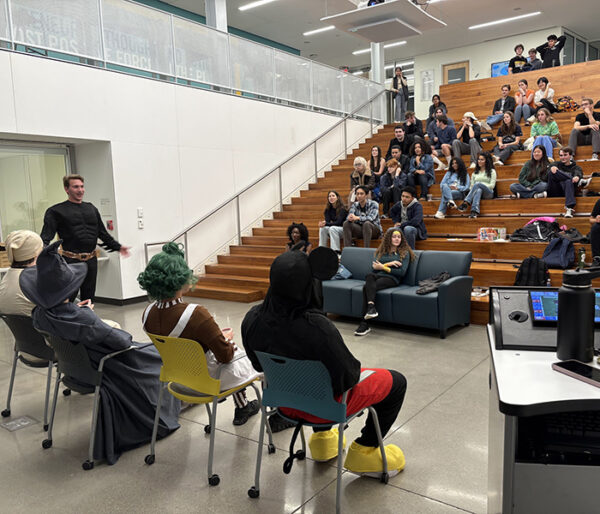
DiMaso grew up in a family of actors and arrived at Babson already familiar with improv, but even he was surprised at how relevant the craft is to his consulting concentration. Job interviews, he said, often hinge not on rehearsed answers but on the ability to respond fluidly. “You get unexpected questions all the time,” he said. “Having the confidence to think quickly has absolutely paid off.”
Julia Marcelis ’27, the club’s treasurer, had a very different background—they were a circus artist who performed trapeze and aerials for years. Improv was new territory. But it unlocked something unexpected.
“I realized how much improv makes you think about motivation—what do I want, what does the other person want?” said Marcelis, who concentrates in accounting and in leadership, people, and organizations. “That’s the core of leadership. Improv became this low-stakes way to practice reading people and responding thoughtfully.”
Practicing High-Pressure Presentations
One of the troupe’s favorite activities mirrors a common nightmare scenario for entrepreneurs.
The lights go down at the hushed beginning of a crucial pitch or presentation. The first slide in the deck clicks on screen, but it is unrecognizable. Same with the next slide. The “Wrong Slide” game requires the presenter to confidently provide an explanation for whatever is featured on each mystery slide, despite never seeing it before.
“It’s perfect training for the moment when something goes wrong in a meeting and you have to act like it’s all part of the plan,” DiMaso said.
The skills it builds map cleanly onto the business world:
- Public speaking — building confidence in front of an audience
- Poise — remaining unruffled under unexpected circumstance
- Audience awareness — responding to unspoken uncertainty
“You get used to standing in front of people with no idea what you’ll say next—and still making it work,” Marcelis said. “Now, when I pitch or present in class, I feel so much more confident.”
Strategy in Spontaneity
Another key tool the troupe practices is Game of the Scene, a foundational improv concept. It teaches improvisers to identify the central comedic or narrative “engine” of a scene and heighten it in ways that feel natural and collaborative.
The game naturally strengthens:
- Pattern recognition — spotting what’s working and doubling down on it
- Strategic thinking — choosing the next move that strengthens the whole “team,” not just your own character
- Storytelling clarity — keeping a narrative focused under pressure
In short-form improv, speed and creativity take center stage. In long-form, DiMaso explained, “It becomes more strategic. You’re thinking about how to sustain a scene, how to support your partners, and how to make choices that move everyone forward.”
For entrepreneurs assembling pitches or managing teams, that mix of quick thinking and long-view strategy mirrors real-world leadership.
Learning to Listen
Improvisers sometimes call improv “the art of saying yes,” but Marcelis said the deeper skill is empathy.
“My mentor always said, ‘empathy above all,’ ” they noted. “In improv, your job is to be in service to your scene partner and to the audience. The best scenes happen when you’re fully listening.”
That awareness has shaped the way Marcelis approaches leadership coursework.
“In leadership class, we talk about leading through the heart, and improv has been my practice space for that. You learn to understand people—what they’re trying to say, what they need from you—and respond in a way that moves things forward.”
Finding Your Voice—and Your Confidence
Every semester, new members join with little or no performance experience. Many are shy. Many have stage fright. But something shifts once they realize they can step into a character—and step out of their shell.
“For business students, being able to adapt and pivot quickly is so important. Improv forces you to think on the spot. You can’t plan ahead—you have to react, adjust, and keep moving.”
Joseph DiMaso ’27, president of Students Against Gravity
DiMaso described a classmate who spent freshman year quietly avoiding performances. “Now, they’re one of the best improvisers on the team,” he said. “It’s so rewarding to watch someone find their voice.”
Marcelis has seen the same transformation. “Watching people go from nervous to fearless is incredible,” they said. “They find their humor, their style, their presence. And that’s something they carry into presentations, interviews, all of it.”
An Entrepreneurial Training Ground
Both DiMaso and Marcelis emphasized that improv is fun—deeply fun. It’s a creative break in weeks filled with accounting, analytics, and cramming for finals. It’s also become a community.
But the talent born from that fun is undeniably valuable.
Confidence. Quick thinking. Empathy. Listening. Adaptability. Presence. Storytelling. Teamwork. The ability to make a choice under uncertainty—even when the spotlight is on.
Skills, in other words, that define great entrepreneurs and business leaders.
As Marcelis put it: “If you can stand in front of 50 people and make up a story with no plan at all, pitching your business suddenly feels a lot less scary.”
Latest Stories

Posted in Community, Entrepreneurial Leadership

Posted in Entrepreneurial Leadership

Posted in Entrepreneurial Leadership