AI & Entrepreneurship in South Korea’s Silicon Valley

Almost 7,000 miles from Babson College’s Wellesley campus, Woosong University sits among apartment buildings, bus routes, cafes, and hilltops in what’s sometimes known as Asia’s Silicon Valley: Daejeon, South Korea.
It’s where students come from all over the world to specialize in artificial intelligence and data science, international business and hospitality, and more specialized programs, such as K-Pop Beauty Design. It’s also where John Yun wears many hats.
As dean of the university’s Endicott College of International Studies, director of the university’s AI Research Institute, and head of Venture Program—as well as speaker at the Babson Academy’s 2026 Babson Collaborative Annual Global Summit in Cordoba, Argentina—Yun spends much of his time thinking about how AI and entrepreneurial education intersect.
“One of my key passions is helping students develop the mindset and capabilities necessary to thrive in uncertain and rapidly changing environments,” Yun said. When he first became familiar with Babson’s Entrepreneurial Thought & Action® (ET&A®), everything clicked.
Finding Thought in Action
Yun comes from a corporate background. Before joining Woosong in 2024, his roles across global organizations were centered around IT, innovation, and software. Now, his goal is to fold in the entrepreneurial mindset and AI literacy across Woosong in as many ways as possible.
Woosong University originally joined the Babson Collaborative in 2017. Through his colleagues, Yun learned about Babson’s global reputation as the No. 1 school for entrepreneurship, and ET&A’s focus on action, experimentation, and adapting stood out.
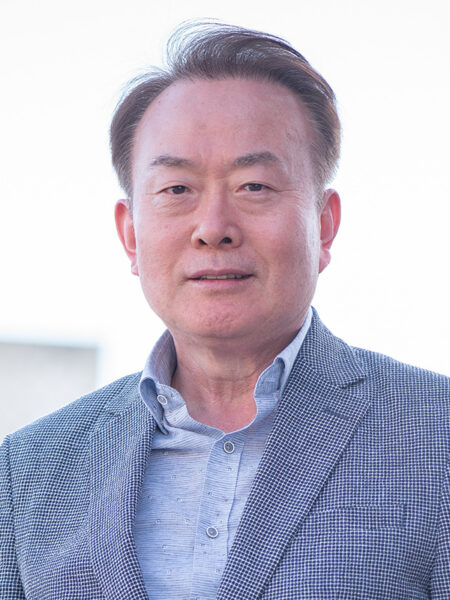
“That philosophy resonated strongly with me because it reflects how innovation actually happens,” he said.
Yun also had seen firsthand how well students and faculty engaged in the semester-long Young Founders Entrepreneurship Program, in which 32 of Woosong’s SolBridge International School of Business students created their own ventures. Ten Babson faculty and five SolBridge educators jointly taught the program, which focused on business creation, and explored topics such as concept validation, rapid prototyping, and team formation and dynamics.
During the course, students moved from uncertainty to gaining confidence in their venture ideas. “They began to appreciate that entrepreneurship is not about having perfect ideas; it is about learning, adapting, and taking initiative,” Yun said. On the other hand, faculty exchanged notes on teaching methods, experiential learning, and ways to foster the entrepreneurial mind.
“What impressed me most was how universal the ET&A approach proved to be,” Yun said. “Students from different cultures and academic backgrounds responded positively because the methodology empowers them to become active participants in their own learning journey.”
With this in mind, he plans to move forward in applying an entrepreneurial mindset to the next frontier of education: artificial intelligence.
Transforming Education
In a world where change is the only constant, “the ability to act despite uncertainty has become one of the most valuable skills a student can develop,” Yun said.
He strongly believes that AI is transforming the world in the same way the internet did, and that it’s not a matter of whether AI should or shouldn’t be used in education, but how.
Redesigning learning experiences with AI is the task and also the challenge. “The role of education must evolve,” he said. “Universities can no longer focus solely on transmitting information because AI can now provide information instantly.”
Helping educators navigate this shift is a part of Babson Academy’s focus, as well. Its inaugural AI for Entrepreneurship Educators program empowers entrepreneurship faculty to design AI-driven coursework with confidence, explore best practices, and collaborate with innovative peers. The program will launch in the fall in collaboration with The Generator, Babson’s interdisciplinary AI lab where students actively experiment with real-world AI applications.
“Students often believe they need to have all the answers before they begin. ET&A teaches the opposite.”
John Yun, Woosong University
It’s an extension of the same questions that Yun focuses on at Woosong. So far, the Endicott College of International Studies is putting this into practice in a few ways, Yun says. He cites the benefit of students using AI to explore industries, look at market trends, create hypotheses, and prepare for interviews.
He also notes that Retrieval Augmented Generation (RAG) can be used to validate ideas and uncover insights. On the business creation front in the university’s Venture Program, students can quickly prototype business models, marketing materials, websites, prototypes, and presentations faster than before.
Even with speed on their side, students still need to develop their own judgment, critical thinking, ethical reasoning, and peer collaboration skills, he said. Those “human-centered activities remain essential,” he said. That’s where Babson’s ET&A methodology focus on adaptability comes in full circle.
“One of my key passions is helping students develop the mindset and capabilities necessary to thrive in uncertain and rapidly changing environments,” Yun said. “Students often believe they need to have all the answers before they begin. ET&A® teaches the opposite.”
Seven thousand miles away from Wellesley, it’s clear that good ideas, like entrepreneurs, stay agile in a changing world.
Latest Stories

Posted in Entrepreneurial Leadership
Posted in Community
Posted in Entrepreneurial Leadership