The Odyssey: What a 2,700-Year-Old Epic Says About the Future of Moviegoing

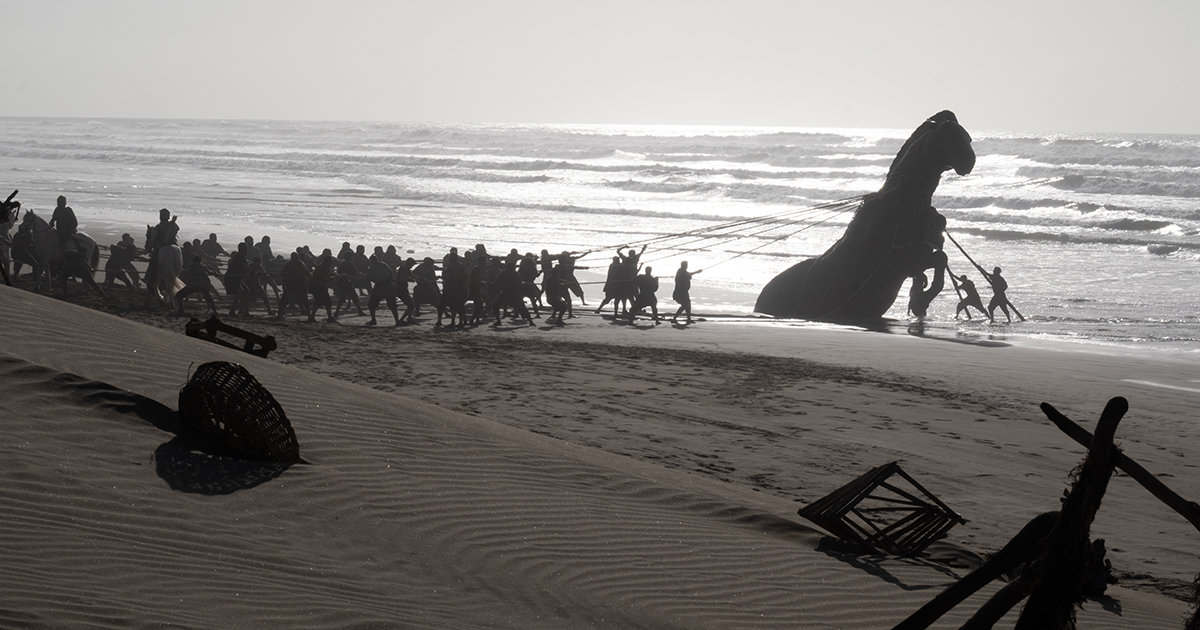
The excitement surrounding Christopher Nolan’s billion-dollar blockbuster The Odyssey goes well beyond the question of how the director adapted Homer’s ancient epic to the big screen.
For Julie Levinson, a Babson College professor of film and the William R. Dill Governance Professor, the fascination with the movie’s technical details—from its use of IMAX film to its different aspect ratios—is almost as striking as the anticipation surrounding the story itself.
“Given the state of cinema as a business, it’s really wonderful to see this level of engagement,” Levinson said. “And, if anybody can do it, Christopher Nolan can.”
That engagement is notable at a time when the movie theater faces unprecedented competition from streaming, television, and increasingly ubiquitous personal screens. Levinson sees Nolan’s The Odyssey as part of a long history of filmmakers using technology and spectacle to persuade audiences that some movies are worth leaving home to experience.
At the same time, the film is arriving as interest in The Odyssey itself remains remarkably durable. Jenny Rademacher, professor of literary and cultural studies at Babson and chair of the Arts and Humanities Division, said the 2,700-year-old classic continues to resonate because its central concerns are deeply human: the search for meaning and belonging, struggle and transformation, the risks of violence and power, and perhaps most importantly, the desire to find one’s way home.
“Odysseus is also flawed,” Rademacher said. “While he successfully faces a lot of challenges, he also misreads things, makes mistakes, and his hubris often gets him into trouble.”
That complexity may be part of what makes the ancient story so adaptable. Odysseus is not simply a heroic figure who conquers every obstacle. He is someone who struggles, makes mistakes, and changes along the way, qualities that allow audiences thousands of years later to recognize something of themselves in his journey.
The Immersive Experience
The Odyssey phenomenon is a fascinating chapter in the history of cinema itself, said Levinson.
“Film is an art form, it’s a technology, and it’s a business,” she said. “And, in some ways, that’s an unholy marriage.”
Those three elements have repeatedly pushed against one another throughout film history, sometimes producing major technological innovations. Levinson points to the early 1950s, when television emerged as a major threat to movie theaters. Hollywood responded by making movies bigger and wider, introducing widescreen formats and technologies such as CinemaScope and Cinerama to give audiences something they could not experience on their television sets.
Nolan appears to be pursuing a similar strategy in an era when the competition is no longer just television.
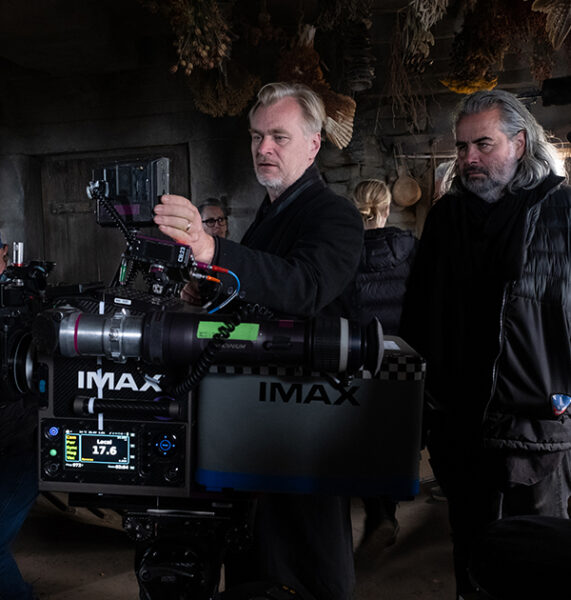
Melinda Sue Gordon/Universal Pictures)
“He’s trying to do the same thing, to get people away from their televisions, obviously away from their phones,” Levinson said. “Get people back into the theater and excited not just about what happens to Odysseus and his people, but what happens in the intensity of what we’re seeing.”
That strategy already has generated extraordinary attention around the movie’s format. Nolan shot The Odyssey entirely on IMAX 70mm film at a time when digital filmmaking has become the industry norm. The IMAX 70mm version uses a taller aspect ratio, allowing audiences to see more of the image vertically and creating what Levinson describes as a particularly immersive experience.
The technical choices also come at a cost. IMAX film cameras can hold only a limited amount of film at a time, creating challenges for actors and crew, while relatively few theaters have the equipment and expertise necessary to screen the movie in the format Nolan intended. That difficulty is part of the point, Levinson said.
Nolan is, in effect, “planting his flag in the sand,” she said, adding that there is something special about experiencing a movie on film and in a theater designed for it. The result is a rare kind of anticipation in which audiences are talking not just about what a movie will be about but also about how they will see it.
That enthusiasm parallels the earliest days of cinema, when audiences were fascinated simply by the fact that photographs could move, Levinson said. In her view, Nolan has managed to recapture some of that basic wonder.
“Apart from what happens in the plot of The Odyssey,” Levinson said, “People are going to see the drama of this huge image in which you feel like you’re in the midst of the action.”
That immersive quality is particularly appropriate for an epic such as The Odyssey, which is filled with enormous landscapes, monsters, battles, journeys, and encounters with the supernatural.
Levinson points to scenes involving the slaughter of the suitors, Odysseus lashed to the mast, and the eerie appearance of the dead in Hades as examples of moments where Nolan’s visual approach placed viewers directly inside the drama.
Why The Odyssey Still Resonates
Rademacher sees another reason for the film’s potential appeal: The Odyssey is built around questions that remain difficult to answer.
“In trying to make sense of our lives, we keep returning to these deep, familiar narrative structures,” she said.
Rademacher points to the enduring appeal of the “hero’s journey”—a pattern of struggle, discovery, and transformation that continues to mirror human experience.
And perhaps that resonance is particularly powerful now. Amid rapid technological change and uncertainty, Rademacher suggests, people may be increasingly drawn to enduring stories and experiences that feel tangible and authentically human.
She points to renewed interest among younger generations in activities such as knitting, vinyl records, and live concerts, experiences that offer a sense of physical presence and human connection in a culture increasingly mediated by algorithms and screens. Her 25-year-old daughter has described the impulse as a desire for “authenticity and whimsy.”
Can The Odyssey Save the Movies?
For Levinson, the larger question is what the phenomenon might mean for the future of movie theaters. The current enthusiasm surrounding The Odyssey could simply be an unusually powerful combination of Nolan’s reputation, an enormous cast, Homer’s famous story, and the film’s extraordinary technical ambitions.
“Is this a one-off?” Levinson asks. “Or is it maybe a road map for how cinema can get off from its deathbed and revitalize the industry and get people coming back to the theaters and excited about them?”
“Film is an art form, it’s a technology, and it’s a business. And, in some ways, that’s an unholy marriage.”
Julie Levinson, Babson College professor of film and the William R. Dill Governance Professor
Levinson is cautious about predicting the answer. But she believes theaters may increasingly survive through movies that give audiences a reason to leave their couches and phones behind.
“Theaters and film going will continue to exist for special events, for big films, for the likes of this,” she predicts.
For all the attention being paid to IMAX cameras, aspect ratios, and film versus digital, the phenomenon surrounding The Odyssey may be about something simpler: the desire to experience a great story together, on a giant screen, in a dark theater. But the impact on the industry, which has historically been conservative business-wise, remains to be seen.
“It’s going to be really interesting to see what Hollywood learns from this artistically, technically, and commercially, if anything,” Levinson said.
Posted in Insights
Latest Stories

Posted in Insights

Posted in Community

Posted in Community