Network Support: Where Technology Meets Equity


Spring 2026

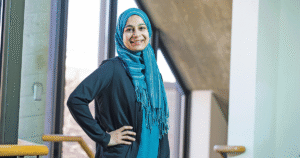



It was a chance meeting at a dinner party and a shared commitment to career and family that brought Nada Hashmi to Babson College.
Hashmi, now an assistant professor of information systems, had just earned her PhD at MIT and was considering her next steps when she found herself at a dinner party seated near former Massachusetts Lt. Gov. Kerry Healey, who was president of the College at the time. Pregnant and weighing whether to delay pursuing a tenure-track role, Hashmi shared her hesitation with Healey.
“She looked at me and said, ‘Workplaces should be accommodating women with talent like yours,’ ” Hashmi recalls. “She said, ‘Why should you have to choose? Men don’t do that.’ ”
It was a pivotal moment. Seeing a woman in senior leadership who was direct, accessible, and unapologetic about ambition reshaped Hashmi’s vision of what was possible. Babson soon rose to the top of her list—not only for its leadership but also for its people.
“I wanted to be in a place where teaching mattered as much as research—and where colleagues genuinely support one another,” she says.
That balance has defined Hashmi’s experience at Babson, where her research explores the use of technology to enhance collaboration and equity in leadership. Like many new faculty members fresh from doctoral programs, she arrived deeply trained in research but quickly learned that teaching requires a different kind of intentionality.
“I assumed if I explained it, students would take responsibility from there,” Hashmi says. “The students were very honest with me—they said, ‘No, we need you to hold us accountable.’ ”
That feedback reshaped her approach. Hashmi began using frequent quizzes and check-ins, not as punitive tools, but as a way to ensure students were absorbing material. Mentorship from other colleagues helped her refine both her pedagogy and research agenda.
“They helped me bridge passion with standards,” she says. “How to really listen to students. How to grow as a researcher. How to do both well.”
Support at Babson, she notes, often extends beyond formal mentorship. A writing group formed by Amanda Weirup, assistant professor of management, became a professional lifeline—especially for women balancing research, teaching, and family life. “We meet for uninterrupted time to write—no meetings, no distractions,” Hashmi says. “It’s my core community at Babson. We’ve gone on retreats. We show up for each other. I don’t think that kind of support exists everywhere.”
But for Hashmi, the most powerful moments still happen in the classroom.
One moment came at the end of a semester, when a student quietly thanked Hashmi for something she hadn’t realized she was offering: representation.
“I’m Muslim, and I wear hijab,” Hashmi says. “I’m the only female professor at Babson who does. A student came to me and said how meaningful it was to see someone like her at the front of the classroom.”
For Hashmi, that affirmation reinforced the broader impact of teaching—one that goes beyond syllabi and software. “You never know what’s going to spark confidence or curiosity in a student,” she says. “But when it does, it’s incredible.”
Posted in Community
Latest Stories

Posted in Insights
Posted in Community

Posted in Community