First Health Hackathon in Rwanda Highlights Babson-UGHE Collaboration
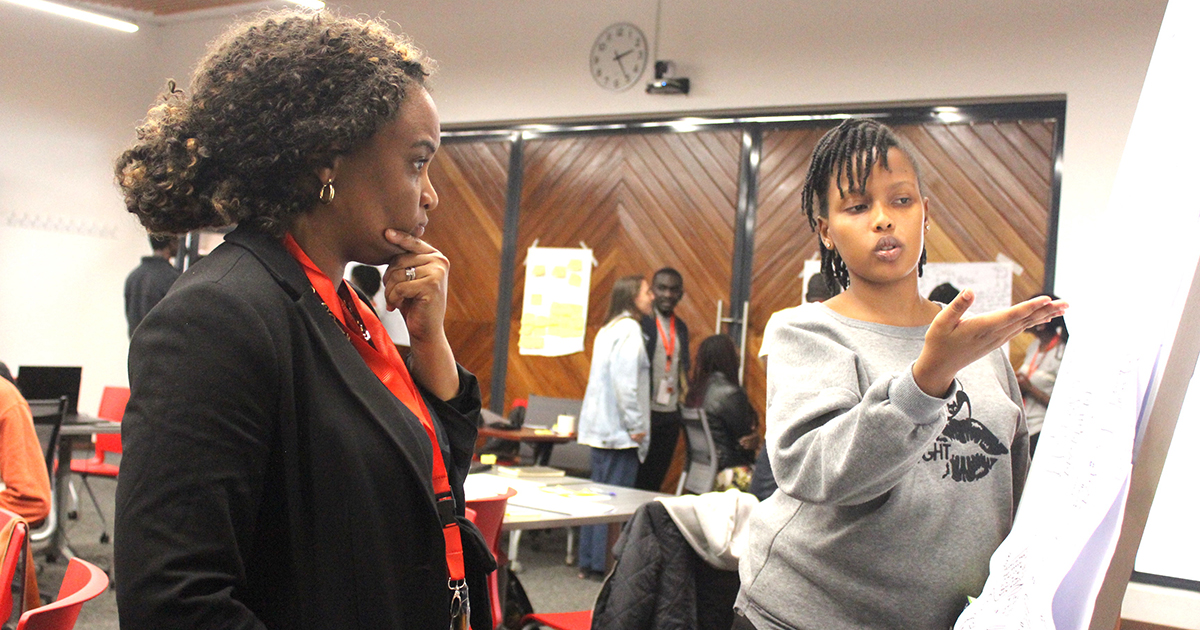
Dozens of students focused on solving problems in African healthcare systems as part of the first health hackathon run jointly by Babson College’s Kerry Murphy Healey (KMH) Center for Health Innovation and Entrepreneurship and the University of Global Health Equity (UGHE).
At the July event on the campus of UGHE in northern Rwanda, 40 students from three Rwandan schools and several countries identified problems in healthcare delivery and ideated and refined potential solutions during a roughly 48-hour period.
Wiljeana Glover—the founding faculty director of the KMH Center and The Stephen C. and Carmella R. Kletjian Foundation Distinguished Professor of Health Innovation and Entrepreneurship—led the Babson contingent, which also included undergraduate student Emmanuel (Manny) Nsanganwa ’24.
As an associate professor, I had the privilege of joining the Babson community members who organized and facilitated the hackathon. As part of our debriefing, I interviewed Glover, who is responsible for the UGHE relationship, grant funding, and strategy and execution on behalf of Babson. Here are the highlights of that conversation:
What did this hackathon accomplish?
“We achieved the measures of success that we agreed upon up front: First, students learned and implemented the themes of design thinking, and they built relationships between each other and everyone else involved, including facilitators and outside stakeholders that they consulted. Also, the top three ideas are going into our Innovation Center there, an incubator in which their ideated innovations and plans will be further refined over the fall and winter, and presented for possible deployment by the end of the spring.
“Finally, we also strengthened the Babson-UGHE institutional relationship, which matters because it allows students and faculty at both schools to learn about and impact the realities of healthcare, especially in middle- to low-income contexts and underserved communities.”
What is the purpose of the Babson-UGHE relationship?
“Our institutions were introduced to each other by someone at the Kletjian Foundation. We have a mutual goal of promoting innovation and entrepreneurship in health care for underserved communities.
“We got our first grant right as COVID shut down the chance of in-person collaboration. So, this event is extremely significant because it was our first chance to see how we worked together in person. Also, the pandemic highlighted the need to promote our mission: who else has been involved there to help figure out how to improvise mask-making or ventilator parts? Or to catalyze the other hacks and work-arounds that were needed?
“I’ve seen firsthand this need—for nurturing healthcare innovation—in my hometown in Georgia. Our Innovation Center is a proof-of-concept that health innovation labs in middle- and low-income settings can create value.”
What should we expect from this partnership during the next several months?
“Most immediately, the three winning teams of the hackathon will enter the Innovation Center program this fall. This means they will engage in seminars and be introduced to tech partners. In January, Babson students will travel to Rwanda to help these teams further refine their innovations. By the end of the spring, we hope that the teams’ innovations—ideated at our hackathon and refined over the course of the year—can be presented to hospitals, ministries, or investors for deployment.”
Would you call this hackathon, because of its role in your longer-term plans, a high-stakes event?
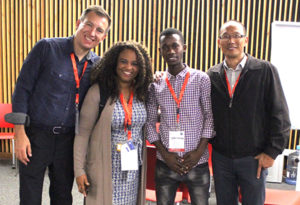
From left: Associate Professor Adam Sulkowski, Wiljeana Glover, student Modeste Mwiseneza, and Dr. Rex Wong of UGHE.
“Yes, it was a key moment in terms of seeing if we work well together and therefore the future of the relationship, which is important to us and our students, because Babson doesn’t have a hospital. So, for any student or our 20 affiliate faculty who are interested in innovation in the healthcare space, this setting is a great opportunity to experientially learn and to work in the real world of healthcare service.”
Any surprising observations or highlights to share about the hackathon?
“One surprise lesson learned was the importance of excitement—of how much the students anticipated and enjoyed experiential learning. The sheer value of building the excitement helps to catalyze all of the impacts and outcomes that we discussed. It was great to see that they developed a shared language in a short period of time, so that they could work across areas of expertise, and include students from other Rwandan schools like Kepler and African Leadership University (ALU).
“It also impressed me how much value they got from our primer on design thinking—that they followed through and acted earnestly on the major theme of reaching out to stakeholders. The winning team did that best. They called seven stakeholders to ask and absorb their input.
“Finally, it bears mention how great it is to see the trajectories of teams and their ideas through a hackathon: that the seed of an idea is not how it ends up. We see how important it is to let it grow. For example, one team only had ‘make a more efficient health system’ as an idea on Friday night. But, within 24-48 hours, they had a fleshed-out idea that was specific: a digitized referrals system.
“Now, it will be exciting to see, after 6-12 months of incubating, whether and how any of their top three ideas get deployed to serve the ultimate goal of easing suffering and saving and improving lives.”
Latest Stories
Posted in Community
Posted in Entrepreneurial Leadership, Outcomes
Posted in Community, Entrepreneurial Leadership, Outcomes