At Babson, High School Students Bring Fresh Perspective to the Summer Classroom

For Babson College Associate Professor Jia Hao, teaching high school students in the Arthur M. Blank School Summer Program offered an unexpected lesson: even students who are confident, independent, and technologically savvy still needed some support.
“They want to know that their ideas are being taken seriously, and sometimes they need just a small push beyond their comfort zone before they realize how much they are capable of contributing,” said Hao, who is also the Zwerling Family Endowed Term Chair at Babson. “That became one of the most meaningful lessons for me this summer.”
Hao was one of several faculty members who taught in the Blank School Summer Program for teens, a new, flexible pre-college experience for rising high school juniors and seniors. The program, which began this year, offered dozens of hands-on courses in entrepreneurship, business, artificial intelligence, and leadership. Students could live on campus, commute, or take courses online.
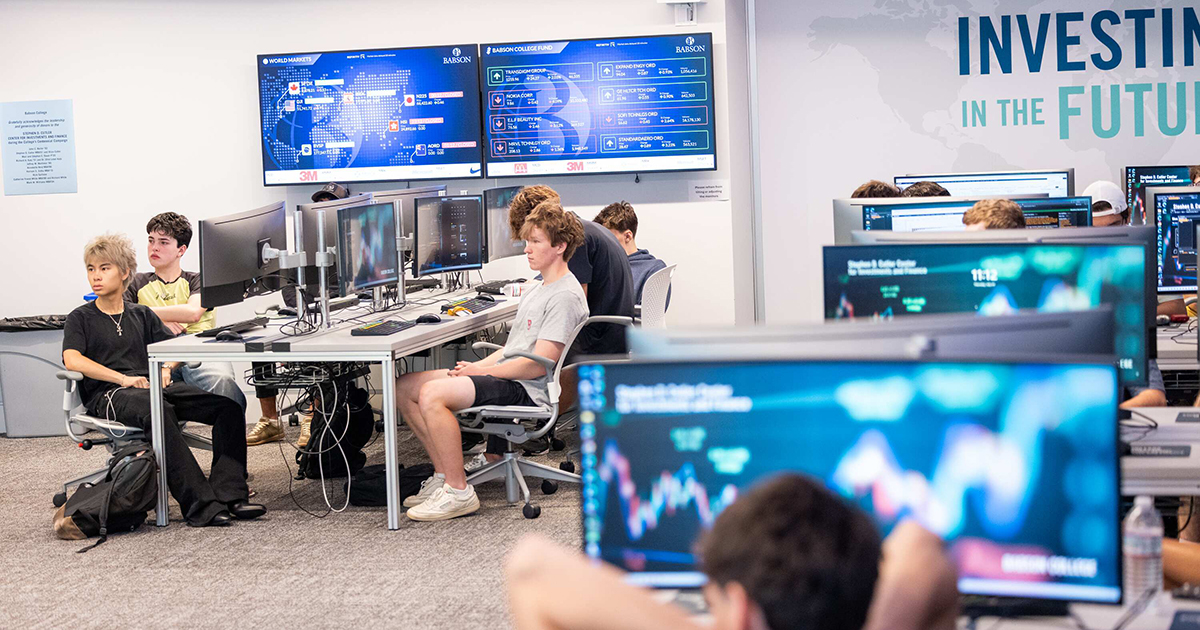
During Hao’s finance class—Babson Entrepreneurial Investor Lab: Decode Companies, Allocate Capital, Pitch Your Strategy—students explored their comfort with uncertainty and the financial future they want to build. They analyzed real companies, evaluated risk and value, built diversified portfolios, and ultimately presented the reasoning behind their investment decisions.
After nearly 20 years of teaching finance, it was Hao’s first time teaching high school students. She entered the summer thinking primarily about what she could teach them. She left thinking just as much about what they had taught her.
Invested and Advanced
Many students already had experience with business and finance, creating investment clubs at their high schools or developing startup ideas and business models.

“They were much more hands-on, entrepreneurial, and comfortable experimenting with new tools than I had expected,” Hao said.
Scott Magnacca MBA’92, an adjunct faculty member whose marketing class, Becoming Unstoppable: The AI Productivity Lab and Personal Brand Launchpad, focused on using AI to build a personal brand, had a similar reaction.
“I expected to spend the week simplifying—translating business and AI concepts down for an audience that wasn’t quite ready for them,” Magnacca said. “Instead, I found myself teaching at the same level I’d use with senior executives, and this room of 16- and 17-year-olds kept pace with it.”
What impressed Magnacca wasn’t just what students knew but also their commitment. They showed up on time and participated actively in debates and case discussions. “I’ve taught adult executives who don’t bring that level of consistency,” he said.
Paul Cheek, a senior lecturer at MIT who shared his expertise with Babson’s pre-college students, enjoyed seeing how quickly students turned ideas into action. His course, Launchpad AI: Building a Startup from Scratch with the AI-Driven Entrepreneurship Model, challenged students to develop an AI-native startup, moving from market research and idea validation to prototyping, financial modeling, and pitching in just one week.
“Over the course of the one week, I saw a bunch of students super engaged in the process,” Cheek said. “Trying things, failing, learning, refining, and ultimately coming out at the end of the week with extremely high quality business pitches that I would not have expected from a group of high school students.”
Challenging Teachers and Themselves
Students attending the pre-college summer program not only arrived prepared, but they also were willing to push back on some lessons, Magnacca said.
One student challenged the very idea of a “personal brand,” arguing that the term felt dated to his generation. Rather than viewing personal branding as creating a polished persona, the student suggested that his generation thinks of it more as a searchable, verifiable record of what someone has done.
“He wasn’t wrong,” Magnacca said. The exchange reminded him that these students weren’t simply absorbing established frameworks; they were willing to stress-test them.
Students also treated AI less like a new technology they needed to learn and more like an everyday capability. What impressed Magnacca wasn’t simply their familiarity with AI, but their ability to recognize when to trust it and when to override it with their own thinking.
“Over the course of the one week, I saw a bunch of students super engaged in the process. Trying things, failing, learning, refining, and ultimately coming out at the end of the week with extremely high quality business pitches that I would not have expected from a group of high school students.”
Paul Cheek, MIT senior lecturer who taught Launchpad AI
Cheek saw that confidence from a different angle. Students were eager to use AI to build things, sometimes so eager that they wanted to skip ahead.
“They jumped right into that, feeling like, ‘Oh my gosh, I can do this! Amazing,’ ” Cheek said. “The challenge is that we can get ahead of ourselves.”
For Cheek, the experience reinforced the importance of entrepreneurship fundamentals. As AI makes it easier to build products and businesses, entrepreneurs must make sure they research the market, know their customers, and ensure their potential business addresses the problems they want to solve.
Learning from the Students
For Hao, one of the most meaningful lessons wasn’t about finance or technology. It was about the environment in which students learn.
When she taught in person, she noticed how much students learned from one another—through spontaneous questions, team debates and moments when one student’s observation caused another to reconsider an idea.
Teaching online the following week, Hao intentionally created more opportunities for students to participate and asked every student to contribute at least one question during final presentations. Instead of making some students uncomfortable, the exercise had the opposite effect.
“I was amazed,” Hao said. “Their questions were thoughtful, creative, specific, and sometimes raised issues I had not planned to discuss myself.”
The experience gave Hao new insight on teaching.
“Support and challenge are not opposites,” she said. “When students feel safe, respected, and encouraged, sometimes a small push beyond their comfort zone reveals abilities they did not yet know they had.”
Posted in Community
Latest Stories
Posted in Community
Posted in Community