Asian/Pacific American Heritage Month Brings Greater Awareness Amid Troubling Trend
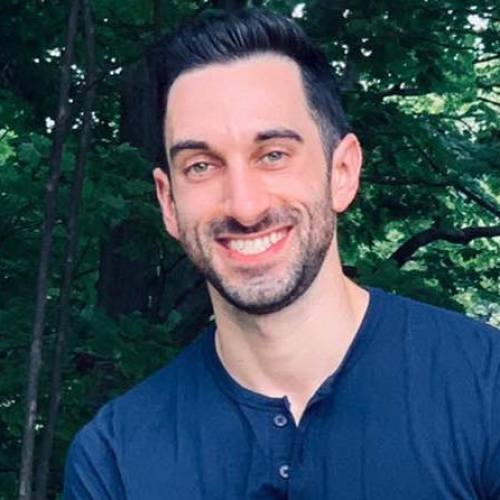
Ziyuan Zhu ’23 is a first-generation college student. Shortly after she was born in China, her parents immigrated to America, believing that living in the United States would provide greater opportunities for Zhu as she grew up.
Both her father and mother worked long hours in the restaurant industry in order to make ends meet. “It was the only thing they could do,” Zhu said. “They couldn’t speak English, they had no choice, they worked really hard. This is a collective representation for Asian immigrants.”
Zhu’s story is one of countless stories that comprise the history and heritage of Americans with Asian and Pacific island roots. That common history is celebrated this month during Asian/Pacific American Heritage Month, which this year holds heightened importance amid an abhorrent increase in hate crimes and violence toward Asian Americans.
In what has become yet another pandemic of racial injustice and violence, where do the solutions lie to this troubling trend? According to Zhu and Jen Lo ’22, leaders of the Babson Asian Pacific Student Association, it is up to everyone to make a difference—and not be silent.
“If you see something, say something,” Lo said. “That comes from every culture, as well. If they see racism occurring, and speak up, it will make an impact.”
Sticking to the Facts
Nearly 100 anti-Asian hate crimes were officially reported to law enforcement in the first quarter of 2021, compared with 36 reported incidents in the first quarter of 2020. New York City specifically saw a 223% spike over that time period, with 13 and 42 reported incidents in 2020 and 2021, respectively.
These only represent a fraction of incidents that truly occur, however, as many hate crimes go unreported. And, though statistics on Asian Pacific American hate crimes are up, both Zhu and Lo agree these incidents of racism have been a continuous, long-standing issue.
“If you see something, say something. It will make an impact.”
Babson Asian Pacific Student Association leader Jen Lo '22
“There’s always been discrimination,” Lo said. “Especially the stereotyping of Asians and Asian culture. COVID has increasingly made it worse. Violence is not OK at all.”
With misinformation on an uncontrollable rise, especially across social media, Zhu also has been conscious about what forms of media she consumes in order to align herself with the facts.
A source she has used frequently and recommends is NextShark, which aggregates Asian and Asian American business, culture, and political news into a single feed.
About BAPSA
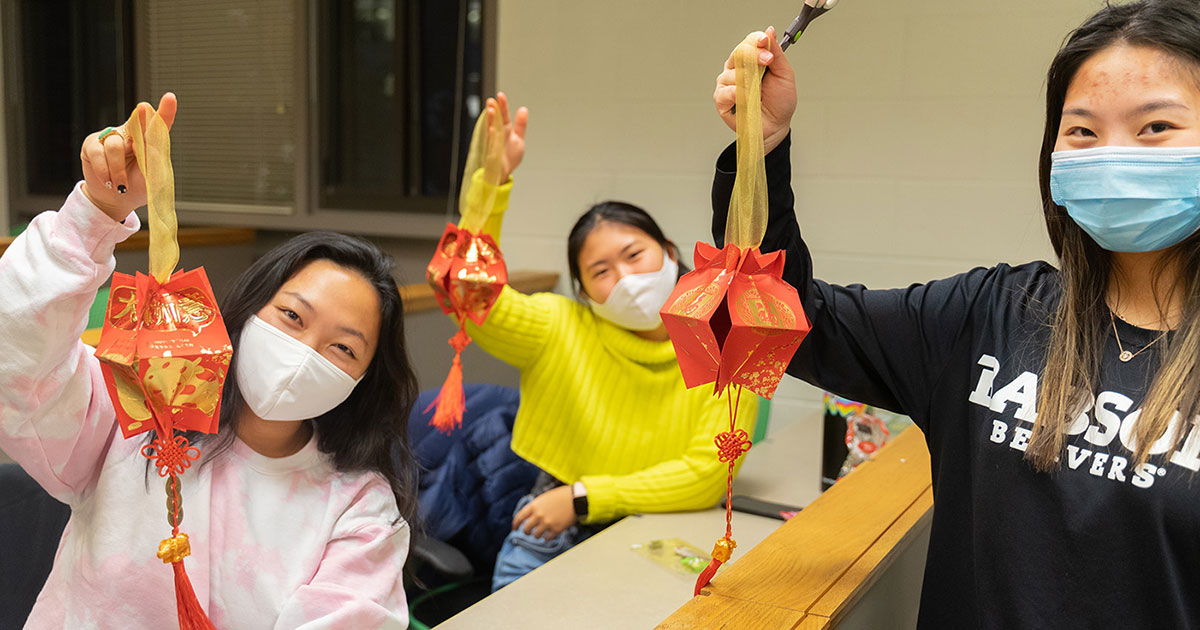
Established in 2000, BAPSA is an umbrella organization for all Asian clubs at Babson College. The organization prides itself on diversity, self-awareness, friendship, and experience, and programs a number of Asian culture social events on campus.
In the fall, to keep connections continuous in the virtual landscape, BAPSA led a mentorship program in which it paired first-year students and sophomores with juniors and seniors.
“The majority of our events are so Babson students can be exposed to Asian cultures of all sorts,” Lo said. “We try to incorporate as many cultures as possible. … (We want to) connect the student body.”
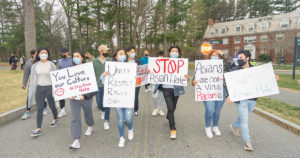
Babson College students, staff, and faculty march in an April 11 demonstration in support of Asian American and Pacific Islanders.
The important work of BAPSA has taken on greater urgency in the past year. In April, amid the rise in hate crimes and violence, BAPSA worked with the Babson Origins of Necessary Equality (ONE) to organize a student walkathon and demonstration for #StopAsianHate.
Students such as Lo and Zhu have demonstrated their leadership among their peers and on campus to continue lifting up voices in the Asian Pacific American community and raising awareness of issues important to all of us.
“It’s up to first-generation Asian Americans,” Zhu added.
Posted in Community
Latest Stories
Posted in Entrepreneurial Leadership


Posted in Insights