A Babson Symposium Explores What AI Means for Business and Humanity
Imagine for a moment your typical entrepreneurs.
Imagine them toiling away in a hatchery or office or garage, trying to turn their idea into reality. They are passionate and committed, and their projects are deeply personal to them.
Now, tweak that vision just a bit. Imagine that, instead of their own ideas or passions, the entrepreneurs were working on something else entirely. What if they were working on ideas, not dreamed up by them or other people, but by the analytical and calculating mind of artificial intelligence?
That was the entrepreneurial question that Jacqueline Lane, an assistant professor at Harvard Business School, investigated in her research. She spoke of her work at a recent AI symposium held at Babson College.
In her study, Lane and her fellow researchers reviewed business ideas proposed by humans vs. those generated by ChatGPT. Their evaluation revealed the advantages and limitations of using AI in entrepreneurship.
On the one hand, the researchers found that business ideas from humans were the most novel. “The uniqueness we bring (as humans) is really important for generating these innovative, moonshot ideas,” Lane told the crowd of professors, students, and tech professionals gathered in Babson’s Olin Hall.
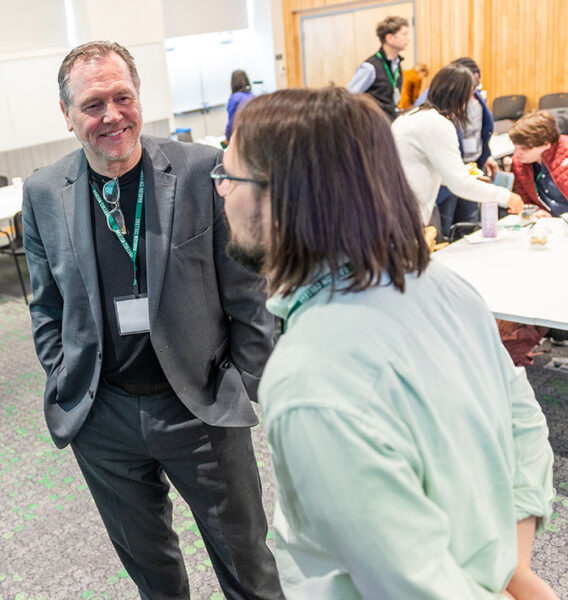
While the most original business ideas came from humans, however, the ideas deemed the most valuable from a financial, strategic, and environmental perspective originated with AI. AI also required significantly less resources to generate its ideas. “It’s no question that AI saves a lot of time and money,” Lane said.
Society stands on the jagged frontier of AI. Its capabilities are uneven, sometimes profound, sometimes unremarkable, but its rise is undeniable. As the spring semester came to an end, the Babson AI symposium explored that jagged frontier and what it means for humanity, particularly its implications for business and entrepreneurship. Entitled “Human Expertise in the Age of AI,” the symposium featured speakers from industry and academia.
“I think the question of what human expertise means in the age of AI is one of the questions of our generation, in part because so much hinges on the answer—employability, wages, inequality, purpose, political power,” said Babson’s Sebastian Fixson, the Marla M. Capozzi MBA’96 Term Chair in Design Thinking, Innovation, and Entrepreneurship. “I don’t think anyone has a full answer, at least not yet.”
A Greater Conversation
The use of AI in business and beyond raises a host of issues. How is the technology being adopted? How is it assisting workers? How is it strengthening, or weakening, the judgment of its users?
“What does it mean for creativity and judgment and the future of work?” asked Ariel Armony, Babson’s provost and executive vice president, in his welcoming address at the symposium. “How do we ensure that technology expands rather than diminishes human knowledge? These are societal questions. Human questions.”
“We need to ask better questions about the future. For Babson, this is an opportunity to contribute to a greater conversation.”
Ariel Armony, provost and executive vice president
These human questions surrounding a fast-growing technology are exactly why Babson decided to convene the symposium, which was hosted by the Work Futures Lab. Part of The Generator, Babson’s interdisciplinary hub focused on AI, the Work Futures Lab researches and designs new ways to organize work in the age of AI.
“We need to ask better questions about the future,” Armony said. “For Babson, this is an opportunity to contribute to a greater conversation.”
Fixson agreed. “This is precisely why we created the symposium,” said Fixson, also the founding faculty director of Babson’s Doctor of Business Administration program and the lead of the Work Futures Lab. “Perhaps Babson, with its mix of research and practice faculty, can play an important role here.”
Understanding an AI Future
At the symposium, speakers delved into their work trying to understand AI’s implications.
In his research, Steven Shaw, a postdoctoral researcher at the University of Pennsylvania’s Wharton School, looked at subjects’ reliance on AI to solve a word problem. Even when the researchers manipulated AI’s answer to be wrong, an overwhelming majority of the participants didn’t double-check the result and trusted it to be right. Shaw labeled this behavior “cognitive surrender.”
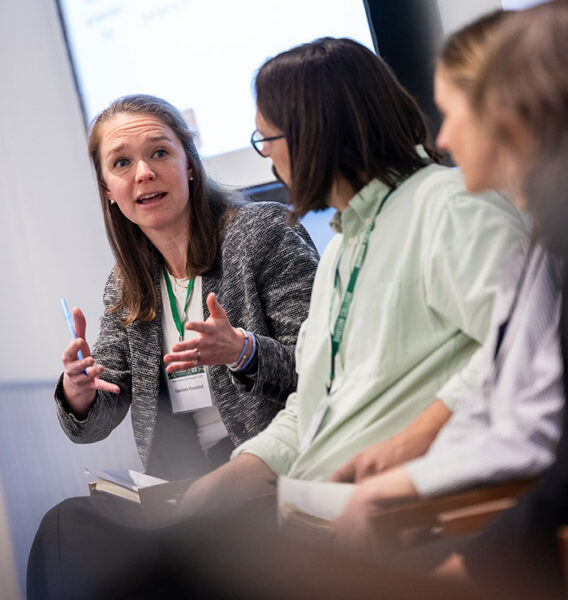
This deference to AI also was a finding of Lane’s research. Beyond looking at how AI can generate business ideas, Lane discussed how AI can be used to evaluate them. Overall, her research found that while AI can be helpful, it also can cause humans to defer to its recommendations, particularly when AI provides detailed explanations for its reasoning.
“These chatbots can be quite persuasive,” Lane said. “AI narratives alter the attitudes and behaviors of human decision makers.”
Nancy Baym, partner research manager at Microsoft, and Eleanor Dillon, principal researcher at Microsoft, looked at how AI is adopted in the workplace. Too often, well-intentioned companies set up AI trainings and workshops for employees, thinking this will lead to widespread adoption and increased productivity.
What actually leads to adoption, however, isn’t so much workshops but employees talking to each other and sharing examples of how they have used AI. “Peer influence is the most important driver of regular AI use,” Baym said. “Peer influence can make or break your rollout.”
To encourage that peer-to-peer communication, employers must create a safe, open environment that embraces AI exploration (and failure) and gives time (and channels) for employees to talk about it all. “Leaders need to create conditions where peer sharing becomes possible,” Baym says.
All of the symposium’s discussion aimed to make sense of a future that’s already here and bringing with it changes that are still settling out. “I think the future is uncertain but very interesting,” Shaw said. For its part, Babson will continue to look at these issues, Fixson said, to move the conversation surrounding AI forward.
Posted in Insights
Latest Stories

Posted in Community