On Juneteenth, the Case for Entrepreneurship and Babson
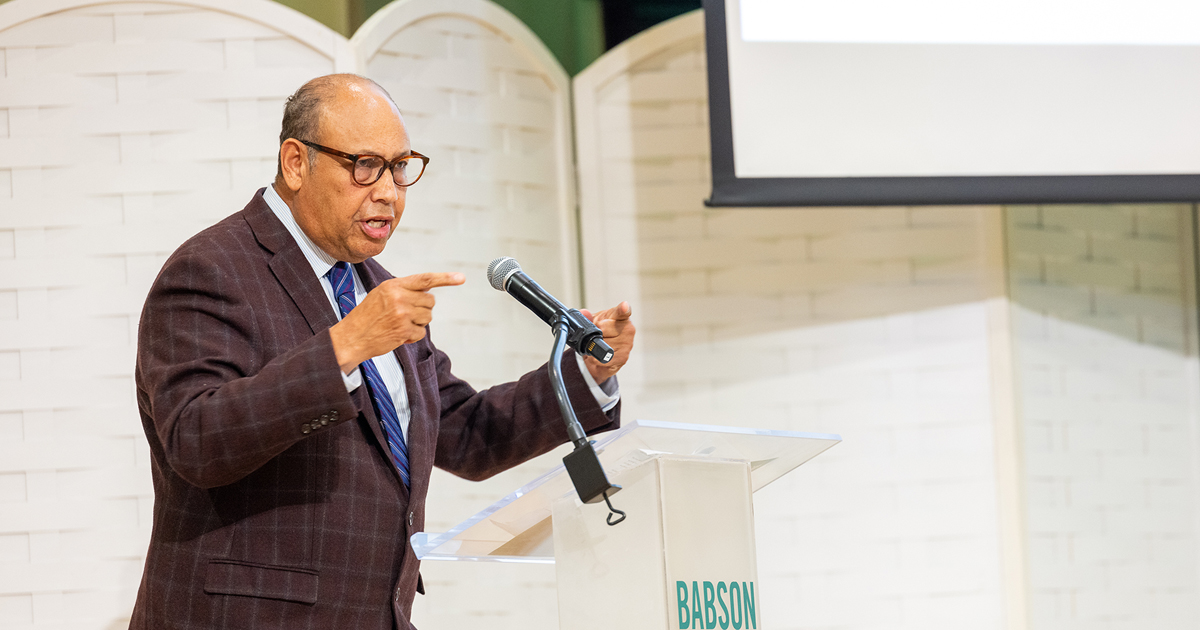
Boston business leader and civic innovator Richard L. Taylor delivered a compelling and forceful message on the importance of entrepreneurship and the role of Babson as the keynote speaker of the College’s Juneteenth observation Thursday.
“Because of its mission and (being) the number one school in the world for entrepreneurship, Babson has an outsized role to play in balancing the scales of economic freedom and justice today and beyond 2026,” said Taylor, the chairman of the Taylor Smith Group. “Why is that? Because entrepreneurship has been one of the central forces behind America’s rise from a collection of colonies to become the world’s largest economy.”
Sadie Burton-Goss, the chief inclusive excellence officer at Babson, welcomed dozens of attendees to the virtual event, which was led by the Inclusive Excellence and Belonging Committee.
In his recorded welcome remarks, President Stephen Spinelli Jr. MBA’92, PhD said that Juneteenth marks the delayed arrival of freedom in 1865 and is a reminder that progress takes persistence and action.
“This year’s theme, Freedom, Justice, and Entrepreneurial Leadership, reflects how we lead at Babson,” Spinelli said. “Entrepreneurial leadership is about identifying opportunity, expanding access, and turning ideas into action that creates economic and social value. Juneteenth invites deep introspection and calls us forward with purpose, reminding us that we are both the architect and the builder of the future.”
The Power of Entrepreneurship
Jessica Chance, director of the Graduate Center for Career Development, introduced Taylor, who previously taught Babson’s trademark Foundations of Management and Entrepreneurship (FME) course and real estate courses.
Taylor, who also spoke at Babson’s Inclusive Excellence Summit last year, delivered important historical lessons about the creation of Juneteenth and its importance, especially in narrowing the persistent racial wealth gap. He spoke of the challenges over the decades and current times in seeking solutions.
“By process of elimination and a clear reading of the historical record, we are only left with entrepreneurship to balance these generational disparities,” he said. “While natural resources, geography, immigration, education, and political institutions all played important roles, entrepreneurship transformed these advantages into economic growth, innovation, and global influence.
“Because of its mission and (being) the number one school in the world for entrepreneurship, Babson has an outsized role to play in balancing the scales of economic freedom and justice.”
Boston civic innovator Richard L. Taylor
“Entrepreneurship will be the ultimate pathway to bring generational economic parity in our country—the ability to start businesses, raise capital, make America a magnet for innovation. The American way is to fuel and ignite business ideas that can be good enough to attract capital.”
Citing the College’s founder, Roger Babson, Taylor called on Babson to continue leading.
“Babson, more than any other organization, has a platform to change the color of wealth in America,” Taylor said. “(The founder) famously said, ‘The successful man’—implied woman or institution—‘is the one who had the chance and took it.’ The successful Babson is the one who will see the opportunity and take it.”
Freedom, Justice, and Entrepreneurial Leadership
The virtual event began with an opening invocation from Emily Miles, co-chair of the Inclusive Excellence and Belonging Committee and the director of Horn Library. “I encourage each of you to think about how we can leverage entrepreneurial leadership in service of both freedom and justice,” she said.
Other highlights included:
- Ryan Lee MBA’27, president of the Graduate Student Council, read the Land & Labor Acknowledgment
- A reading of “What Is Juneteenth,” by Nana Kwame Opoku MSBA’25, now a graduate assistant in the Office of the President; Rodrigo Guerrero, office administrator at Babson Boston; Rashmi Tripathi MBA’27, graduate assistant; and Markus Christie MBA’26.
- In the musical selection, Semaj Cormier ’27 sang “Lift Every Voice and Sing,” known as the Black National Anthem.
“The true call to action for all of us is really this,” Burton-Goss said in her closing remarks, “How will we, on a day-to-day basis, in our work, in our lives, and in our communities, ensure that all people are able to experience freedom, justice, and joy again.”
Latest Stories
Posted in Community, Entrepreneurial Leadership, Insights

Posted in Community
Posted in Entrepreneurial Leadership