Bringing AI to the Barn: An Entrepreneur Helps Dairy Farmers
For many of us, milk is a ubiquitous part of day-to-day life. Wake up in the morning, and you might pour some into a bowl of cereal. In the evening, you might enjoy a glass of it with a couple of cookies.
A lot of effort and money, however, goes into producing that milk poured into the bowl or glass. Unfortunately, that work isn’t getting any easier. “Farmers are struggling,” says Bryan Ramirez Galindo MSEL’25, an entrepreneur whose startup interacts directly with dairy farmers. “It’s a combination of a lot of things, economically speaking, but also labor.”
Operating costs are going up, but the price of milk hasn’t risen accordingly. At the same time, the productive lifespan of dairy cows has dropped, and farmers are having trouble finding workers as immigration policies change. Many farmers’ children and grandchildren also may not want to go into the business. “You don’t have people qualified enough to run your operations,” Ramirez Galindo says.
Ramirez Galindo hopes to ease some of these burdens with the venture he developed at Babson College, Vacavision, an automated herd manager that can keep an eye on every farm’s cow 24/7. He serves as the venture’s CEO.
Vacavision can help to identify behaviors related to fertility, illness, and stress in cows, issues that can be easy to miss, but the trick is persuading farmers to use it. The dairy industry is vast—with roughly 24,000 dairy farmers in the United States alone, according to U.S. Department of Agriculture—and it’s built on trust and relationships. Ramirez Galindo is working hard to make connections, meet farmers, and have conversations.
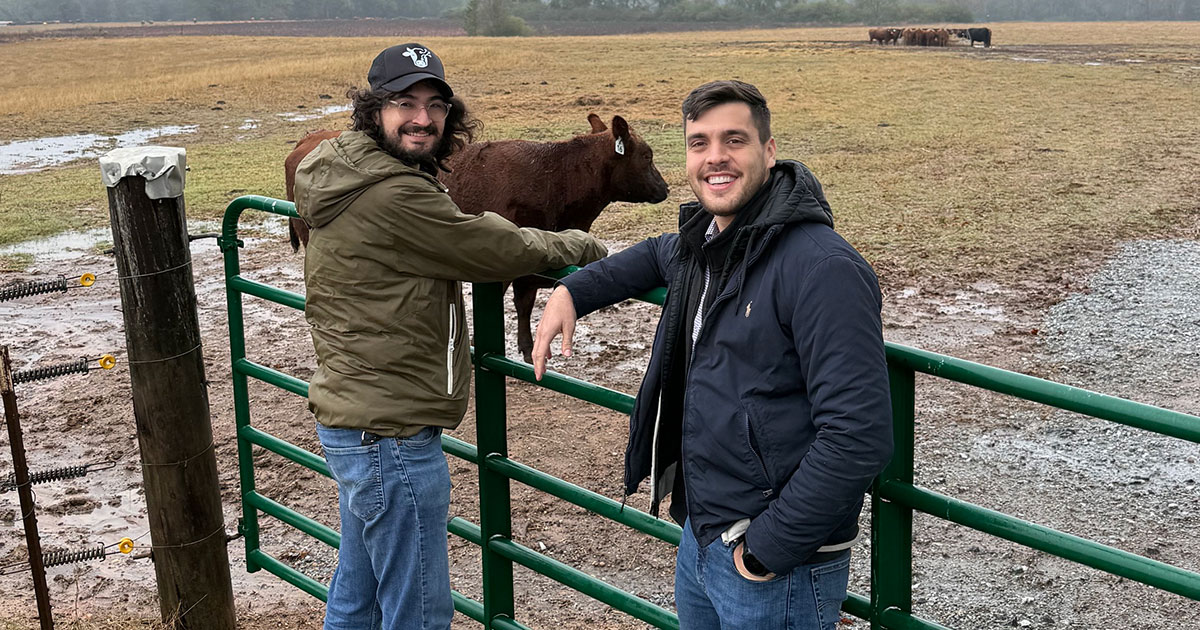
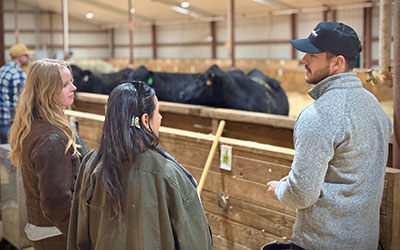
“You have to be out there,” he says. “You have to get your boots dirty. There’s no shortcut for being on the ground with farmers.”
Cows and the Bottom Line
Ramirez Galindo grew up in Cartagena, Colombia. He came to Babson because he was looking for a different course for his career. He is quick to express love for his parents, but he didn’t want to follow their path.
“I don’t come from an entrepreneurial family. My parents are the most corporate people in the world. They are the most risk averse,” he says. “I went to Babson to do something very different. It took me out of my comfort zone.”
At Babson, Ramirez Galindo drew on his prior experience working at his father-in-law’s livestock software company to identify the business opportunity that would become Vacavision. He launched the venture while in Babson’s Leading Entrepreneurial Action Project (LEAP) course, in which students develop a business idea.
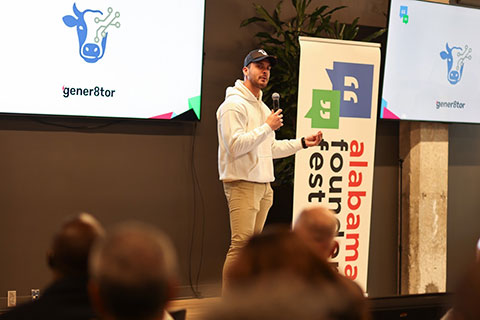
Ramirez Galindo would go on to win last year’s AI Showcase with fellow Master of Science in Management in Entrepreneurial Leadership student Alejandro Torres MSEL’25, who worked on the venture with Ramirez Galindo at Babson. The AI Showcase was hosted by the C. Dean Metropoulos Institute of Technology and Entrepreneurship and Babson’s Information Technology Services Department.
Ramirez Galindo says that no matter how good farm workers are at their jobs, they can’t possibly monitor cows every moment of the day, especially with current labor shortages. “They only have so many eyes,” he says. “Human labor is really expensive.” Some farmers turn to hardware, by placing monitoring sensors directly on cows’ bodies, but that is an invasive, expensive, and hard to maintain option.
Vacavision proposes another way, by mounting cameras in barns and then using artificial intelligence to analyze the video and track cows’ movements and behavior for signs of fertility or health issues. Besides cows, the technology can be used to monitor other farm animals as well, including horses, pigs, and chickens.
For now, though, cows remain the company’s focus. Helping workers to not miss when cows are fertile or sick can have big consequences for the bottom line. “No pregnancy, no milk,” Ramirez Galindo says. “It’s as simple as that.”
Finding Farmers
Ramirez Galindo has a venture he believes in, but now he must find customers. So far, this has been a challenging process for a variety of reasons. To begin with, Vacavision is a startup. “I used to do sales. I know how to talk to a customer,” he says. “But that was in an established business. It wasn’t starting from scratch.”
He has faced barriers trying to connect with customers in the United States, not only because he’s not a local but also because, as he puts it, he doesn’t speak “farmer.” “Farmers work almost 100% on trust,” he says. “We are not locals. That definitely impacts us. That’s a wall between us.”
The livestock software company of Ramirez Galindo’s father-in-law has a large network of customers in Latin America, so the entrepreneur also targeted those connections, which brought a different host of challenges. Many farmers in Latin America are in remote areas with little to no Wi-Fi access or even cell signal, so connectivity is an issue. They also might not have barns, so there’s nowhere to mount cameras.
Then there’s affordability. “If you talk to a U.S. farmer, you say you’ll charge them $2 a month per animal, and they say that makes sense,” Ramirez Galindo says. “In Latin America, that leaves them without any way to be profitable.”
Despite the issues Vacavision faces, the outreach doesn’t stop. In the United States, Ramirez Galindo has found success in making connections through an agricultural-focused accelerator in Alabama, so much so that he has moved to the state and opened the company’s first physical office there. “The community there has been remarkably welcoming and engaged,” he says.
Pilots have followed. Vacavision now has pilots running across three states, and its first paid pilot goes live this month. The company also has been admitted to two accelerators in Latin America.
Ramirez Galindo is convinced Vacavision is what an industry running thin on labor and patience needs. “Every cow tells you something long before a human notices,” he says. “We just make sure nobody’s listening too late.”
Latest Stories
Posted in Community
Posted in Entrepreneurial Leadership, Insights

Posted in Insights