Teaching Entrepreneurship to Neurodiverse Students Who Learn Differently

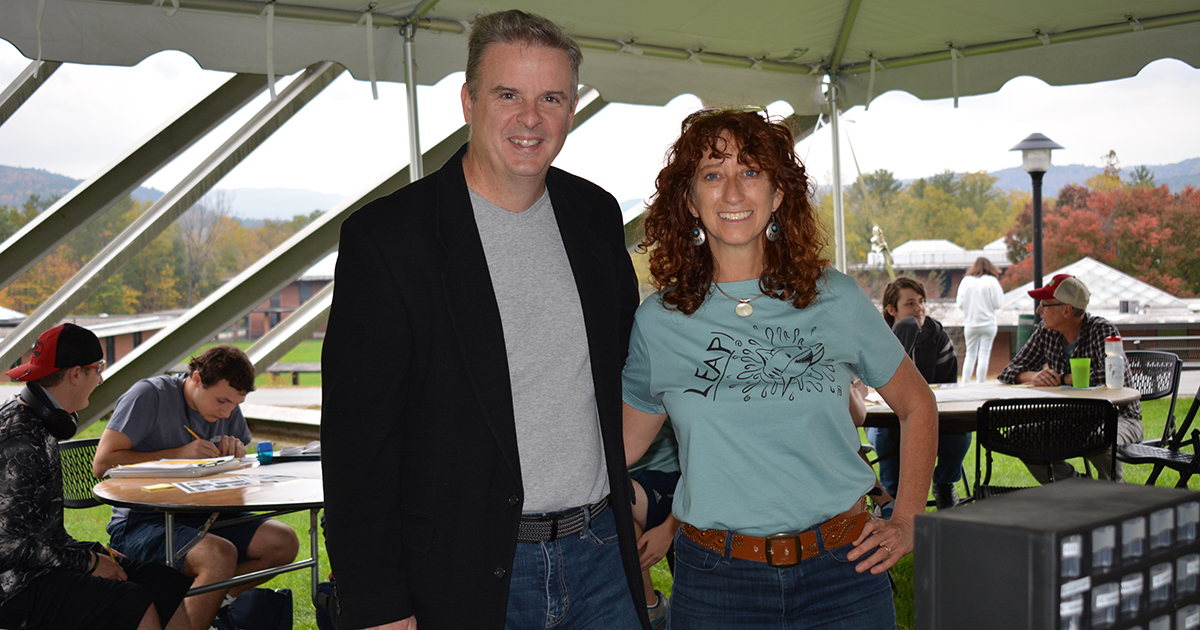
Professor Andrew Corbett traveled to Vermont this fall and addressed neurodiverse students with learning differences, including commercial bee farmer Lucas Sillars, founder of Luke’s Bees.
“Some of the early research shows that individuals like this actually can become really good entrepreneurs,” said Corbett, the Paul T. Babson Distinguished Professor of Entrepreneurial Studies at Babson College.
Individuals with neurodevelopmental conditions, such as attention deficit hyperactivity disorder (ADHD), autism, and dyslexia, often require special academic programs or personalized assistance tailored for neurodiverse learners.
Motivated by a desire to give back, Corbett volunteered his time and energy in October to address students at Landmark College, a private institution for undergraduates who learn differently.
“He established a really nice rapport with the students,” Tamara Stenn, faculty advisor for the Landmark Entrepreneurship Accelerator Program (LEAP), said of Corbett’s interactions at Landmark’s campus in Putney, Vermont. “In fact, even afterwards, they were so excited about having met him, and they loved how he connected with them.”
Stenn invited Corbett to Landmark’s fourth annual Entrepreneurship Day to address students with learning and attention issues.
“It was humbling in many ways to work with these students. It was eye-opening,” Corbett said. “Folks like this that learn in a different way can be entrepreneurs and can be really good entrepreneurs. So, I feel like it’s Babson’s duty to be out there and help, so when Tamara asked for help, I was happy to go and do it.”
Teaching Entrepreneurial Leadership
Connected through the Academy of Management, a professional association for management and organization scholars, Corbett and Stenn became acquainted less than two years ago as fellow researchers. More recently, Stenn submitted content for a scholarly book that Corbett is editing.
Sharing a common bond as researchers and professors of entrepreneurship, Stenn thought her students could benefit from Corbett’s hands-on expertise.
“Taking time off from his sabbatical to come and spend the day with us was really great,” she said of Corbett. “He came early and saw our small Idea Lab. We’re a campus of 400 students, so we don’t have a giant shared maker space like Babson.”
Landmark may not have a 9,800-square-foot maker space like Babson’s Weissman Foundry, but Stenn said Landmark has entrepreneurship students who value entrepreneurial leadership.
“Letting my students get out and interact more professionally with other entrepreneurs, they love it,” Stenn said of her students. “We enjoy collaborating.”
“The way we teach at Babson and what we do—experiencing it real, practical, hands-on—works very well for this group, as well.”
Babson College Professor Andrew Corbett
Inclusive Teaching in Action
Addressing a group of about 20 Landmark students outdoors and using colorful graphics, lots of movement, and eye contact, Corbett told the students to brainstorm a pie-in-the-sky business concept and develop the idea into a feasible venture.
For the most part, though, Corbett used the same experiential approach to teaching that he uses at Babson while with the Landmark students. “This is inclusion,” Corbett said. “What’s interesting about that is I had to make some differences in how I approached it and engaged them—I had to be loud—but the experiential learning is, for most of those students there, the best way for them to engage. That’s what we do at Babson.
“The way we teach at Babson and what we do—experiencing it real, practical, hands-on—works very well for this group, as well,” Corbett added. “So, I didn’t have to change a whole lot from that perspective.”
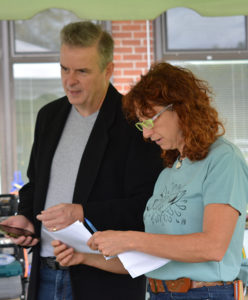
Babson Professor Andrew Corbett and Landmark College Professor Tamara Stenn address students with learning differences.
Beginning his day early, Corbett drove to Landmark’s campus and spent about seven hours interacting with the students before returning home. He described the full-day experience as rewarding.
“It was a pleasure for me to go up there,” he said of Landmark’s fourth annual Entrepreneurship Day event, which incorporated a theme around solar energy panels this year. “I really had a lot of fun, too. It was a great day.”
Stenn echoed those sentiments and thanked Corbett for providing a true Babson College experience to the Landmark campus. “We had a wonderful day together,” she said. “I’m glad that we now have an ally.”
Among the students Corbett interacted with that day included Sillars, the entrepreneur who started Luke’s Bees. Corbett described Sillars as a role model to others who learn differently.
“In many ways, he was like our Babson students,” Corbett said of Sillars, an entrepreneurship student at Landmark. “He is beekeeping, making honey, repackaging it in the regional area, selling the honey through stores, and making other things out of the honey as well. … It’s really great.”
Reflecting real-world entrepreneurial experience to help students generate ideas for a startup—that’s the Babson way. “This is what we teach at Babson,” Corbett said. “We believe in the methodology of Entrepreneurial Thought & Action®, and we believe that, if you want to be, we can help you discover how you can become an entrepreneur.”
Posted in Insights
Latest Stories
Posted in Community, Entrepreneurial Leadership

Posted in Insights
Posted in Insights