The Bottom Line? Stay in Boston.
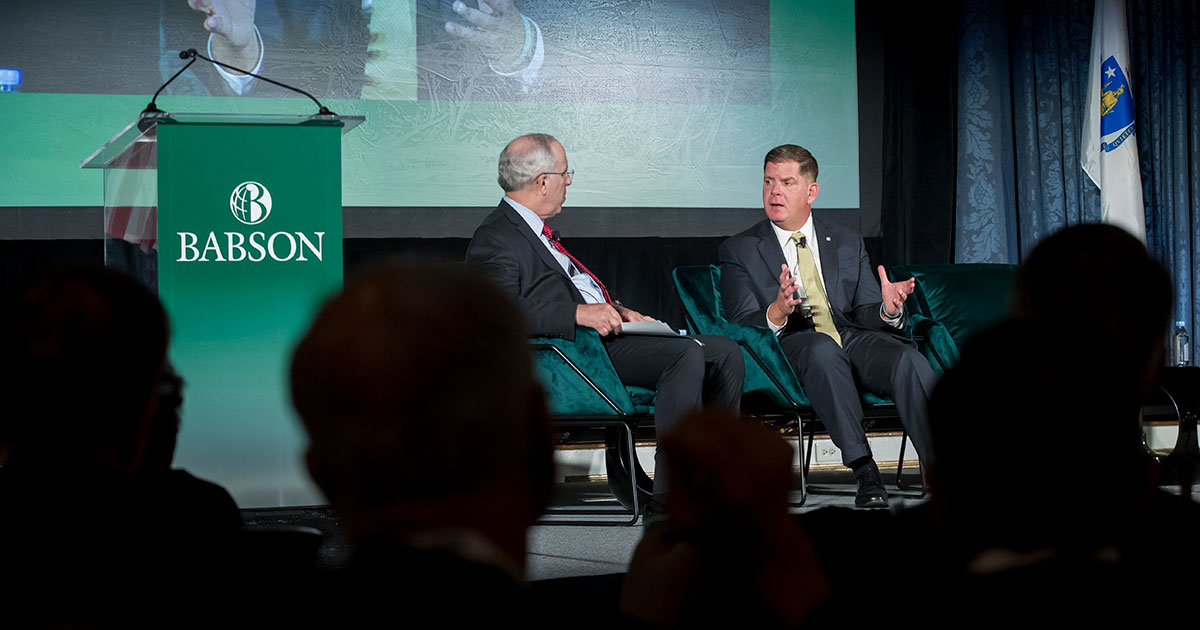
In her opening remarks, and in welcoming Boston Mayor Martin J. Walsh to Babson’s Centennial Celebration, Babson Chief Administrative and Financial Officer Katherine Craven set the scene:
“Over the past several years, Boston has grown at a rate of roughly $5 billion in development and 20,000 jobs each year,” she shared.
“Forty thousand small businesses call Boston home.” Maybe even more impressive is that “this is the only city on the East Coast where every single resident lives within a 10-minute walk to a park,” said Craven.
Mayor Walsh, as well as Governor Charlie Baker and local business leaders, took to the Babson stage in the heart of Copley Square to discuss the relationship between education and government systems that empower, and don’t impede, entrepreneurial innovation and advancement.
Such a collective effort will continue to have a positive impact on the City of Boston.
Our Best and Brightest: Motivating Them to Stay
“You are in the heart of the innovation and creativity economy here in Boston and Massachusetts,” said Baker in his welcome address at Babson Connect: Worldwide. “Babson is absolutely one of the folks that plays big here. We’re grateful to the Babson community for all you bring to the Commonwealth.”
Ranked the No. 1 city for startups and the best city in the world in which to find a job, Boston has quickly become a top contender for business leaders and career seekers during Walsh’s tenure.
“I see myself as a CEO,” said Walsh to Babson President Stephen Spinelli Jr. MBA’92, PhD. “I look at Boston and cities across America … we’re in a competition with each other for talent, and companies, and revenue. I have to have an entrepreneurial spirit.”
Through his observations as a new mayor in 2014, Walsh quickly noticed that even if companies raised money or received funding here in Boston, there was no requirement or incentive to stay. They would “go to Silicon Valley or New York City … they were going where the talent was,” he said.
The key for Walsh, ever since, has been a focus on the broader ecosystem.
“[The] ecosystem, I think, is education. It’s millennials. It’s talent … ecosystem includes housing and making sure our people have places to live, and that we’re not being so insular … we’re also thinking about Greater Boston, like Cambridge and Chelsea,” urged Walsh.
“Just like Babson recruits the best and brightest, as the City of Boston, we want to do the same,” he said.
Walsh went on to reference the opening of Babson Boston, and what a crucial and impactful step it was, not only for the College, but also for the city.
It Takes Partnership and Collaboration to Create a City-Wide Ecosystem
From Walsh’s experience, “it is important for [the City of Boston] to learn from its leading [educational] institutions. Having that relationship and using those partnerships” helps to foster an “allure of Boston. Great education, great companies, a great philanthropic community.” This creates a “well-run city,” said Walsh.
“And, the role for entrepreneurial leaders in Boston?” asked President Spinelli.
Walsh responded like a true public servant. “Take homelessness—that’s not going to get solved by 10 people in City Hall. We need the entrepreneurial thinkers.”
“So, the responsibility is on all of us,” added Spinelli, “to create jobs and opportunities” in the City of Boston.
Latest Stories
Posted in Community
Posted in Entrepreneurial Leadership, Insights

Posted in Insights