Lessons Learned During a Business Crisis

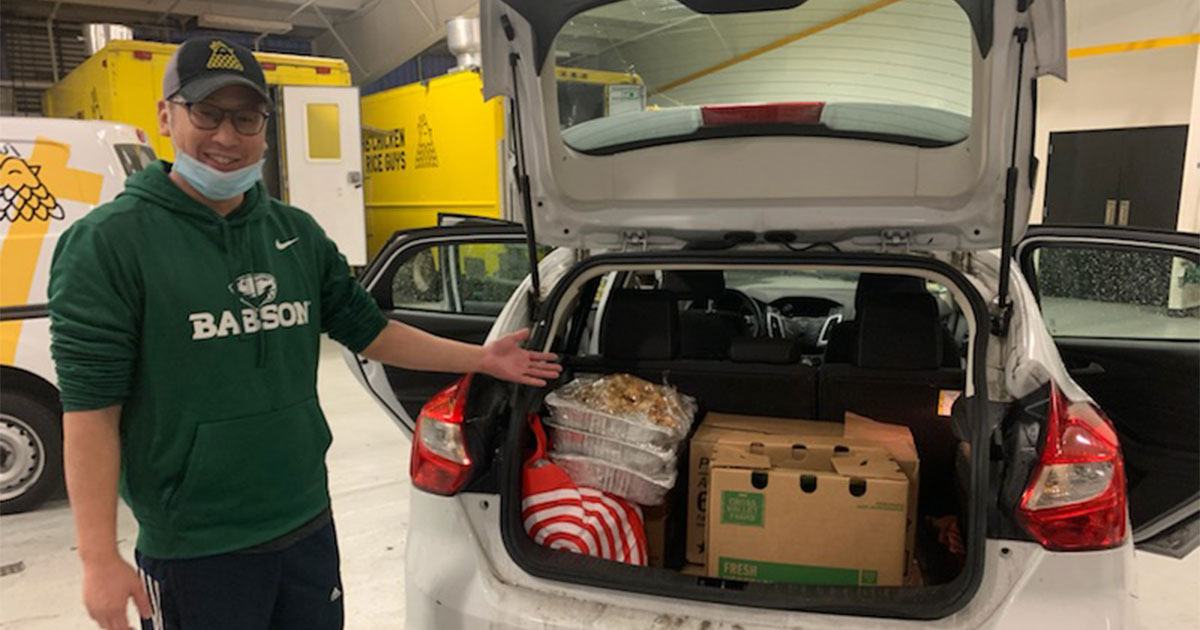
As the coronavirus pandemic has disrupted much of day-to-day life, Ian So ’08 has thought a lot about 2017.
That’s when Chicken & Rice Guys, his Boston-based group of restaurants and food trucks, was forced to shut down for eight days after an E. coli outbreak. That business crisis, which made headlines in the Boston area, proved cataclysmic for So’s company, which laid off dozens of employees and lost millions of dollars in revenue. It also took an emotional toll.
“My emotions were everywhere,” says So, co-founder and CEO of Chicken & Rice Guys. Jaemin Lee ’08, MS’19, also is a co-founder. “At first, I was completely horrified, and I felt unequipped to deal with anything like that. I didn’t want the spotlight. All of a sudden, I was front-page news. It was crazy.”
So now shares some of the lessons he learned from those chaotic days, in the hopes of helping business owners dealing with the pandemic’s turmoil.
Stay Realistic
Normally, says So, business owners must be bullish. After all, opening and running a business requires a leap of faith. They can’t waste energy on being negative.
The pandemic, however, is no place for pie-in-the-sky positivity. “Now, it’s the job of business owners to be as cynical as possible,” So says. “Don’t be optimistic. Prepare for the worst. Business owners need to accept what is going on. They have to be realistic.”
“Prepare for the worst. Business owners need to accept what is going on. They have to be realistic.”
Ian So '08
Have a clear picture of what your cash flow is, and understand that your business may take a long time to regain its footing, even once the threat from coronavirus subsides. Almost three years after the E. coli outbreak, the daily operations of Chicken & Rice Guys may be back up to speed, but financially speaking, the enterprise is still recovering from the huge monetary hole the shutdown caused. “These kind of things never leave your business normal,” So says.
Act Fast on Staffing
If you are forced to lay off staff, take responsibility. “Leaders have to make tough decisions,” So says. “Sometimes you can’t keep everybody.”
Keep in mind that layoffs may not only be the right thing to do for your business, but also for employees as well. You don’t want them to get sick if their job puts them at risk at catching the coronavirus.
Additionally, you don’t want to have your employees hanging on in the hope that your business will reopen soon with the same volume of sales it saw in the past. Instead, letting them go allows them to possibly find a better job somewhere else. “You want to give them the opportunity to make a living,” says So, who has had to furlough much of his workforce during the pandemic as he has scaled back operations.
Be Open
Communication is key in a business crisis. If layoffs are indeed a possibility, let your employees know. “I want my employees to be prepared,” So says. “I don’t sugarcoat it. I give them the worst-case scenario.”
If you need to delay a payment to a vendor, communication is again essential. “Vendors will be less angry if you just pick up the phone,” So says. “Eighty percent of the time they are OK with it, as long as you have the conversation. Most of the time, they just want to know if you are going to go out of business. They don’t want to lose you as a customer.”
Take Care of Yourself
Business owners are by their nature can-do people. They are willing to work hard to solve problems.
But in a business crisis such as the pandemic, working hard may only get you so far. Too much is out of your control. In fact, working till exhaustion can have consequences. “If you’re busy all the time, and you’re being reactive all the time, you can’t make good decisions,” So says.
Take time to exercise, hang out with family, sleep, or whatever you need to do to decompress. “After a certain point, after accepting that you’ve done all you can do, it’s important that you take care of yourself,” So says.
Latest Stories

Posted in Community

Posted in Insights

Posted in Community