Cardfolio Wins Second Annual Babson FinTech Startup Pitch Competition
Listen
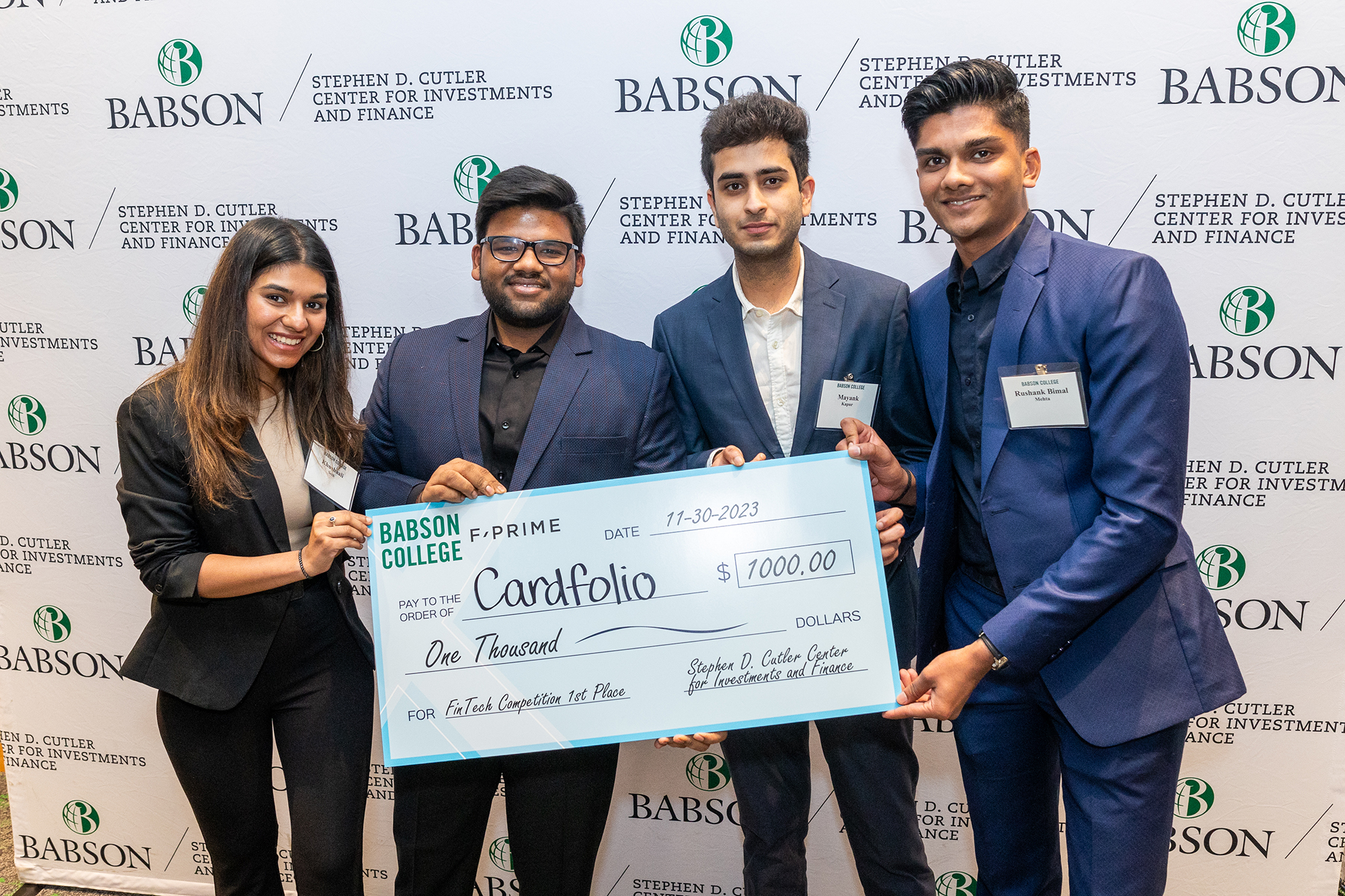
113023 Babson Fintech Pitch Competition The Cardfolio team—from left: Khushaali Seth MSF‘23, Abhishek Mittal MSF‘23, Mayank Kapur MSF‘23, and Rushank Bimal Mehta MSF‘23—won $1,000 for its idea to optimize credit card and loyalty card benefits. (Photo: Nic Czarnecki)

Graduate students Mayank Kapur MSF’23, Khushaali Seth MSF’23, Rushank Bimal Mehta MSF’23, and Abhishek Mittal MSF’23 from the group Cardfolio won the second annual Babson FinTech Startup Pitch Competition. The group also took home $1,000 in cash prizes for its fintech idea.

Cardfolio aims to transform how people use and optimize their credit card and loyalty card benefits. It integrates all of a user’s credit card and loyalty program data into a single, easy-to-use dashboard, allowing for smooth points transfers, automatic redemption before expiration, and personalized, AI-driven maximization suggestions.

Hosted by the Stephen D. Cutler Center for Investments and Finance, the competition featured select students from the undergraduate and graduate fintech courses taught by Assistant Professor Linghang Zeng. As part of their class projects, students worked together to create a fintech startup idea and analyze its prospects for success using course concepts. A total of 29 groups presented their ideas in class, and the top five as voted on by classmates presented their startup ideas to a group of esteemed fintech professionals, including Sarah Biller, executive director at Vantage Ventures; Ravin Nanda, corporate development analyst at Fidelity Investments; John Reed Stark, president at John Reed Stark Consulting; and Jared Shulman ’12, CFA, co-founder and CEO at Lendica.

The graduate trio of Ryan Grund ’22, MSF‘24, Samuel Morgan MSF‘24, and Adeleke Karera MSF‘24 placed second and won $750 for their idea called EduEquity, a platform specializing in analyzing and managing income share agreements between students and educational institutions, which offers funding for students based on their future salary​.

The undergraduate team of Blake Albanese ’24, James Zheng ‘24, Oak Kornsri ‘24, and Demitri Papoulis ’24 placed third and won $500 for their idea for P-AI-MENTS, a cloud-based system that manages the back-of-house payment system for restaurants, aiming to be a modular all-in-one restaurant.

Posted in Babson Briefs

More from Babson Briefs »

Latest Stories

Employees discuss over documents at table during a company retreat
Resolve to Network: Research Shows Company Retreats Help Forge New Connections Company offsites provide more than just a break from regular routines. New research shows retreats can serve an important function, write Madeline Kneeland of Babson College and Adam M. Kleinbaum for The Conversation.
By ,
January 21, 2026

Posted in Insights

Dylan Amaswache ’27 takes a selfie with students sitting at tables behind him
A Salute to Service: How Babson Students Give Back to the Community The arrival of Martin Luther King Jr. Day, a holiday in which many people perform community service, makes for an opportune moment to examine the longstanding tradition of giving back at Babson.
By
John Crawford
Senior Journalist
John Crawford
A writer for Babson Thought & Action and the Babson Magazine, John Crawford has been telling the College’s entrepreneurial story for more than 15 years. Assignments for Babson have taken him from Rwanda to El Salvador, from the sweet-smelling factory of a Pennsylvania candy maker, to the stately Atlanta headquarters of an NFL owner, to the bustling office of a New York City fashion designer. Beyond his work for Babson, he has written articles and essays for The Philadelphia Inquirer, Notre Dame Magazine, The Good Men Project, and other publications. He can be found on Twitter, @crawfordwriter, where he tweets about climate change.
January 16, 2026

Posted in Community, Entrepreneurial Leadership

Close up of young woman holding happy smile face on background epic sunset
Best Way for Employers to Support Employees with Chronic Mental Illness Is by Offering Flexibility New research suggests that workers with chronic mental illnesses need their managers to be flexible and trust them, write Emily Rosado-Solomon of Babson College and Sherry Thatcher for The Conversation.
By ,
January 13, 2026

Posted in Insights