How This Successful Entrepreneur Grew as a Leader in the Babson MBA Program
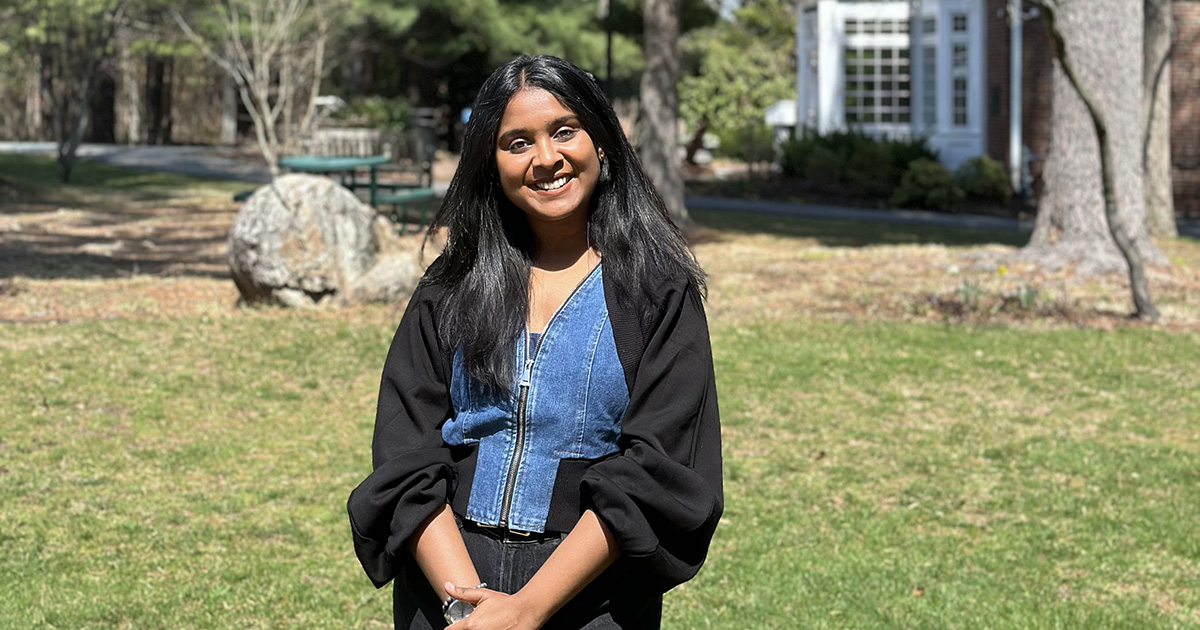
When Ashaa Vigashini Murali MBA’26 enrolled in the MBA program at Babson College, she wasn’t interested in “Business 101.” She wanted to go deeper.
For nearly seven years, Murali has served as the marketing and strategy lead for her family’s thriving leather business. She had even founded her own fashion startup in 2019. By all accounts, Murali was successful, but she believed she still had more to learn.
“I wanted to understand the science behind business,” she said, “the methodology of commerce.”
For Murali, the challenge was trying to create structure for abstract ideas and help her think more critically about her approach to business. So, she turned to Babson.
Murali specifically calls out a course taught by Professor Lidija Polutnik for its structured, economics-based approach to pricing, blending marketing insights and allowing students to apply concepts directly to their own businesses. In that class, as in others, Murali appreciated the encouragement from faculty to “apply what we were learning to our own business ideas, or new ones we wanted to start,” she said. “It’s like an intense consultation for your business ideas.”
Murali also highly valued Leading Business Turnarounds, a challenging and niche course by Assistant Professor of Practice Bret Bero that focuses on making failing companies profitable or sellable. Bero’s deep expertise on reviving failing companies appealed to Murali, who wanted to engage in high-level strategy discussions, even about topics as complex and seemingly far in the future as business turnarounds.
Bero, who also taught core strategy, fostered a healthy learning environment by constantly reassuring students to “fail as much as you want here because we can help you,” Murali said. This sense of “psychological safety,” as she put it, really encouraged her to participate, take on challenges, and unlock deeper learning.
Building a Business with BETA-X

One of the Babson MBA’s core differentiators, Murali said, was the BETA-X program, a unique model built into the first semester. Murali’s initial semester was divided into two seven-week modules, during which students completed eight core classes. Simultaneously, the BETA-X project required her to build a product from scratch for a major company (such as P&G or Shark Ninja). Murali notes that this process allowed her to instantly apply concepts from subjects such as marketing, finance, strategy, and accounting.
She emphasizes that BETA-X provides a “skeletal way of doing it”—teaching students the structure required to build a business from start to finish, including how to identify and pick the best pain points.
“The moment you instantly apply this learning into a project, into a very practical format in parallel with your theoretical classes,” Murali said, “you remember it as an experience and not as a class.”
Murali also had the opportunity to grow her entrepreneurial leadership skills through campus involvement, serving as the president of the Graduate Student Council and as a research assistant to Provost and Executive Vice President Ariel Armony.
Perhaps her most impactful experience has been serving as a co-chair for the student-run Global Entrepreneurial Leadership Forum, a Babson flagship conference. She and her team approached the conference like a business. They reimagined the organizational structure, creating a system of coordinators/trainees with rotational roles, inspired by corporate training programs. This approach trains the next cohort on every aspect of the conference, ensuring continuous leadership growth.
A Unique Entrepreneurial Leader Mentality
Murali found that the Babson MBA experience provided not only the rigorous academic framework she craved but also powerful lessons in leadership and self-mastery that have fundamentally changed her perspective. A big takeaway? Practicing intentionality.
Murali recalls a meeting she had with a faculty member where she had a chance to share her story and her goals. The meeting was quick, but a few weeks later, the professor sought her out at an event to share her feedback. “It wasn’t just something generic, but it was personal to me,” Murali said, noting that the advice the faculty member provided showed she had listened to her, put thought into their conversation, and then connected with intention.
“That’s how you come into a meeting or any setting—with that kind of intentionality. And I think it is pretty lacking in the world now, where you’re constantly distracted.”
Ashaa Vigashini Murali MBA’26
On a separate instance, Murali said her mother came to visit campus and Armony, despite being busy, made time to meet with them and was “very intentional with his questions”.
She learned “that’s how you come into a meeting or any setting—with that kind of intentionality,” Murali said. “And I think it is pretty lacking in the world now, where you’re constantly distracted.”
This lesson has had a profound impact on Murali, who plans to “get back to business” after graduation. Armed with a systemic toolkit and a new perspective, though, she is better prepared to tackle complex challenges.
“My family keeps saying, you’ve changed. You’re so much calmer now,” she said with a laugh, crediting her mentors and experiences at Babson.
Latest Stories


Posted in Insights

Posted in Community, Entrepreneurial Leadership