The Final Ledger: Closing Time in FME
This is the sixth and final installment of an ongoing series about first-year students’ journey through the Foundations of Management and Entrepreneurship (FME) course.
The moment was a long time coming.
After months of work, after connecting with suppliers around the world, after dealing with challenges and hustling to make sales, the team of students behind G & C Kit reached one final glorious milestone—their products had been mailed, and their customers were receiving them.
With that, whatever lingering worries the team members had about their venture vanished. They had dreamed up a business, promised to sell a quality product, and delivered.
“That gave me a lot of satisfaction,” says Arya Patel ’24, a member of G & C Kit, which sold eco-friendly shower kits. “When you are working on the process, you don’t know if it’s all going to work out. There were a lot of issues going on. You’re wondering if this is going to happen.”
Babson College students in Foundations of Management and Entrepreneurship, or FME as it’s commonly called, spend the school year fine-tuning business ideas and turning them into reality. As part of an ongoing series, we’re telling the story of the FME experience, from the pitches and presentations to the pivots and products.
In this sixth and final installment, students take time to reflect now that the school year is over, sharing thoughts on their businesses, their failures and successes, and the intense, challenging, rewarding, and ultimately highly educational FME journey. “It was quite a long process,” Patel says. “It really became a part of my life.”
The Goal Is Learning
FME businesses are disbanded at the close of the school year, and strictly from a bottom-line perspective, they aren’t always a success.
Sophia Pantos ’24 was part of a business called PRO, which stands for Portable Remote Office. Seeing a need with so many students and workers working remotely, PRO initially planned to sell portable, three-panel offices. However, late in the process, the team switched to an entirely new product, a roll-up screen that could provide a nice background for video calls.
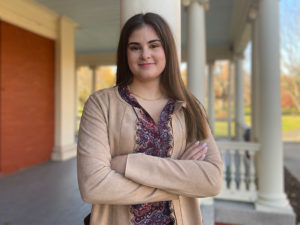
Sophia Pantos ’24
The team thought the new product would be easier and less costly to ship, but it actually caused PRO’s order fulfillment service to refuse to work with the students. That’s because the packages for the new screens were a different size than what the team and the service originally had agreed to with the initial three-panel design.
Because of that setback, half of the team’s inventory was left unsold at the end of the school year. “On paper, it doesn’t look wonderful,” Pantos admits. Making a profit, however, isn’t the primary goal for students in FME. The main goal is learning, and PRO’s experience with the order fulfillment service taught them a hard lesson about the business world, about how it’s not always flexible or cooperative.
“It didn’t feel like a loss,” Pantos says. “In terms of our growth and learning, it was the apex of our journey.”
The Small Details
G & C Kit’s sales also fell short. The students had assumed that something essential and practical as a shower kit would sell well, but they were mistaken. “It was far below our estimates,” Patel says. “When we forecasted the demand, we were too optimistic. We thought they would be fast-moving products.”
That misplaced optimism was compounded by a few critical errors the team made in its sales strategy. At first, the students had relied on social media to drum up sales, which proved ineffective. They next tried reaching out directly to potential customers, but when people expressed interest in buying a shower kit, G & C Kit neglected to follow up. “You need to focus on the small details when running a business,” Patel says.
“We’re all learning from one another’s experience. If someone makes a mistake, it’s a learning opportunity for the whole team.”
Arya Patel ’24
G & C Kit also spent an inordinate amount of time on finding suppliers. Typically, an FME business might sell only one product, but G & C’s kits were made up of toothbrushes, toothpaste, soap bars, and shampoo bars, which meant the students had to work with four separate suppliers. “We spent a lot of time on logistics,” Patel says. “If we focused on only one product, it would have given us more time to focus on marketing and promotion.”
Mistakes, however, are expected in FME. “That is what FME is all about,” Patel says. “We should take all the failures and shortcomings positively. We’re all learning from one another’s experience. If someone makes a mistake, it’s a learning opportunity for the whole team.”
Lessons from the Team
The school year ending meant the members of the FME teams had to say goodbye to each other after working together so closely. In their final meeting, Patel and the rest of G & C Kit took a moment to acknowledge all they had accomplished. “Everyone shared a special moment from the year,” Patel says.
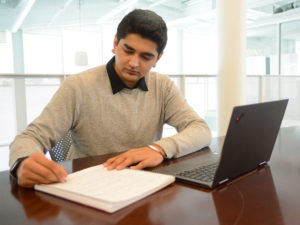
Arya Patel ’24
Pantos says she grew close with the PRO team members, who already have made plans to reunite for dinner in the fall. The group felt comfortable sharing their ideas and opinions with each other. “We spent so much time together. We all know each other so well,” she says. “I found eight people who are just as passionate about business as I am, and they are kind and amazing leaders.”
Pantos learned a lot from the team. One student shared Excel expertise, while another demonstrated the importance of empathy. Others talked of their cultures. “I internalized everything they taught me,” Pantos says. As they worked together, she believes they showed the true meaning of leadership.
“It’s not about power or authority at all. It’s not about one person doling out tasks,” Pantos says. “It is truly about working with others to produce the best possible outcomes. It’s about perseverance and dedicating yourself to achieving a goal.”
The Babson Way
With the school year at an end, Pantos couldn’t help thinking back to the very first FME class, she and her classmates sitting up straight, smiling, trying to make a good impression. They have learned so much since then about the inner workings of business. “I now understand all the intricate pieces of the business world in such a detailed manner,” she says.
One byproduct of that is Pantos has a newfound interest in accounting. “I was never interested in accounting before coming to Babson,” she says. “Now, I have found an interest in numbers and finance and how they tell a business’s story. You look at financial statements and understand the decisions a business makes. Numbers don’t lie.”
“They are teaching you the Babson way. It is the way to think and ask questions. That’s what makes the Babson education so invaluable.”
Sophia Pantos ’24
For Patel, the FME taught him three big lessons about the entrepreneurial process. First, he says, the key to being an entrepreneur is observation and identifying problems that need to be solved. Second, entrepreneurs can’t be afraid to take the first step. Take a well-calculated risk, he says, and see what happens.
Finally, even if you have a good strategy, remember that success is defined by execution. “No matter how much hard work you put in, if you don’t execute, you won’t get the results,” he says.
Ultimately, the most important lesson learned in FME is how to think like an entrepreneur. Finding opportunity, dealing with uncertainty, pivoting, collaborating—this is the entrepreneurial mindset that students carry with them through the rest of their College days and beyond. Pantos and Patel were thankful to their FME professors for all their effort and inspiration.
“They are teaching you the Babson way,” Pantos says. “It is the way to think and ask questions. That’s what makes the Babson education so invaluable.”
Pitches and Pivots: Our FME series
Part 1: A Babson Rite of Passage Begins
Part 2: Think Big, Observe, and Create Solutions
Part 3: 3 Minutes, 3 Slides, and the Fate of a Business Idea
Part 4: Preparing for Launch: It’s All About Manufacturing
Part 5: Product Problems, Inventory Issues, and Mailing Mishaps
Part 6: The Final Ledger: Closing Time in FME (above)
Posted in Community
Latest Stories


Posted in Insights
Posted in Community, Entrepreneurial Leadership