A New Institute Takes a Broader View of Entrepreneurship

Entrepreneurship. That’s what Babson College does best. For decades, the institution has been in the trenches with individual entrepreneurs, working and sweating with them, helping them begin and build their businesses.
Now, Babson wants to look at the bigger picture.
Thanks to a $10 million gift from the family of John Butler ’52, Babson is establishing the Butler Institute for Free Enterprise Through Entrepreneurship. The new institute will look at entrepreneurship from a macro level, examining how government, business, and society can help entrepreneurship to grow and thrive in communities across the world.
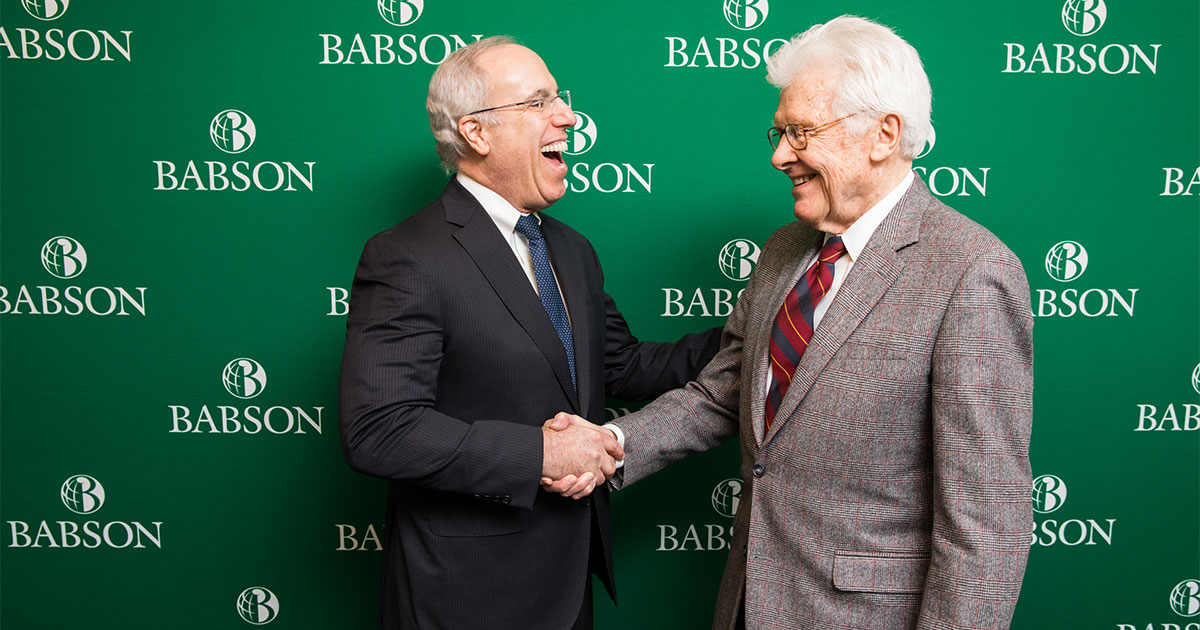
The Butler family, philanthropists and community leaders who have long-term ties to Babson, made their investment in the College because they believe in the power of entrepreneurship. “We have admired entrepreneurs for a long time,” says John Butler, the chairperson of his family’s business, Cottingham & Butler, an insurance broker based in Dubuque, Iowa. “They make an amazing contribution to our society.”
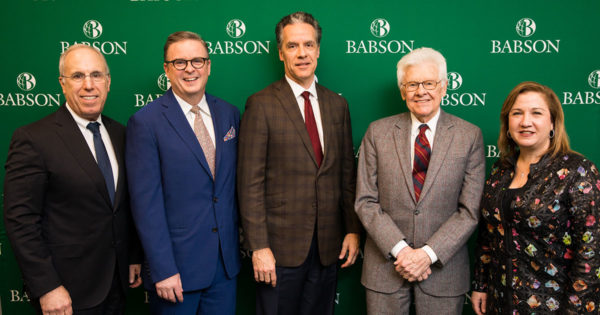
President Stephen Spinelli Jr. MBA’92, PhD, Professor Andrew Corbett, Andrew Butler ’84, John Butler ’52, and Debi Kleiman, executive director of the Blank Center for Entrepreneurship
Because of that, the Butlers felt a responsibility to find a way to encourage more entrepreneurial activity, says John Butler’s son, Andrew ’84. “Entrepreneurship does so much more than help the individual entrepreneur,” says Andrew Butler ’84, Cottingham & Butler’s executive chairperson. “It provides jobs and opportunities. It does so much for our society and economy.”
Examining Big Questions
The Butler Institute will examine big questions surrounding entrepreneurs and their relationships to the communities and governments in which they interact.
What kind of policies, for instance, can government enact to foster entrepreneurship? Should society be funding incubators and startups? Who should lead the entrepreneurial ecosystem in a region—elected officials or the entrepreneurs themselves?
To answer these questions and many others, the institute will look at research, but also reach out to government officials, community leaders, investors, entrepreneurs, and anyone else who might have an impact on entrepreneurial activity.
“All sorts of factors affect whether people in a community engage in entrepreneurship,” says Andrew Corbett, faculty director of the Butler Institute and chair of Babson’s entrepreneurship division. “Hopefully what will come from this are policies that will help regions thrive.”
The institute will also examine how entrepreneurs can be encouraged and supported to tackle large societal problems such as poverty, hunger, and climate change.
“What kind of impact can entrepreneurship have on the greater good?” asks Corbett, who is also the Paul T. Babson Distinguished Professor of Entrepreneurial Studies. “We live in an entrepreneurial age. We live in an age of creativity. This mindset is a way to solve problems. We want to put policies in place that allow this to happen.”
Never Forgot Babson
To be sure, The Butler Institute is an ambitious endeavor that will be unafraid to tackle large, complicated issues. “It’s a big order,” admits John Butler. “To remake the world from Wellesley Hills is a challenge.”
“We have admired entrepreneurs for a long time. They make an amazing contribution to our society.”
John Butler ’52
Butler, however, has faith in Babson, a place he has known since the late 1940s, when as a “rosy-cheeked kid” from Iowa, he traveled east to attend college. “It was a big deal for my parents to send me here,” he says. Butler remembers fondly the professors who influenced him, as well as founder Roger Babson, who was still a presence on campus at the time.
Butler even met Alice, then a Wellesley College student who would go on to become his wife, while at Babson, the two getting together for a fateful cup of coffee after mutual friends told them they should meet.
After he graduated, Butler would eventually join his family’s insurance firm as one of only three employees. Under his leadership, Cottingham & Butler now employs more than 1,000 people.
John ’52 and Andrew ’84 Butler
Through the years, though, he never forgot Babson. The Butler family previously endowed the John E. and Alice L. Butler Launch Pad, Babson’s startup incubator.
A Call to the Community
Beyond its focus on research, the Butler Institute will host programs and events and create courses and activities for students. The institute will be housed under Babson’s Arthur M. Blank Center for Entrepreneurship, and the expansive research of Babson’s Global Entrepreneurship Monitor will now fall under the institute’s purvey.
Corbett encourages all members of the Babson community to become involved in the institute. “I’m unbelievably excited. Through the wonderful and generous support of the Butler family, we have a great opportunity here,” he says. “As we build up the institute, I want to find all the people in our community who want to address these issues.”
Posted in Community
Latest Stories
Posted in Community

Posted in Community