The GEM U.S. Report Asks: What Happens After a Startup Is Launched?
At first glance, entrepreneurship in the United States seems as strong as ever.
The Global Entrepreneurship Monitor’s annual U.S. report, a deep dive into the activity and attitudes surrounding entrepreneurship, found that the practice is seen as an enduring positive force in America, with many people continuing to take the plunge to start a business.
The share of American adults engaged in early-stage entrepreneurship, a widely cited metric known as Total Entrepreneurial Activity, or TEA, remains near historic highs at 18.5%.
“Entrepreneurship in the U.S. continues to be favorably viewed,” says Jeff Shay ’87, MBA’91, a Babson College professor of entrepreneurship and the co-lead of the U.S. GEM team. “We’re still seeing a healthy amount of startup activity.”
Donna Kelley P’24, the other co-lead of the U.S. GEM team and also a Babson professor of entrepreneurship, says that society continues to champion entrepreneurs. “Entrepreneurs are celebrated in the media,” she says. “They have a high status. It’s seen as a good career.”
READ MORE: See the complete GEM U.S. 2025–2026 report.
The findings of the 2025–2026 U.S. report, though, also reveal uncertainty. Entrepreneurs are fretting about tariffs, and Americans are perceiving that the act of starting a business has gotten a little harder than it used to be.
Then there’s the fact that while the TEA rate remains robust, the ownership of established businesses declined as part of an ongoing trend, suggesting that fewer entrepreneurial ventures are reaching long-term stability and success.
“The fact that it has continued to decline is discerning,” says Kelley, the Frederic C. Hamilton Professor of Free Enterprise Studies. “It is a year that entrepreneurship is still strong, but we have some concerns about the sustainability of businesses, about businesses sticking around.”
Figuring out the varied reasons for that ongoing decline, and how to address it, is critical to the long-term health of America’s newest businesses.
The Scope of Entrepreneurship
A global consortium of entrepreneurship researchers, GEM was founded in 1999 as a joint venture of Babson and the London Business School. GEM produces data on economies from around the world. “We’re helping academics, policymakers, entrepreneurs, and various constituents in the ecosystem understand the dynamics of entrepreneurship in their economies,” Shay says.
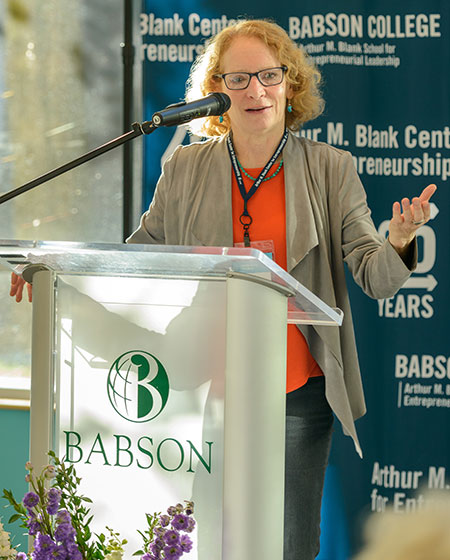
Babson administers the long-standing GEM U.S. report. The 2025-2026 edition surveyed 11,000 U.S. adults ages 16 to 64, as well as a slew of national entrepreneurship experts.
The findings in the latest U.S. report, released Monday, cover the scope of entrepreneurship, from the types of startups (wholesale and retail remain the largest sector, but tech continues to grow); the regions where entrepreneurship flourishes (the South and West have the highest TEA rates); the use of artificial intelligence (67% of entrepreneurs report that AI tools are important to their business model and strategy, a percentage that’s expected to only increase); and funding (entrepreneurship remains largely self-financed, with 55% of entrepreneurs relying on personal savings).
Some of the numbers reveal a creeping uncertainty. Just over half of respondents, for instance, report seeing good opportunities to start a business in their area, a figure down 13% from last year. This perception of opportunity, Shay says, is one of the strongest predictors of entrepreneurial action.
Just over half of respondents, meanwhile, say that starting a business should be easy for someone like them, a percentage that’s down about 5% from last year and nearly 30% from 2019.
Tariffs are also a concern. When the data was collected in June, 58% of entrepreneurs, anticipating higher costs and supply chain disruption, expected tariffs to affect their businesses. “It added a layer of uncertainty to entrepreneurs,” Shay says. “Entrepreneurs wear many hats and have a lot on their plate. This added another layer to their plate.”
Much has happened since the survey was conducted. The announcement of tariffs was relatively fresh when the GEM report asked about them, and many entrepreneurs were unsure of what their effects may be. Kelley says the next report will revisit the issue. “This year, we will ask about the actual impact,” she says.
The Growing Gap
One of the most important stories in the 2025-2026 GEM U.S. report is the growing gap between the strong TEA rate and the diminishing rate of established business ownership, which has been cut roughly in half since 2019, from 10.6% to 5.5%.

To put it another way, that decline means that while nearly one in five U.S. adults is involved with starting or operating a new venture, only about one in 20 own established businesses, which GEM defines as being at least 3½ years old.
Of course, some dropoff between new and established businesses is to be expected. After all, entrepreneurship comes with risk. Not all new venture ideas have long-term appeal. “We have to accept that not all startups will work out, but we would like to see these numbers go up,” Kelley says. “There has been a steady decline.”
Various reasons may exist for this decline. For instance, the TEA rate is high (greater than 20%) among 18- to 34-year-olds, but this is a group whose lives are experiencing many changes. They may bring enthusiasm to a startup but then find another opportunity calling them. “They’re just trying things,” Kelley says. “There may be more fluctuation in what they want to do.”
Some entrepreneurs may have started a venture out of necessity, but when a chance at solid employment came their way, they decided to go for it, craving the stability it may bring. “There has been a lot of uncertainty in the U.S. lately,” Kelley says. “People may value stability during these times.”
Certainly, money plays a part, with 23% of those closing businesses citing a lack of profitability and 11% pointing to an inability to obtain financing. The entrepreneurial spirit may remain alive and well in America, but that spirit far from guarantees that startups will grow into durable and profitable enterprises.
To close the gap between startups and established businesses that last, Shay says entrepreneurs need support and access to effective entrepreneurship education. “We have that gap there. How can we help people cross that chasm?” he says. “We want to make sure there is a support system available to people starting their businesses.”
Posted in Insights
Latest Stories

Posted in Insights

Posted in Community, Entrepreneurial Leadership

Posted in Entrepreneurial Leadership