Kicking Around the World Cup: Babson Professors Discuss Its Power, Prices, and Problems

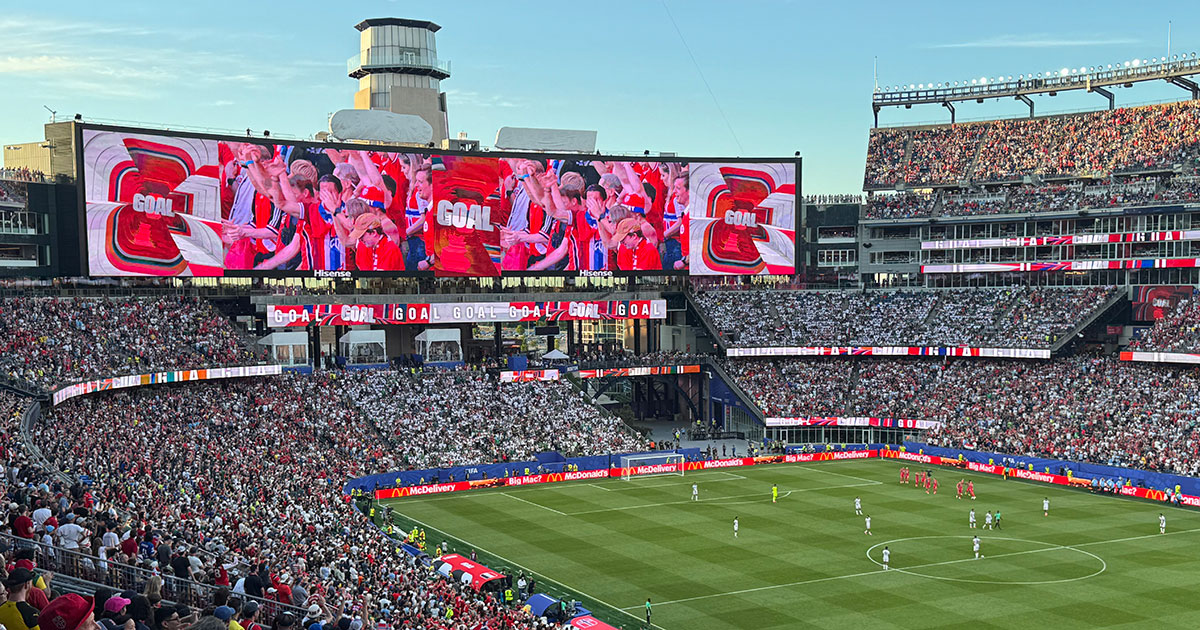
The World Cup is in full swing, and the world is watching. That includes Gary Ottley MBA’97.
“I love, love, love the World Cup,” says Ottley, a professor of practice in marketing at Babson College. “I neglect most of my actual responsibilities to watch all the games when I can, and I am mad at the world when I can’t get to watch games because of those aforementioned responsibilities.”
So far, the World Cup has been filled with stories both on and off the pitch, from the budget-busting tickets and train rides, to the hydration breaks masquerading as advertising breaks, to the red card requiring presidential intervention, to (lest we forget) the amazing, exhilarating, and downright beautiful matches.
Watching all the drama and spectacle unfold, Ottley and other Babson professors paused to share what’s on their minds. As the World Cup rolls along to its final contests, professors’ thoughts turned to the business of sports, the nature of fandom, and what to do about those stressful shootouts.
People Coming Together
Is the World Cup capable of healing divisions, at least for a little while? It may seem idealistic to say so, but it feels true. “This is the one thing that really does bring the whole world together, every four years, like nothing else,” Ottley says.

In the Fan Behavior course he teaches as part of Babson’s sports management concentration, Mike McGuirk and his students spend a lot of time discussing the social impact of fandom, how it creates unity and a strong sense of identity. “I think the World Cup showcases this in many positive ways,” says McGuirk, an associate professor of practice in marketing.
As an example, he points to Scottish fans, who arrived en masse to the Boston area and charmed many local residents with their kilt-wearing, beer-drinking, and troublemaking antics around the city. “The Scottish Tartan Army stands out to me because of the way its supporters proudly express their Scottish identity and build a sense of community wherever they travel,” McGuirk says.
Fandom also builds connections. Differences disappear when people are singing, chanting, and celebrating together. “Fandom helps promote societal integration, as people from different backgrounds come together to share the experience of supporting their teams,” McGuirk says.
Sports Is a Business
No matter how big of a fan you are, though, there’s no escaping the fact that sports is a business. The World Cup is a blunt reminder of that. Ottley went on the website of FIFA, international soccer’s governing body, to buy tickets for matches held in Foxborough, Massachusetts. It didn’t go well.

“I spent an inordinate amount of time on FIFA’s website in their queue, only to be denied, or to be faced with ticket prices in the high hundreds and low thousands,” he says. “From a business/marketing perspective, and even as a marketing professor, I find FIFA’s obvious and blatant money grabs to be disappointing at best, reprehensible at worst.”
Not that his opinion matters. “Every game I’m watching seems to be in full stadiums, so clearly FIFA doesn’t need fans like me,” he says. “There seems to be enough who can and will pay those ridiculous prices.”
Another example of FIFA’s quest for revenue is the hydration breaks. Instituted for the World Cup, the three-minute breaks occur midway through each half. While their stated purpose is to keep players hydrated and healthy, they also serve as a chance to show advertisements. “It breaks up the game’s momentum, and unless the game is being played in an actual heat wave, is patently ridiculous,” Ottley says.
An Alternative to the Shootout
As someone apt to dive into the intricacies of sports, Mathematics professor Rick Cleary wonders if there’s a way to improve a critical aspect of the World Cup.

One of the topics in Cleary’s Sports Applications of Mathematics course is the various rules used to break ties. These are often complicated and controversial. Major League Baseball, for instance, places a runner automatically on second base in extra innings, an efficient but clunky way to help teams score and end the game.
In the knockout rounds of the World Cup, matches can’t end in ties since one team must win to advance to the next round. If the match is even after regulation, it proceeds to 30 minutes of extra time, and if that doesn’t break the logjam, then the penalty shootout starts. One of the most thrilling moments in all of sports, but one that reduces the team effort that defines a match to a series of kicks, the shootout involves players taking turns shooting at the goal from the close range of the penalty mark.
“Some people find the shootout unsatisfactory, even if it can be exciting,” says Cleary, the Robert E. Weissman ’64, H’94, P’87 ’90 and Janet Weissman P’87 ’90 Professor of Business Analytics.
As an alternative to the shootout, Cleary suggests putting each team’s bench to the test instead. “I think a nice alternative would be to play the overtime using the ‘B teams’ for each squad,” he says. “World Cup rosters are huge, about 26 players, and so many players have not appeared in a game, and some have played just a few minutes. If the ‘A teams’ are equal, put out the other players for a 30- to 60-minute overtime and the country with the deeper talent pool is likely to win.”
Will the U.S. Fully Embrace Soccer?
As one of the co-hosts of the World Cup, the United States has seen the passion of fans and the joy of the games up close. “Every game is a huge deal, like a game seven or a Super Bowl,” Ottley says.
The United States already has many soccer enthusiasts, but Ottley wonders if this World Cup could propel the sport to a new level of popularity in the country.
“Americans are experiencing it this year in person, and folks here can actually see what it means to every other country in the world,” he says. “Perhaps this is the World Cup that will finally convince Americans that the beautiful game is really that.”
Posted in Insights
Latest Stories
Posted in Community
Posted in Entrepreneurial Leadership, Insights

Posted in Insights