Rome Serves as a Classroom on Democracy
When Kingsley spoke to the group of Babson College students, the room fell silent.
The students were visiting a refugee center in Rome, as part of an education abroad course, and Kingsley spoke of what had led him to the center. A person with albinism, he was seen as cursed by his community, by even his family, in his home country of Nigeria. He faced such terrible discrimination that he ultimately had to flee. “He was targeted, ostracized, and threatened with death,” says Sophia Pantos ’24, one of the students in attendance.
The students were amazed by the strength Kingsley summoned in confronting and surviving these heartbreaking challenges. They also admitted they had never known this type of prejudice existed.
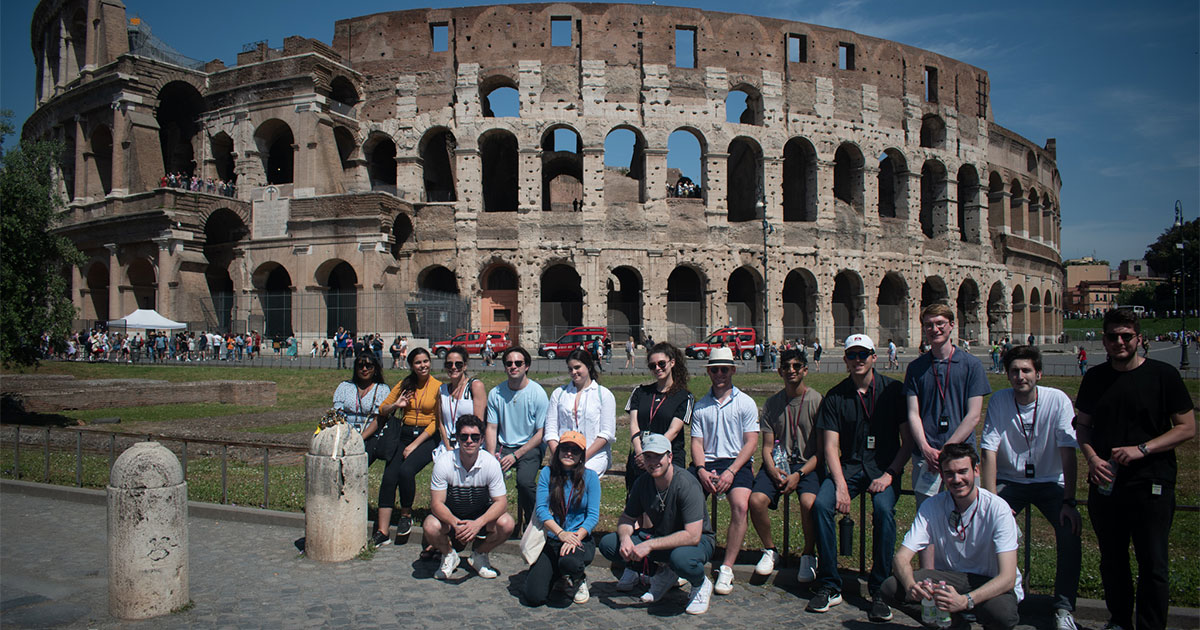
The visit to the refugee center, Centro Astalli, served as a conclusion for the Rome class, Origins of Democracy, Imperialism, and Human Rights. Over the course of eight days during the summer, the class took a group of 15 Babson students to many of the awe-inspiring sights one might expect to see in a visit to the Eternal City: the Colosseum, the Roman Forum, the Vatican.
The students were uplifted by the history all around them. “Everywhere one turns, there are monuments, churches, arches, and stone-paved streets that were constructed hundreds or thousands of years ago,” Pantos says.
The course, however, was about much more than sightseeing. In a city where the Roman Senate once governed, the Babson group reflected on democracy, on its origins and ideals, and on how it can fall short in representing all people.
Looking to the Past
The Babson course in Rome was led by Elizabeth Swanson P’19, a professor of literature and human rights and The Andrew J. and Joyce D. Mandell Family Foundation Senior Term Chair. Swanson envisioned the class as a “refresher course in democracy” and thought that Rome was a fitting place to go. “I thought I would like students to see where these ideas were formed and implemented,” Swanson says.
The group climbed Palatine Hill, the site of Rome’s founding, while reading Virgil’s account of that event. They studied Shakespeare’s Julius Caesar while visiting the Curia of Pompey, site of the Roman Senate. They read articles and toured museums and took in the breadth of Roman history and art. “They saw the full range of Roman artworks,” Swanson says. “It’s stunning and overwhelming.”
“Everywhere one turns, there are monuments, churches, arches, and stone-paved streets that were constructed hundreds or thousands of years ago.”
Sophia Pantos '24
Hidden underneath all the glory and beauty of Rome, however, was the pain of people. Citizens of the city were typically poor, Swanson says, and Rome’s armies conquered and subjugated lands and people far from their own. “Despite its commitment to high art and ideals, Rome is a cruel, violent culture,” Swanson says. “Rome is a place where you can witness the devastating impacts when democracy encounters imperialism.”
As the Babson group looked to the past and all its triumphs and tragedies, they also took stock of the present.
What Democracy Means
Much reflection happened after the visit to Centro Astalli. Run by the Jesuits religious order of the Catholic Church, Centro Astalli offers support to refugees living in Italy. In 2021, its Rome branch alone assisted some 10,000 people, from countries such as Mali, Ivory Coast, Afghanistan, Pakistan, and Senegal, offering them meals, medical services, language lessons, and legal support. Every day, more than 500 volunteers help at the center.
The refugees at the center represent just a small portion of those who have been displaced from their homes around the world. According to the U.N. Refugee Agency, more than 89 million people were forcibly displaced by the end of 2021. “It’s a massive crisis,” Swanson says. “People are on the move for so many reasons.”
Despite the enormity of the issue, the Babson group was struck that the Centro Astalli seemed tucked away and far removed from Rome’s tourist sights. “It appeared that this massive problem was being hidden away from society almost with the hope that it would disappear,” Pantos says.
As he spoke to the Babson students, Kingsley encouraged them to educate themselves about the plight of refugees. “I am just one of the stories,” he told them.
Visiting the center made Pantos think about what democracy means for people coming from different countries and circumstances. “Our American concept of democracy hinges on the ability to seek and fulfill one’s own vision of life, liberty, and the pursuit of happiness,” she says. “It was critical for us to consider what this means for those who are in the most desperate of situations.”
Posted in Community
Latest Stories
Posted in Entrepreneurial Leadership