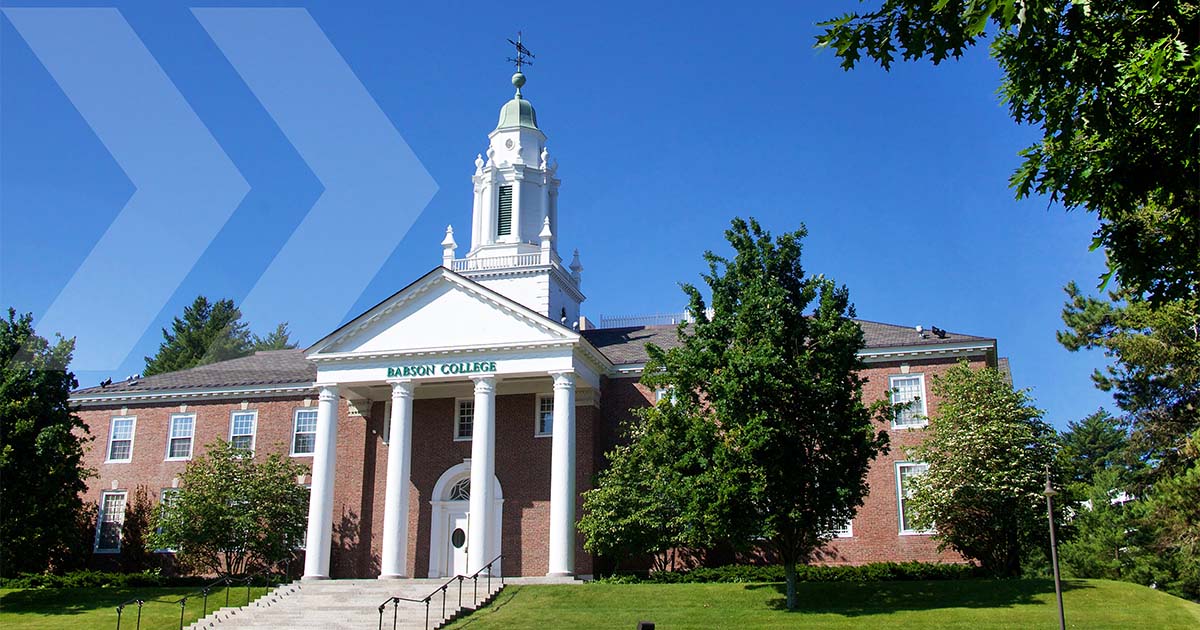
Project Empathy Brings Powerful Storytelling, and Perspective, to Babson College Campus

Anyone familiar with the phrase, “Nothing personal, it’s just business,” knows that empathy has not always had a natural home in the professional world.
Yet, as business has evolved, empathy has emerged as an integral business skill. Empathy, studies have found, helps entrepreneurs find innovative solutions to human problems, and helps them inspire and lead others to solve those problems.
Put another way, “everyone responds to being understood. That’s where empathy becomes a real business skill,” said Peter Hunt ’89.
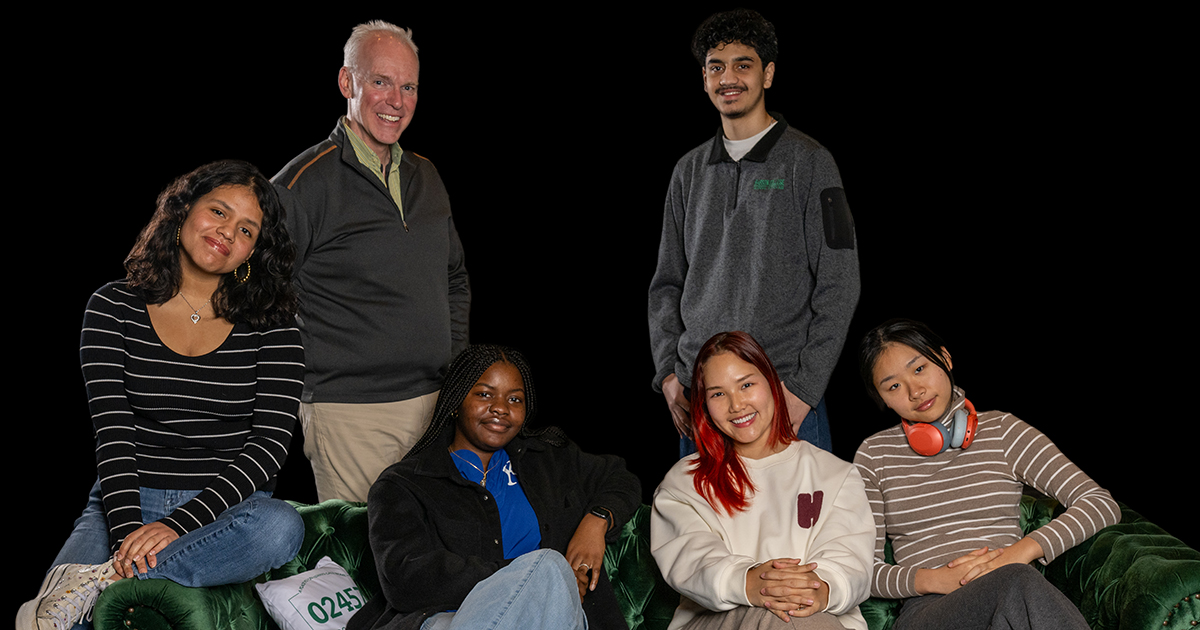
Hunt has returned to Babson College to direct Project Empathy, a live storytelling performance by Babson students that asks participants to do something both simple and challenging: listen closely, and then step into and perform someone else’s experience.
The result is a two-night show, held March 31 and April 1 by BabsonARTS at the Sorenson Black Box, where no one tells their own story. Instead, each student shares a peer’s story, word for word, emotion for emotion.
From Entrepreneurial Roots to Empathy
Hunt came to Babson thanks to an early entrepreneurial streak selling Christmas wreaths and mowing lawns as a kid in rural Connecticut. He first participated in Project Empathy four years ago and saw an opportunity to bring the program to Babson as founder Catherine Cote began expanding the experience.
“I thought, who could use this?” he said. “And Babson came to mind—not because it lacked empathy, but because empathy is so essential to effective business.”
Hunt sees empathy not as a “soft skill,” but as a critical capability, especially in environments where people must collaborate across differences.
“I thought, who could use this? And Babson came to mind—not because it lacked empathy, but because empathy is so essential to effective business.”
Peter Hunt ’89
“In business, you don’t get to choose everyone you work with,” he said. “You’re often dealing with people who think differently than you. That’s where empathy becomes work; it’s not automatic.”
The program challenges students to extend empathy even in moments of tension or misunderstanding.
“It’s easy to be empathetic when it comes naturally,” Hunt said. “The real question is: Can you extend it when it doesn’t?”
Inside Rehearsals
The Babson production features five student storytellers: Pichsinee Pituksuntisook MSEL’26, Rayaan Ali Rana ’29, Fatima Orozco Reyes ’28, Ellie Song ’29, and Oluchukwu Ukaegbe ’26. They span undergraduate and graduate programs, and represent countries including China, Thailand, Pakistan, and Guatemala.
Since January, the group has met weekly, balancing full course loads with hours of rehearsal, writing, and reflection.
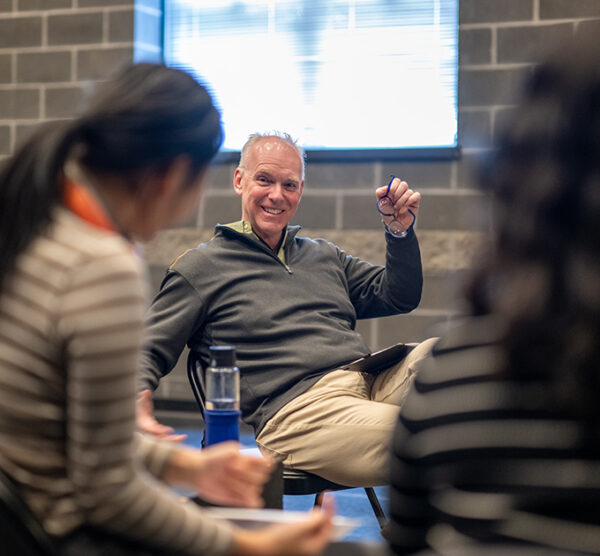
Each session blends two elements: exploring how empathy shows up in business and daily life, and developing each other’s stories through practice and peer feedback. Students memorize and perform their assigned stories without notes, focusing on tone, pacing, and emotional authenticity.
“Some moments require you to pause and let the audience feel it,” Hunt said. “You can’t just rush through someone else’s experience.”
A Different Kind of Learning
For Hunt, one of the most striking aspects of the experience has been the students’ commitment.
“These students are busy,” he said. “And yet they chose to spend two hours every Friday doing this work, writing, revising, practicing. That says a lot.”
It also has revealed something broader about Babson. While Hunt remembers a less diverse campus during his time as a student, today’s participants reflect a global community who recognize empathy as an important part of their business education.
“Each student was able to share specific ways in which empathy training was showing up in their coursework,” he said. “That was meaningful for me to hear as an alumnus.”
Building Connections
Beyond the stage, Hunt hopes the experience creates lasting impact through the relationships it builds.
“They could articulate how empathy shows up in their coursework. That was meaningful for me to hear as an alumnus.”
Peter Hunt ’89
Participants share deeply personal stories, often forming connections that go beyond typical classroom interactions.
“There’s a depth of connection here that’s different,” he said. “They’re seeing each other in a way they wouldn’t otherwise.”
Looking Ahead
Hunt hopes Project Empathy will become an annual tradition at Babson and expand to include a broader range of voices.
“I’d love to bring in the student who would never, in a million years, get on stage,” he said. “That’s where the real growth can happen.”
For now, the upcoming performance offers a powerful glimpse into what happens when business education meets human understanding.
And for Hunt, it’s a full-circle moment, returning to Babson not just as an alumnus, but as a guide helping students expand their perspective.
“I knew I would enjoy bringing back to my alma mater a program that wasn’t obviously about business,” he said, “but has an important tie to effective business and effective interaction with human beings.”
Get Tickets to Project Empathy
Register here for free tickets to Project Empathy, March 31 and April 1 at 7 p.m., at the Sorenson Black Box.
Latest Stories
Posted in Community, Entrepreneurial Leadership

Posted in Entrepreneurial Leadership
Posted in Entrepreneurial Leadership