Bridging How Humans and Intelligent Technology Can Learn Together
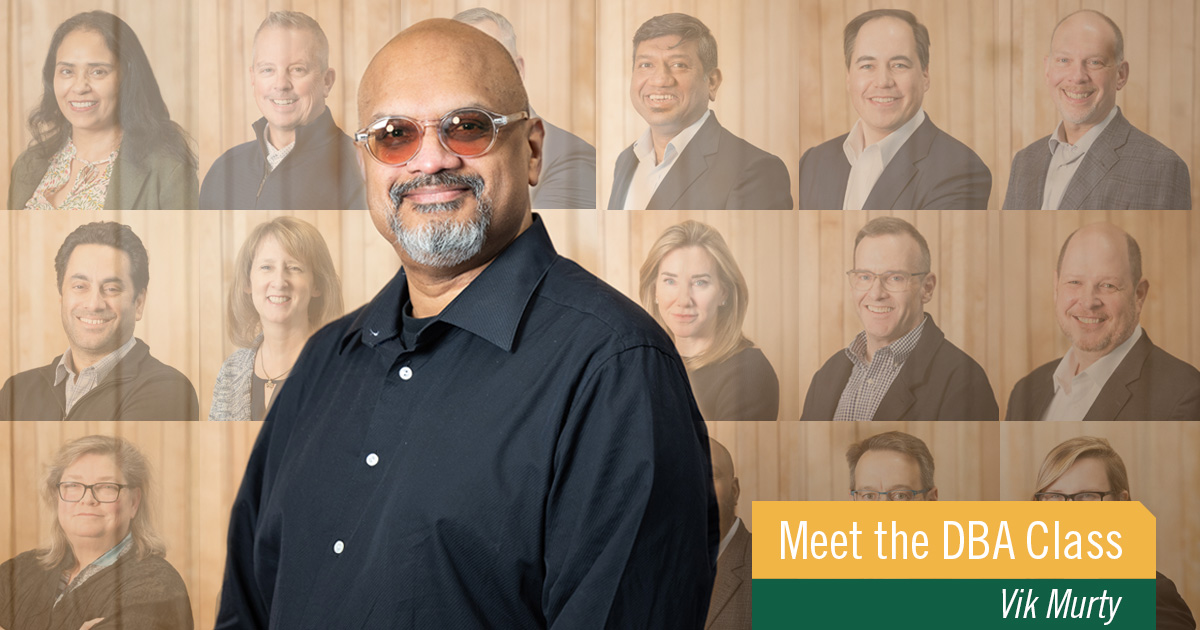
Editor’s note: As Babson’s new Doctor of Business Administration program begins, we are highlighting the individual entrepreneurial leaders who comprise the inaugural cohort. This is one in a series of DBA candidate profiles.
As a professor and budding researcher, Vik Murty MBA’03, DBA’28 is driven by a consistent question: How can individuals and organizations think, decide, and adapt more effectively in a world shaped by rapidly evolving technologies?
It’s a question he has been pursuing over the course of a career spent at the intersection of emerging technologies, organizational behavior, and entrepreneurial strategy, focusing on how individuals and organizations adapt when working alongside intelligent systems.
Before pivoting his career to academia, Murty applied his entrepreneurial mindset in the marketing of consumer electronics and technology, working for companies such as DirecTV, Samsung, Mitsubishi Digital TV, and Channel Intelligence by Google.
For the past decade, he has taught and directed the technology curriculum at the Universidad del Desarrollo in Chile. He also is the founder and academic director of the university’s Master of Business Technology program.
Now, Murty is a member of the inaugural cohort of Babson’ Doctor of Business Administration program, where is focused on examining how emerging technologies such as AI influence learning, productivity, and competitive advantage.
What drove you to want to pursue your DBA, and why did you choose Babson?
“I wanted to shape ideas that outlast me. My work in entrepreneurship, technology, and education has been about helping others turn possibilities into products. But increasingly, I’ve felt that to make a deeper and more enduring contribution is to complement experience with rigorous exploration. A DBA is not just another degree for me; it’s a deliberate step toward transforming practice into scholarship to turn the questions I’ve wrestled with in the classroom and the business field into knowledge that others can build upon.
“Coming back to Babson was an obvious choice because it is the one place where entrepreneurial thinking and academic rigor are not treated separately. Babson’s emphasis on creating knowledge that is relevant fits exactly with how I see the future of business scholarship. I also believe deeply in Babson’s cohort-based model, the chance to learn alongside other accomplished professionals, exchange ideas, and be challenged by faculty who understand both research and real-world impact.”
As you begin the program, what is one big problem you would most want to solve, and what research area are you aiming to explore to help solve it?
“The problem that most compels me is the growing gap between human learning and technological change. While technology evolves exponentially, our ways of learning, adapting, and integrating it into business and organizational life remain largely linear. This mismatch leaves both individuals and organizations struggling to fully realize the human–technology potential with the fear that tech run amok will cause disasters.
“I want to explore how people and organizations learn, adopt, and scale through emerging technologies not just as tools but also as catalysts of new forms of value creation. My research will likely focus on how the curves of human learning and machine learning intersect, and how that interaction shapes adoption, ethical boundaries, and performance outcomes. As a professor of business innovation and technology strategy, I’m especially interested in how we design learning experiences and organizational practices that allow humans to partner effectively with AI and other emerging technologies to accelerate not just adoption, but also to drive meaningful positive impact.”
What part of the program are you most looking forward to?
“The opportunity to think deeply and systematically to move beyond ‘doing’ to exploring understanding. The idea of framing complex problems, designing rigorous research, and contributing new knowledge is something I’ve wanted to do for a long time. I’m also looking forward to Babson: The cohort experience is a unique chance to learn from peers who bring diverse experiences, perspectives, and questions to the table. I know those conversations will challenge my assumptions and stretch my thinking. And, finally, I’m excited to once again work with Babson’s faculty who not only advance theory but also uniquely shape the practice and academic scholarship to develop the skills to eventually stand among them as a contributor to education at a global level.”
At this point, what are your hopes and aspirations professionally after the DBA program?
“My aspiration is to continue to be a bridge between academia and practice as someone who not only teaches and researches but also designs new ways for organizations and individuals to navigate technological transformation. My thought leadership will be focused on the intersection of entrepreneurship, emerging technology, and human potential in a space where ideas become experiments, and experiments become impact.
“I also see myself writing, speaking, and advising more broadly, sharing insights from my research to help companies, educators, and policymakers rethink how we prepare people for a future shaped by human–tech collaboration. Ultimately, my goal is to create knowledge that does not simply sit on a shelf, but instead shapes how people think, learn, and act in a world where technology and humanity are increasingly inextricably intertwined.”
This is part of a series of profiles highlighting the individual entrepreneurial leaders in the inaugural cohort of Babson’s new Doctor of Business Administration program. Read more about Babson’s first DBA candidates.
Posted in Community
Latest Stories


Posted in Community