A Babson Student Builds a Cycling Startup and Lands at COP 30
Riding a bike is not always safe in Brazil. Gustavo Augusto Kopp de Lima ’28 knows this firsthand.
While in high school, Kopp was riding a bike in his hometown of Colombo when a car, hurtling out of a parking lot, crashed into him. “The car came really fast,” Kopp says. “He said he didn’t see me.”
Kopp didn’t have to go to the hospital, but his leg was hurt, his bike was destroyed, and he was left with a feeling of unease. “It was a traumatic experience,” he says. “I was really scared about cycling for a long time.”
Talking with others in the accident’s aftermath, Kopp learned that many shared that unease about biking in Brazil. They spoke of roadways dominated by cars. They spoke of all-too-common bicycle thefts. “They said, ‘Yes, this is why I don’t cycle. It’s so dangerous to do,’ ” Kopp says. “It opened my eyes about cycling safety.”
Traffic statistics back up those disheartening perceptions of biking safety in Brazil, with more than 1,500 cycling-related deaths occurring in 2020, an unsettling number that averages out to almost four cyclist deaths a day in the country.
Kopp decided to do something about it. In 2021, a year after the accident, he founded JoinBike, a platform that seeks to connect Brazilian cyclists so they can ride together. Joining with others, Kopp says, creates safety in numbers.
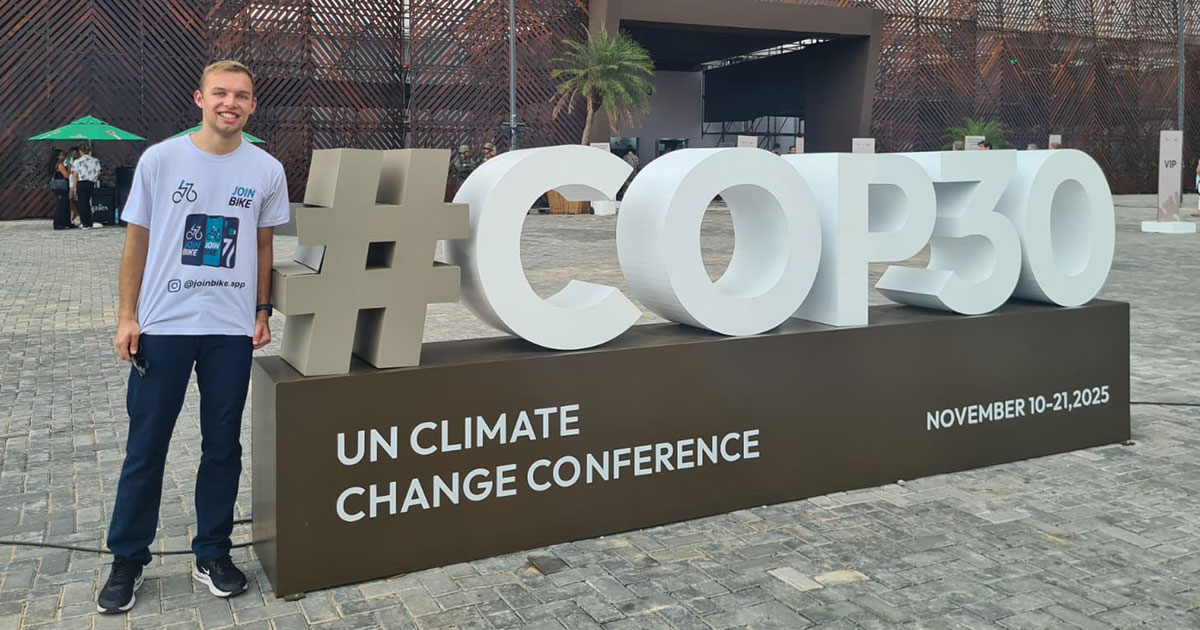
So far, Kopp has raised more than $50,000 to build JoinBike. In November, he spoke about his efforts at the latest session of the United Nations Climate Change Conference, commonly referred to as COP 30. “The main hope is that people can be sure they can cycle safe in Brazil,” Kopp says. “They can’t use safety as a reason not to ride. This is our dream.”
Building a Social Network
JoinBike allows bicyclists to find each other. If they’re looking to take a bike ride and are seeking company, they can post their upcoming route and pace on the platform. They also can peruse a list of rides that other cyclists have posted and join one.
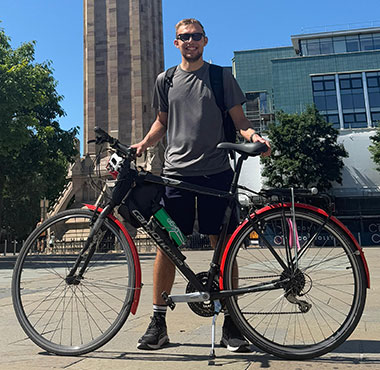
Though the startup is still in its early stages, it has already connected more than 4,000 cyclists for rides. For now, it’s focused on cyclists who live in the neighboring southern Brazilian cities of Colombo and the much larger Curitiba, though the venture recently expanded to Belém, a northern Brazilian city where COP 30 was held. Kopp plans to add more Brazilian cities in the future.
Other plans for JoinBike include the launching of an app, which would be supported by advertising, allowing it to be free for users. “We are trying to create a social network,” Kopp says. “We already have a big community of people waiting for the app.”
Until the app is launched, the platform utilizes WhatsApp for its activities. The idea of doing business with a not entirely built-out product, of moving forward using WhatsApp as essentially a prototype and not waiting for the app to be finished, is something he picked up at Babson. “You don’t have to have the perfect product,” he says. “This I learned at Babson.”
Another institution that has taught Kopp a lot is Brazil’s Federal Institute of Paraná, a public university and high school that he attended. When he first formulated the idea for JoinBike as a high school student, his teachers provided encouragement. One told him, “Innovation is having a problem and solving it,” which is exactly what Kopp aims to do with JoinBike.
Through funding JoinBike received from Brazil’s Ministry of Education, Kopp has hired students at the Federal Institute of Paraná to help with the startup. Today, he manages a team of four students.
The Journey to COP 30
In November, Kopp’s entrepreneurial journey with JoinBike took him to a big stage at COP 30, which had more than 40,000 attendees from nearly 200 countries.
Brazil’s Ministry of Education gave JoinBike an unexpected invitation to speak at the conference, and with financial assistance from Babson’s Gerri Randlett Got Your Back Fund, Kopp was able to fly to Brazil in the middle of the semester to attend. “I didn’t want to miss it,” he says.
Kopp presented at the conference and took part in a fair with other sustainability projects. Following in the footsteps of Ela Gokcigdem ’24, who attended COP a few years earlier, Kopp talked with all kinds of people: policymakers, investors, biking influencers, government officials.
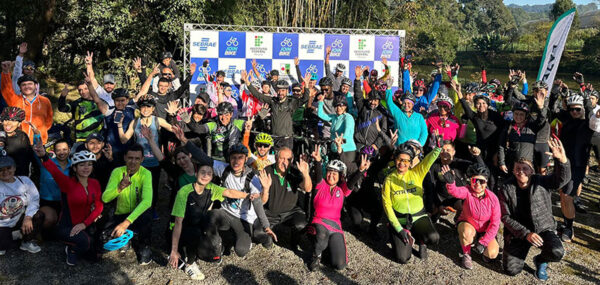
JoinBike also organized a bike ride at the conference. More than 200 cyclists joined, a substantial number given that bike riding remains an activity that isn’t always encouraged in the country. Kopp noted how COP 30 didn’t have any bike racks for attendees.
“It was great to see people connect with our mission,” he says. “We are always trying to organize this type of event to show how good group cycling is.”
At Babson, biking remains a big part of Kopp’s life, just as it always has been. He’s thinking of creating a College cycling club, and he often bikes to nearby Framingham, Massachusetts, to eat at Brazilian cafes. “For me, cycling is freedom,” he says.
That freedom is something he aspires to extend to others in Brazil. If JoinBike can make potential cyclists feel safe, Kopp hopes they will hop on a bike. “The first move is the hardest one,” he says. “Once people try it, it’s easier to come back.”
Latest Stories
Posted in Insights
Posted in Insights