Why This Mission to the Moon Matters
Jonathan Sims remembers watching the first space shuttle, Columbia, launch for the first time as a 6-year-old. He recalls watching the tragedy in 1986 when Challenger broke apart on takeoff, and a teacher, Christa McAuliffe, and six other astronauts died.
And, he remembers watching space-walking astronauts on shuttle Endeavour pull a satellite into the cargo bay with their gloved hands. “Only my fellow space nerds know about that last one,” he says, “but it was incredible.”
Now, Sims, an associate professor of strategic management at Babson College, has seen something even more incredible: astronauts looping around the moon.
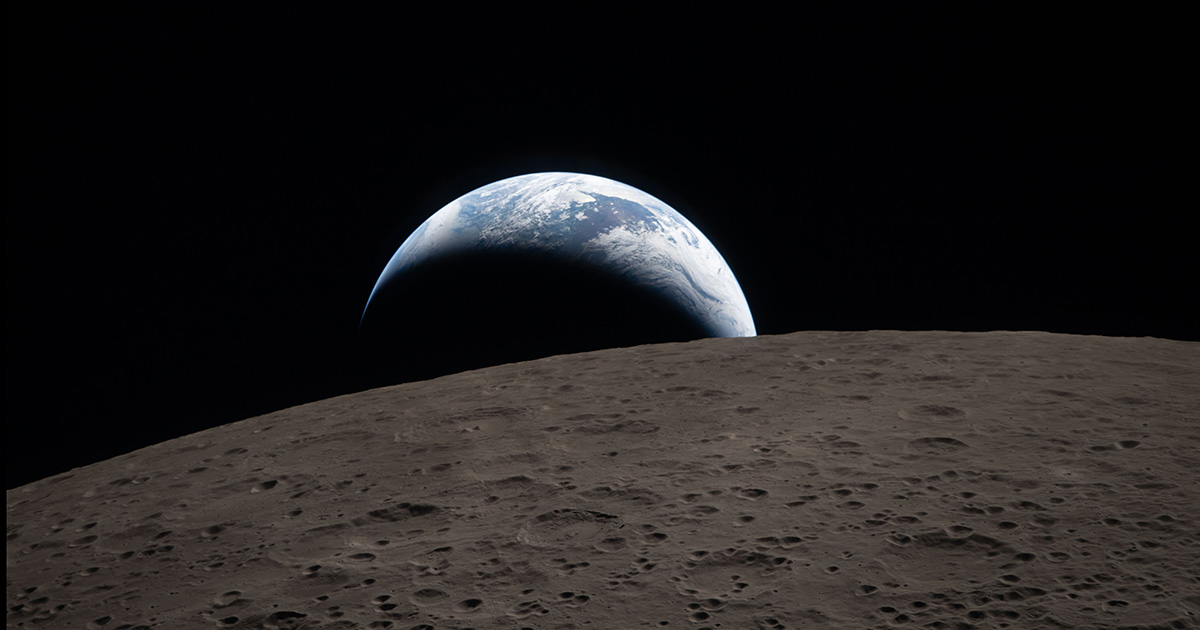
NASA this month returned humankind to deep space for the first time since the last moon landing in 1972, as the crew of Artemis II circled the moon, capturing stunning images of the moon and Earth. It’s the first step toward landing humans back on the surface of the moon with the goal of establishing a permanent colony.
“I was born after we returned from our last trip to the moon. So, this is a first for me, as it is for anyone under 53,” Sims said. “We had developed this capability to do what a lot of people thought was impossible, and then we simply stopped doing it. With Artemis II, we are seeing parts of the moon we’ve never seen before, and NASA is testing a new rocket system with humans on board for the first time.”
Sims—who will be assuming the role of the faculty director of the Center for Engaged Learning & Teaching—teaches a course at Babson called Moonshot Strategy, in which students learn how to tackle the seemingly impossible. Sims spoke with Babson Thought & Action to share his perspectives on the Artemis II mission, why it matters, and what a moonshot is really all about.
How important is this mission to the moon?

Jonathan Sims, associate professor of strategic management, teaches a course at Babson called Moonshot Strategy.
“For fans of human spaceflight, returning to the moon is the Super Bowl, World Series, and March Madness rolled into one. Even if you’re not a space fan, think about what it means: For the last half-century, the farthest any human has been from Earth has been about 380 miles, in orbit. The moon is a quarter of a million miles away. About 24 hours after launch, the Orion capsule Integrity fired a rocket to break free from Earth’s orbit. That hadn’t happened with humans aboard since Apollo 17 in 1972. The Artemis II crew includes the first woman, the first African American, and the first citizen of another country to leave Earth’s orbit, and they have already traveled farther from Earth than any human ever has.
“For me, it’s especially important because it can bring people together. There’s a line in last summer’s racing film F1, where Kerry Condon’s character says to Brad Pitt, ‘F1 is a team sport. It always has been.’ I thought about NASA when I saw that movie. We see the astronauts and celebrate them, as we should, but Artemis was made possible by thousands of individuals from all walks of life—working together in an age where that seems difficult. We can draw inspiration from the teams as much as from what they’re achieving.”
How do you respond to skeptics who question why we’re going back, or how expensive it is?
“As for skeptics, I think it’s important to welcome them to the conversation. Everyone has a right to question how we spend taxpayer money. We tell our students that it can be more difficult to defend a financial or quantitative argument with adjectives, so saying something is ‘expensive’ really won’t help much. What are the numbers? What’s the return on investment? NASA, which required over 4% of the federal budget in the 1960s to go to the moon, now receives less than 0.5%, and human spaceflight is only part of its mission—the rest is science. That’s still a lot of money, but for comparison, it is roughly one-30th of the Defense Department’s annual budget. In the ’60s, NASA helped create industries, products, and management processes that are still with us today. For example, NASA became the first major buyer of integrated circuits so it could build a guidance computer that weighed pounds not tons. That helped create an industry that allows us to fit over 10 billion transistors in our mobile phones, which many of us are using to watch Artemis. And, yet today, NASA’s entire budget is less than half of what Americans spend on pet food alone. I’ll add that my dog Luna—yes, named after the moon—is not helping to bring that number down.
“But the ROI isn’t measured solely by technological advances. How many 10-year-olds will be inspired to study STEM? How many college students will seek to understand how teams work together to accomplish a difficult task? How does this help us better understand and care for our own planet? After all, it was on Apollo 8—the first mission to orbit the moon—that Bill Anders took the famous photograph of the entire Earth, which later helped inspire Earth Day. That kind of ROI doesn’t fit on a spreadsheet, but it matters.”
“We practice deconstructing a big ‘impossible’ task into smaller ones that collectively achieve the moonshot. The Artemis program is a perfect example—each mission builds on the last, each one is challenging, but none is truly impossible on its own.”
Jonathan Sims, associate professor of strategic management at Babson
You teach a fascinating course called Moonshot Strategy. What does that involve?
“In class, we consider moonshots to be anything truly audacious and so difficult that people would be forgiven for saying it’s impossible. The class combines history, science, organizational behavior, and strategy to answer a challenging question: How do you reverse-engineer the impossible?
“In part of the class, we practice deconstructing a big ‘impossible’ task into smaller ones that collectively achieve the moonshot. The Artemis program is a perfect example—each mission builds on the last, each one is challenging, but none is truly impossible on its own. And who you bring to the mission matters as much as the mission itself. Apollo should have sent crews that reflected America’s diversity; Artemis II is finally starting to set that right.
“We also talk about personal moonshots. How many of us can say someone told us we couldn’t do something—and then we ignored them and went ahead and did it? In 1903, The New York Times predicted it would take up to 10 million years for humans to learn how to fly. The Wright brothers either didn’t see that article, or ignored it, because about two months later, they proved them wrong.
“We continue to tell ourselves we can’t do things—we can’t work together, we can’t compromise, we can’t fight climate change. If we keep saying that, it becomes a self-fulfilling prophecy. But, if we really study history, we see examples of how humanity has done what we thought was impossible again and again.
“When our students graduate, they have the tools to understand the significant challenges they face as individuals and we face as a society. They should also know how we overcame the ‘impossible’ in the past. So they can do it again.”
Posted in Insights
Latest Stories

Posted in Community