How Babson’s Global Surgery Slingshot Influences Worldwide Change
It was early in Irene Devine Dzirasa’s career as a public health nutritionist when she realized the world needed to change. At least, the world she saw and experienced in Ghana.
“I was confronted daily with the harsh realities of healthcare inequity—meeting children suffering from severe malnutrition and congenital conditions, born into families battling deep poverty and geographic isolation,” Dzirasa said. “Seeing how difficult it was for these hard-to-reach communities to access basic care sparked a lifelong commitment to fixing broken systems.”
Dzirasa has built her career since then at the intersection of policy, advocacy, and access, and has worked to ensure that life-saving surgical care is not a privilege but a fundamental component of global health systems.
In 2024, that work brought her to Babson College as a member of the inaugural Global Surgery Slingshot cohort, a program designed to help healthcare innovators scale solutions in low- and middle-income countries through the Kerry Murphy Healey Center for Health Innovation and Entrepreneurship under the Arthur M. Blank School for Entrepreneurial Leadership.
An estimated 5 billion people—more than half of the world’s population—lack access to safe, timely, and affordable surgery, according to the Lancet Commission on Global Surgery, making it one of the most overlooked gaps in public health today.
That global challenge is sharply felt in countries such as Ghana, where Dzirasa’s policy and convening work has focused. Today, the country performs only about 30% of the surgical procedures its population needs, according to Ghana’s Ministry of Health and the country’s National Surgical, Obstetric, and Anesthesia Plan. This shortfall is said to be driven by infrastructure gaps, workforce shortages, and uneven access.
Motivated for Global Change
This is the problem that Dzirasa witnessed at the local level early in her career and it continues to fuel her passion today.
“My motivation is simple,” Dzirasa said. “I engage in national and global advocacy because I want to change the policies that keep these children in the dark, turning access to safe care from a privilege into a guarantee.”
In spring 2024, she joined the inaugural cohort of Babson’s Global Surgery Slingshot. The program convenes a global cohort of clinicians, policymakers, and entrepreneurs to turn frontline insights into scalable, investable solutions. It also equips participants with the tools to expand access to care where it’s needed most.
“The course broadened my horizon on how to identify resources and navigate both public and private investments to support global surgery initiatives.”
Irene Devine Dzirasa
Currently, the program is in its fourth year and has continued to mark its impact, with participants of the program starting initiatives in 24 countries.
For Dzirasa, being part of the program shaped the goals of her project and provided her with confidence, a clear path forward, and an entrepreneurial mindset.
“The course broadened my horizon on how to identify resources and navigate both public and private investments to support global surgery initiatives,” Dzirasa said.
Impact in Ghana
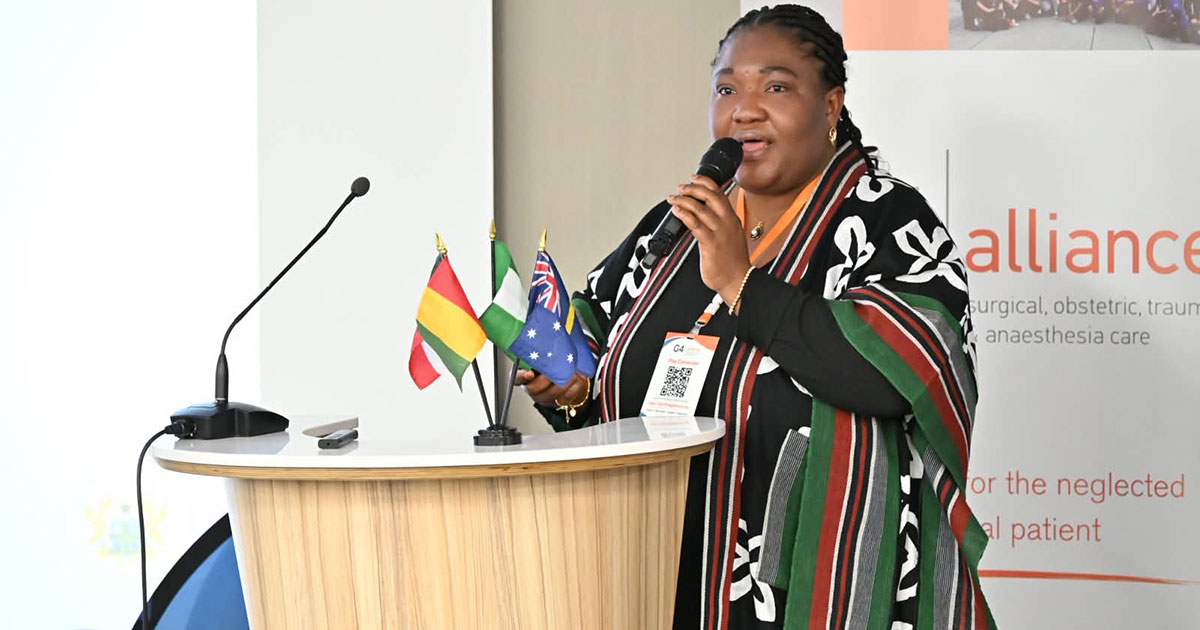
After completing her engagement with the Global Surgery Slingshot program, Dzirasa returned to Ghana with even more passion and with a carefully crafted road map for how to implement and fund what she called her Ghana Surgical Dialogue. This was an initiative designed to bring together healthcare leaders, policymakers, and frontline providers to strengthen surgical care across the country.
The dialogue was successful in gaining support from Operation Smile and Mercy Ships, bringing together representatives from all 16 regions of Ghana to help shape recommendations for the National Surgical, Obstetric and Anesthesia Plan.
“By translating high-level dialogue into localized action, the initiative has directly contributed to the rise of safe surgeries across the country,” Dzirasa said. “These are no longer just concepts on paper. They are being actively implemented at the regional and district levels, resulting in standardized safety protocols, better-equipped facilities, and improved access to safe obstetric, trauma, and anesthesia care.”
Dr. Errol Norwitz, executive director of the KMH Center for Health Innovation and Entrepreneurship, points to Dzirasa as an example of what can be accomplished when talented frontline healthcare entrepreneurs who understand the local context within their home countries are identified and supported.
“This is exactly the kind of impact the Kletjian Foundation was hoping to have when they provided the resources to stand up this training program free of charge to all participants,” Norwitz said. “Equipping promising providers and policymakers on the ground with the entrepreneurial skills and mindset to effectively implement their ideas is making a meaningful difference as they work every day and often in extremely challenging conditions to improve the health of individuals and populations in Low- and Middle-Income Countries (LMICs).”
Latest Stories
Posted in Entrepreneurial Leadership

Posted in Community, Entrepreneurial Leadership

Posted in Entrepreneurial Leadership, Outcomes