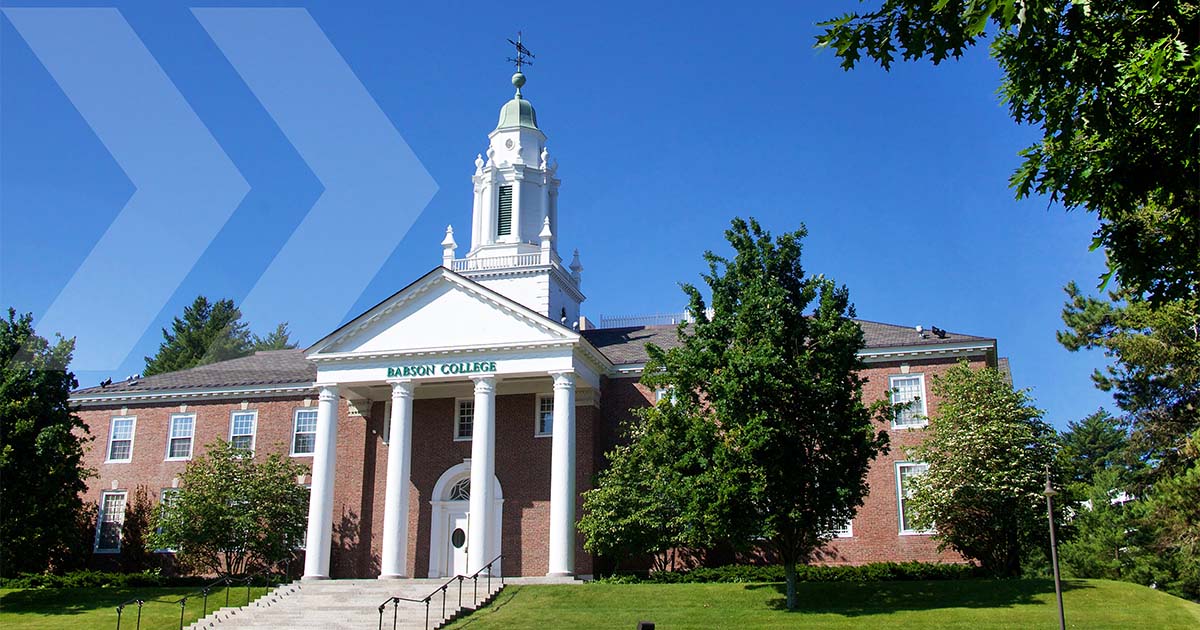
Big Ideas Take Center Stage at Babson’s B.E.T.A. Challenge
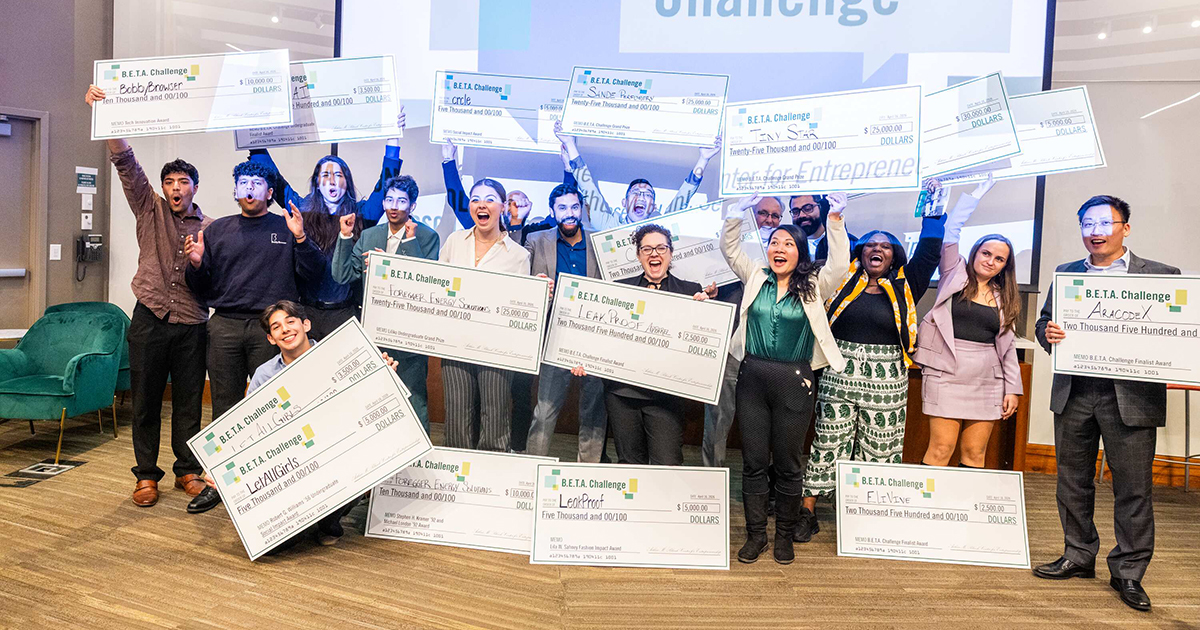
Contenders from across the globe pitched deeply diverse, sophisticated ventures at this year’s Babson College B.E.T.A. (Babson Entrepreneurial Thought & Action®) Challenge, with the winning businesses ranging from fine perfumes to child-authored books.
The nine competing ventures varied both geographically and topically, with one company offering a wearable device that tracks fluctuating hormone levels and another offering an AI-powered platform that improves how cancer drugs are delivered.
“All of the competitors did fantastic jobs. Everybody had such strong differences,” Lassiter Foregger ’27 said. Foregger won the undergraduate track with her clean-energy company, Foregger Energy Solutions. She received $25,000 and the Stephen H. Kramer ’92 and Michael London ’92 Award, an additional $10,000 earmarked for the undergraduate winner.
“This whole competition has been a really humbling experience,” she said. “It’s exciting to see how many people are doing so many really, really great things.”
Jihan Ramdhani MSEL’24, whose Indonesian-based perfumery, SANDE Perfumery, won the alumni track, had taken a 31-hour flight from Indonesia just to compete in the College’s signature business competition.
“It’s all worth it, because it’s such a great opportunity,” said Ramdhani. “Words can’t describe what I’m feeling right now.”
“All of the competitors did fantastic jobs. Everybody had such strong differences.”
Lassiter Foregger ’27 of Foregger Energy Solutions, which won the undergraduate track
Joy Meng MBA’28 credited her graduate track win to the strong support and sense of community at Babson. Meng pitched Tiny Star, a business that promotes literacy education by encouraging children ages 6 to 10 to write their own books. The books are then published and available for purchase on Amazon and other locations.
“I really want to say thank you to Babson. This is a great place to belong to,” Meng said. “Babson has given me so much. It’s like a second life.”
Alexandra Dunk MBA’22, associate director of entrepreneur programs and engagement at the Arthur M. Blank Center for Entrepreneurship, who hosts the challenge, also thanked the Babson community for their support.
“The B.E.T.A. Challenge is really strengthened by our Babson faculty. They’re involved at every stage of the competition—from sponsoring student teams and helping them refine their applications to serving as judges across multiple rounds,” she said. “Faculty members are also an incredible sounding board as we keep iterating and enhancing the competition experience for our student and alumni entrepreneurs.”
The Big Night(s)
The B.E.T.A. Challenge, now in its 15th year, received a record-breaking number of applications, Dunk said. For the second year in a row, 18 ventures faced off in the semifinals the night before the big finale, offering a back-to-back showdown for contenders.
After the semifinals, nine ventures went on to compete in the Winn Auditorium at Olin Hall for more than $160,000 in cash plus in-kind prizes. The event was supported by generous donors and sponsored by Liliko, a store offering trendy Asian treats and foods that is scheduled to open in Wellesley this summer. Other sponsors included, the C. Dean Metropoulos Institute for Technology and Entrepreneurship, the Kerry Murphy Healey Center for Health Innovation and Entrepreneurship, and the Institute for Social Innovation.
Liliko, which is owned by Babson parents Ying Chen P’29 and Larry Liu P’29, sponsored the $25,000 undergraduate award, marking the first time a company has fully sponsored a B.E.T.A. Challenge grand prize.
In addition to the $25,000 grand-prize awards, the finalists in the undergraduate track were awarded $3,500 each. The finalists in the alumni and graduate tracks were awarded $2,500 each.
Other elements were included in the finale this year. While judges deliberated on the winners, several guests engaged with the audience, including 2025 B.E.T.A. Challenge alumni track winners Anthony Gatti MBA’24 and Nathan Ruff-Williams MBA’23. The creators of dog supplement startup PetPax Co., spoke about what they have done since winning the challenge last year.
Allison Byers, a graduate track judge, also spoke about her book, Fundraisingfor the Rest of Us, offering insights and answering audience questions about how founders can secure funds for their venture and connect with the right backers.
Alumni Winner: SANDE Perfumery
Ramdhani told judges that he has watched the world’s leading perfume makers harvest the finest aromatic raw materials from his home country of Indonesia, only to sell the perfumes created with those materials at astronomical prices.
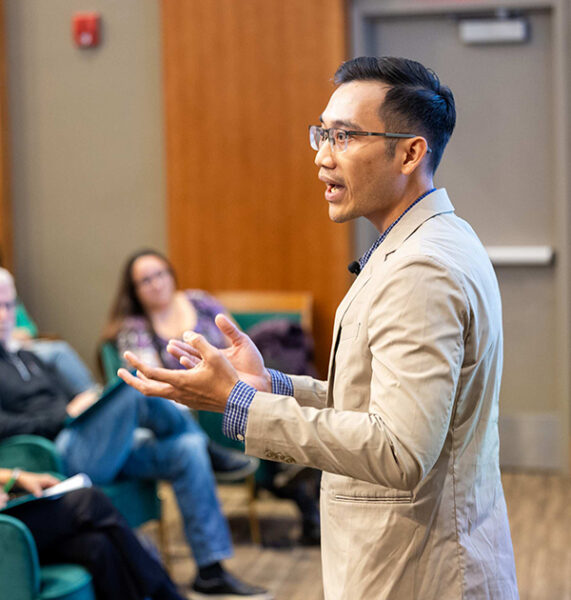
“If Indonesia has the ingredients,” Ramdhani said, “Why doesn’t it own the fragrances?”
His company, SANDE Perfumery, works directly with local farmers to make the most of the materials that Indonesia has to offer. Creating his own perfumes in house, Ramdhani owns more than 700 perfume formulas and has six signature scents currently for sale at $21 a bottle.
And while he is limited to selling in Indonesia, Ramdhani said he has seen strong demand in the few months since he has opened.
“More and more people are willing to pay more money for original fragrances,” he said. “We believe Indonesia has everything it needs to become a leader in fine perfumery.”
The other alumni finalists were Rohit Nayak MBA’23 and Moneer Azzam who pitched Ceerum, an AI-driven platform that helps municipalities with planning if they want to incorporate more clean energy use; and Emily Brady-Santos MBA’14 and Leakproof Apparel, which designs more absorbent clothing for women who are breastfeeding. In addition to receiving $2,500 for being a finalist, Santos also won $5,000 for the Lila W. Sahney Fashion Impact Award.
The alumni track judges included Babson College Entrepreneur in Residence and Adjunct Faculty Priya Iyer; Founder and CEO of Startup Boston Stephanie Roulic; and Founder of Hands on Angel Steve Walsh.
Graduate Winner: Tiny Star
An enthusiastic presentation was key for Meng and Tiny Star, a company focused on solving a common issue for parents of children from ages 6 to 10—too much time watching television and scrolling online.
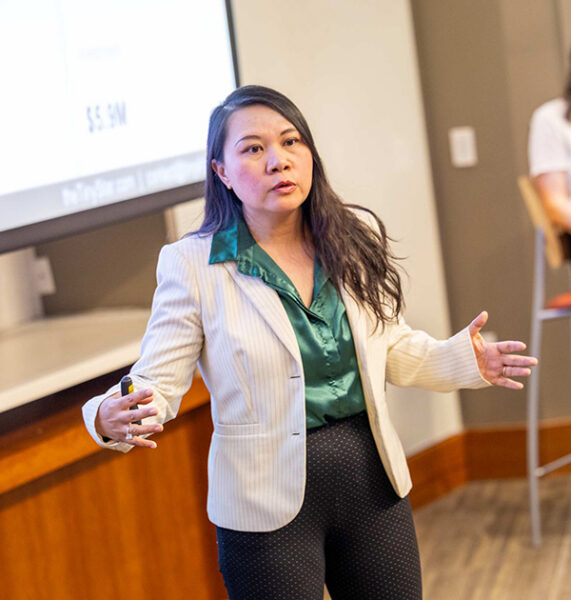
“What if children made another life where they’re creating a new product themselves with the power of their imagination?” Meng said. “My daughter published her first book at age 4, and we want to bring this experience to all families.”
Tiny Star serves as an after-school program where students can not only write their own stories, but those stories are published. The published books have an ISBN number and physical copies are available for sale and in local libraries, Meng said.
“By transforming their creativity into a real book, it creates an identity and lifelong confidence,” she said.
The other graduate finalists were Inge Cheng MBA’28 and AracodeX, an AI-driven platform that improves how cancer drugs are delivered and activated in the body; and Martina Marrali MBA’26 and EliVive, a wearable platform that uses sweat to help women measure their hormonal levels. Marrali and EliVive also won $5,000 for the Innovation Most Likely to Disrupt Healthcare Award.
The graduate track judges were Allison Byers, founder and CEO of Scroobious; Paul Cheek, senior advisor for entrepreneurship & AI at MIT and senior lecturer at MIT Sloan School of Management; and Isabelle Plante MBA’02, head of strategic growth at Bright Horizons.
Undergraduate Winner: Foregger Energy Solutions
The competition is always fierce among B.E.T.A. Challenge finalists, but the strong contenders in this year’s undergraduate track made judges take note.
“This is amazing,” said Gerri Randlett, assistant vice president of alumni engagement and annual giving, who was an undergraduate track judge. “Think about the fact that you are undergraduate students. I just want to remind everybody in this room. It is just incredible.”
Foregger, who had competed in the Rice Business Plan Competition in Houston only days before, detailed her clean-energy kit manufactured by Foregger Energy Solutions, which mitigates diesel consumption in refrigerated trucking trailers.
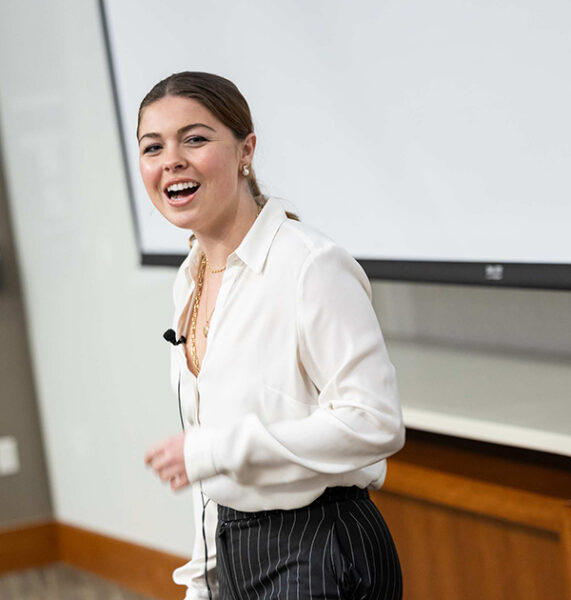
“We use AI to retrofit big rigs with energy-efficient kits that will save them money on diesel gas and save the environment,” Foregger said. The kit is installed on the rear axle of the trailer bed and it captures energy generated during braking, converting it into usable electric power. The power is stored in a battery which is used to power the refrigeration system.
“This is a massive industry, and these trucks are facing high diesel prices,” Foregger said.
Other undergraduate track finalists were Srikar Srinvasan ’27 and Taihei Rokumoto Eastwood ’28, who pitched Arcangel AI, a platform that automates patents, trademarks, and copyrights enabling companies to secure an IP faster and for less money; and Mateo Acosta-Rubio ’27 and LetAllGirls, an educational technology for underdeveloped regions without internet access. Classrooms would use an intranet device that provides students with access to hundreds of up-to-date resources. Acosta-Rubio won $5,000 for the Robert G. Williams ’56 Undergraduate Social Impact Award.
In addition to Randlett, the undergraduate track judges were David Chang, co-founder of viaAI and a founding member of TBD Angels; and Jamie Steenbakkers’18, MBA’27, co-founder and COO of Busy Beauty.
Special Awards
In addition to the special awards won by Foregger Energy Solutions, Leakproof Apparel, EliVive, and LetAllGirls, three other sponsored awards were presented at the finale.
- Bukonla Adeniyi MBA’26, Camilo Ernesto Martinez MBA’26 and Ori-Lane, graduate track semifinalists, won $30,000 for the Lila W. Sahney Endowed Fashion & Textile Innovation Award.
- Chad Patterson MBA’21 and crcle, an alumni track semifinalist, won $5,000 for the Social Impact Award.
- Krish Bhatia ’26, Aryan Patil and BobbyBrowser, undergraduate track semifinalists, won $10,000 for the Tech Innovation Award.
What’s Ahead in 2027
Planning has already begun for next year’s B.E.T.A. Challenge.
“Over the years, we’ve evolved the competition from a stand-alone event to a two-day experience for our Babson founders,” Dunk said. In addition to the semifinals and finale, founders also attend a private networking luncheon with investors and a reception. That will continue in 2027.
“It is all designed to help the founders build their networks and receive more feedback,” Dunk said.
Latest Stories
Posted in Community, Entrepreneurial Leadership