How the Real Estate Industry Is Embracing Artificial Intelligence
Like nearly every industry, real estate is wrestling with artificial intelligence. Real estate, though, is not like most industries.
Beyond being one of the most tangible investment assets, real estate comes down to real people making real deals.
“Real estate is fundamentally a relationship business, where local market knowledge and relationships shape opportunities and outcomes,” said Erin Degnan Escobedo, Babson College associate professor of practice and the George E. Slye ’53 Term Chair in Real Estate Management.
So, while leaders in the real estate industry are figuring out how to apply artificial intelligence to the realities of real estate, they note its unique challenges.
“Real estate is very much a tangible, very bespoke investment class. There’s very much a human element to it, and there always will be,” said Jon Martin, chief executive officer AEW Capital Management, noting that AI tools can create efficiencies and save time. “But, in the end, it’s going to come down to individual decisions and relationships that win you deals that are going to help you build your portfolios.”
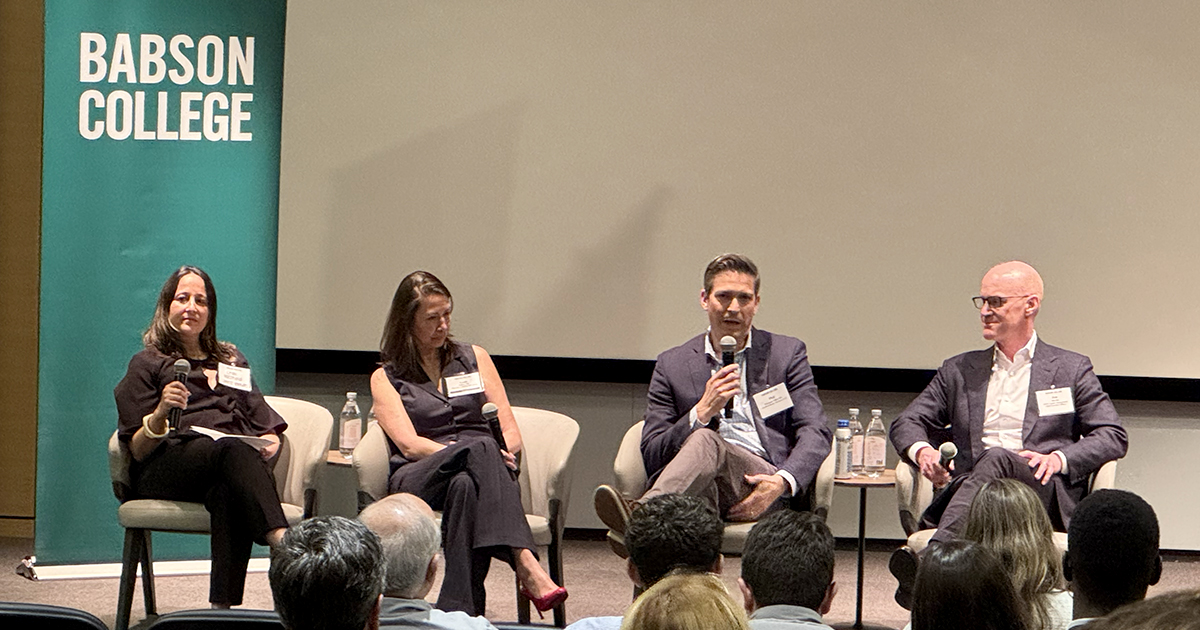
Martin joined Leah Dillon ’99, chief operating officer and head of partner engagement, Alliance Global Advisors, and Phil Dorman MBA’04, co-founder of Greatland Realty Partners, this spring for a panel discussion at Babson Boston. The event was convened by the Boston Affinity Group for its third annual State of the Commercial Real Estate Market.
Introducing the TARCO Institute
The event, which drew about 100 industry professionals from Greater Boston, began with an introduction of the new TARCO Institute for Real Estate and Entrepreneurship at Babson College. Launched last September, the institute is named after TARCO Properties, which was founded by Todd Ruderman MBA’99 in 2002.
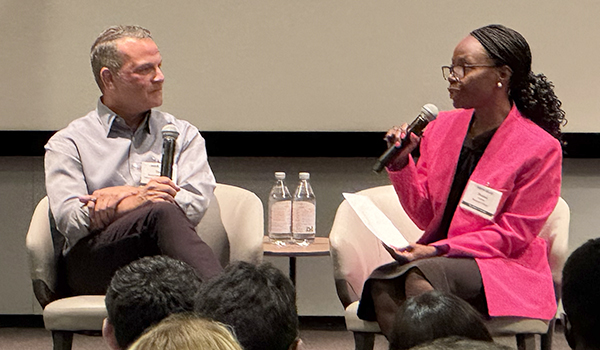
Donna Levin, CEO of the Arthur M. Blank School for Entrepreneurial Leadership, where the institute lives, opened with a conversation with Ruderman, who also is the founder and president of Value Store It Management.
“It’s long overdue to have this institute,” Ruderman said. “We have such a powerhouse of real estate alumni and companies in the Boston area. And Babson is a powerhouse in business and entrepreneurship. It’s a perfect match.”
For Escobedo, who also is the inaugural faculty director of the TARCO Institute, the event was another step toward her vision of elevating real estate entrepreneurship at Babson.
“It really is the mission of TARCO to bring together industry, alumni, students, friends of the College,” she said. “There’s so much momentum right now. It’s so exciting because it’s tangible, and real estate is an industry where we like the tangible.”
AI Uses in Real Estates
While the panel discussion touched on several issues on commercial real estate, moderator Leah Harsfield, founder of Lioness Ventures, sparked a lively conversation about AI.
“I’m the champion of it, trying to give the gift of flame to people that don’t have it,” Dorman said.
At Greatland Realty Partners, Dorman said they are using AI to help revamp their accounting and monthly reporting systems. He estimates they’re burning 1,000 people hours a month just preparing data and creating reports for their eight investments and five limited partners, each with their own structures. His goal is to cut that by 90%.
Likewise, at Alliance Global Advisors, Dillon said they’re working with clients to audit their systems to understand what they have and where the redundancies and gaps are.
“That is a good start, but the real impetus and why you want to solve this solution is because the majority of firms today, especially in real estate, are leaving the proprietary data on the table,” she said. “It isn’t able to be aggregated and analyzed in a way that it can (project) trends, save costs, and ultimately drive performance back to the investor.”
That’s where AI can help. But it has its limitations.
“I’ve spent a lot of hours in it, and I don’t think Claude has come up with one original idea,” Dorman said. “Innovation and the creation of new processes, new ideas, new products, that’s where it’s really going to help not by creating it, but by helping the people that have those ideas bring them to life faster, which is why I don’t think it’s necessarily a job destroyer.”
Dillon agreed. “There’s always going to need to be a human,” she said. “I don’t think it takes jobs away. Yes, it makes some jobs efficient, but I still think you need this human in the loop to push everything forward.”
TARCO’s Impact on Ventures
The AI conversation was particularly relevant to Escobedo and the TARCO Institute.
“AI is a constant theme in the classroom,” Escobedo said. As her experiential learning courses explore AI with guest lecturers, she said they focus on how the advantage will go to those who use AI to deepen trust in their roles and relationships
“AI is a constant theme in the classroom. … In this industry, the advantage will go to those who use AI to deepen trust in their professional roles and relationships with their constituents.”
Erin Degnan Escobedo, inaugural faculty director of the TARCO Institute for Real Estate and Entrepreneurship at Babson
“AI tools are evolving rapidly and are incredibly powerful,” Escobedo said. “In this industry, the advantage will go to those who use AI to deepen trust in their professional roles and relationships with their constituents. The real question professionals should be asking is, how can I use these AI tools to add value and strengthen relationships as a developer working with capital partners, a property manager serving clients, etc.?”
It’s on issues and opportunities such as AI, she said, where the TARCO Institute can lead and play a major role.
“I would love to see that. One of the specific programmatic missions of the institute is to support incubators and accelerators for real estate ventures,” Escobedo said. “It’s absolutely a space where we can innovate, where we can create value, and where we can help students to get to that next stage with their ventures.”
Posted in Insights
Latest Stories
Posted in Insights

Posted in Entrepreneurial Leadership, Insights