High School Startups: A Summer Entrepreneurial Journey at Babson
The cows were purple, and they carried a message.
In Ruth Gilleran’s summer entrepreneurship course, those purple cows were a constant presence. Gilleran gave each student team in the class one of the small squishy toys, which were a nod to marketer and author Seth Godin. To stand out in a crowded marketplace, Godin said, companies must offer something truly different. In a world full of brown cows, figuratively speaking, they must be cows of a distinct color.
“Whatever you do, make it special,” says Gilleran, professor of practice of information management at Babson College. “Make it remarkable.”
Each student team also received a plant from Trader Joe’s that came in a cute pot sporting a face and glasses. That bespectacled planter also carried an underlying message for students, namely that, to be entrepreneurs, they must always be observing, looking for opportunities.
Armed with their cows and plants, students took part in Startup Sprint: Two Weeks to Launch, a two-week course that served as a soup-to-nuts look at the entrepreneurial process. From observation and ideation, to prototyping and branding, to marketing and selling, the course guided students as they launched businesses they had dreamed up only days before.
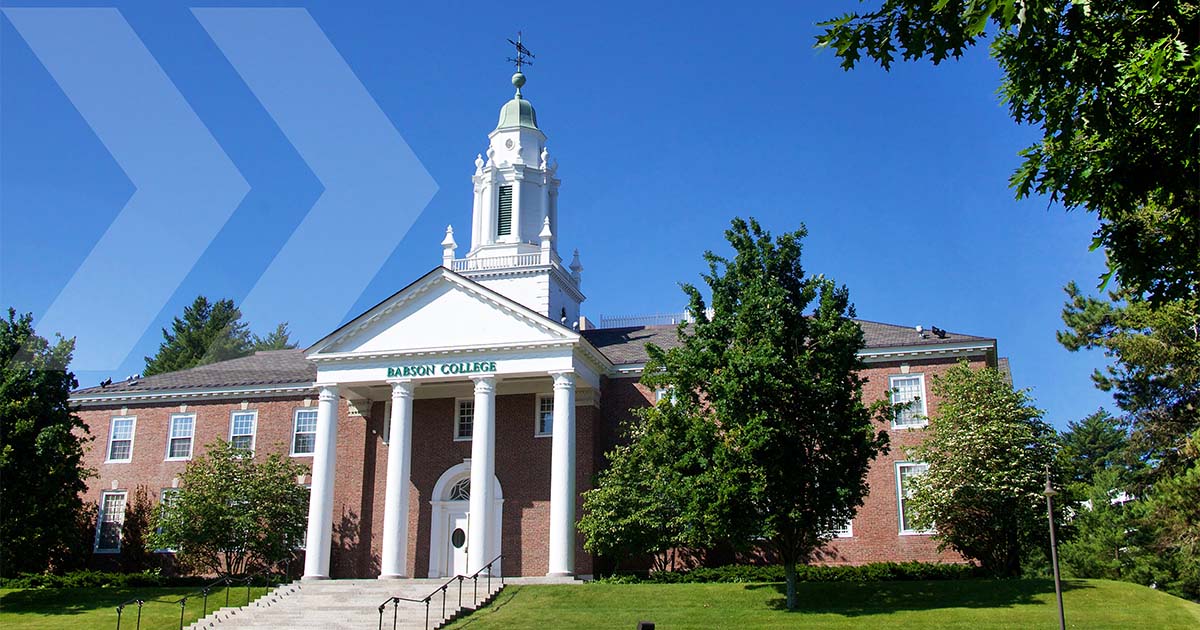
A part of the pre-college summer program offered by Babson’s Arthur M. Blank School for Entrepreneurial Leadership, the Startup Sprint gave high school students a taste of what being in the Foundations of Management and Entrepreneurship, or FME as it’s commonly known, is like. In FME, a signature undergraduate Babson course, College students build, launch, and market their own businesses over the course of a school year.
Gilleran’s summer students weren’t yet in college, but she was proud of how much they learned and grew during the course’s two weeks. “I watched these 17-year-olds who don’t know anything about business come so far along so quickly,” she says.
New to Business
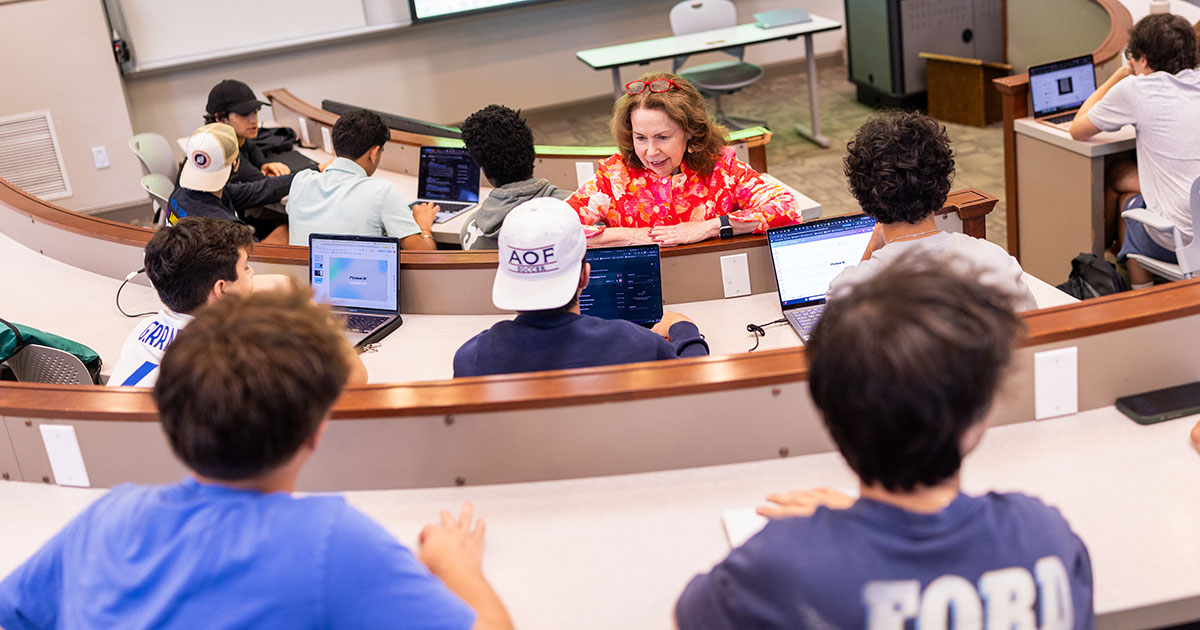
Gilleran has been at Babson for 26 years and is accustomed to teaching college students. Those in high school bring a different energy. They’re a spirited group as they enter a classroom. “It took them awhile to settle down,” she says. “They were excited.”
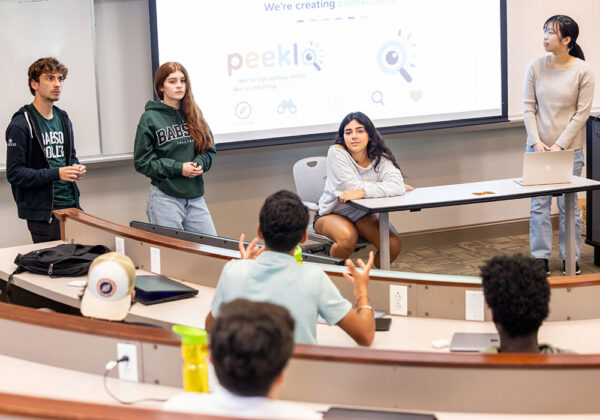
They also don’t have as much business knowledge. Typical high school students, after all, aren’t focused on the nuances of marketing, accounting, and the like. “All the concepts were new to them,” she says. “The vocabulary was new.”
Despite that, Gilleran says the 20 students in the class, broken into six teams, approached the material without stress or hesitation. The first week began with them observing problems in everyday life, using sticky notes to track their business ideas, and they went to the Weissman Foundry to practice prototyping.
By the end of the first week, the students had websites and products to sell. The second week was spent spreading the word of their products via email and social media, preparing pro forma income statements, and prepping for a final presentation about their business.
Of course, the short time frame of the class necessitated that the student ventures pursue simple products: posters, stickers, T-shirts, and sweatshirts. A print-on-demand service was used to fulfill orders, and in the end, the six teams realized about $200 in profit, which will be donated to Boston Children’s Hospital.
The Assistance of AI
A constant companion on the students’ two-week entrepreneurial journey was artificial intelligence. “On day one, I told them they are going to be using AI every class,” Gilleran says.
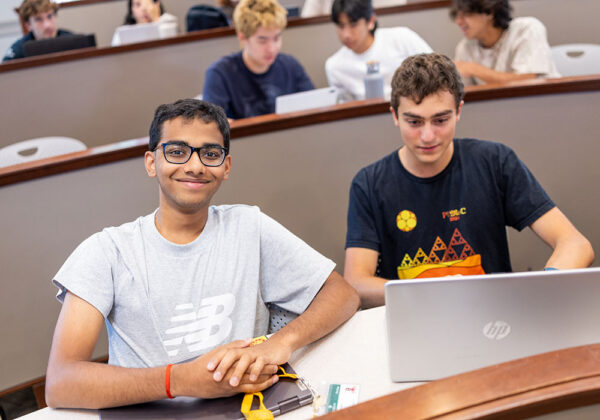
Students used AI to assist with all kinds of tasks, including writing scripts for TikTok videos and coming up with blue sky business ideas (basically, an exercise involving brainstorming concepts without constraint). Student teams built their websites using Lovable, an AI-powered platform that allows sites to be created simply through the use of prompts.
Watching the students in action, Gilleran thought of a prediction made by Sam Altman, CEO of OpenAI. Altman believes that AI will allow a solo entrepreneur to build a $1 billion company, and seeing how fearlessly her students dived into the technology, Gilleran understood how this could happen. AI made their tasks easier and quicker. “It was really brought to life with these 16- and 17-year-olds,” she says.
At the end of the two weeks, students gave a final presentation about their ventures. One team sold soccer-related streetwear, while others sold bumper stickers and inspirational posters. Several of the students’ parents were in attendance. “They were like, ‘Wow,’ ” Gilleran says. “They couldn’t believe how much they’ve learned in two weeks.”
Gilleran felt the same way about the students. “In that short amount of time, they learned the terminology and concepts and applied them,” she says. “I walked out so pleasantly surprised and just thrilled.”
Latest Stories
Posted in Entrepreneurial Leadership


Posted in Insights