Exploring and Developing Entrepreneurial Leadership at West Creek Ranch
The first thing Hannah Shultz was asked to do was leave everything outside the gate of the horse corral. Standing in the round pen at West Creek Ranch with a horse several times her size, Shultz quickly learned that authority, titles, and words meant very little. Under the guidance of head wrangler Hope Nuttall, Shultz used a flag to direct the horse around the pen before setting it aside and attempting to lead through body language alone.
The horse resisted. Shultz adjusted. The horse stopped. Shultz tried again. With each attempt, she became more aware of posture, presence, and intention. Eventually, the horse followed. What appeared to be a horsemanship exercise was, for Shultz of Georgia Interfaith Power & Light, a lesson in leadership.
At most leadership programs, participants spend their days in conference rooms discussing communication, resilience, and change. At West Creek Ranch in Montana’s Paradise Valley, leaders explored those same lessons while guiding horses through an arena, fly-fishing, and practicing yoga beneath expansive Western skies.
The Exploring and Developing Entrepreneurial Leadership program, a collaboration between the Arthur M. Blank School for Entrepreneurial Leadership at Babson College and the Arthur M. Blank Family Foundation, blends classroom learning with outdoor experiences to create a leadership laboratory where reflection, challenge, and connection came together in powerful and unexpected ways. Participants spend half their time learning from faculty and peers indoors and half applying those lessons outside. They discover that some of the most meaningful insights about leadership emerge not from a lecture, but from a horse’s response, a fly-fishing line cast with patience, or a quiet moment of reflection on a yoga mat.
At its core, Babson believes that entrepreneurial leadership is not simply taught. It is practiced. Seventeen leaders representing nine nonprofit and social-sector organizations recently traveled to West Creek Ranch for a four-day immersion designed to bring that belief to life.
Looking Inward
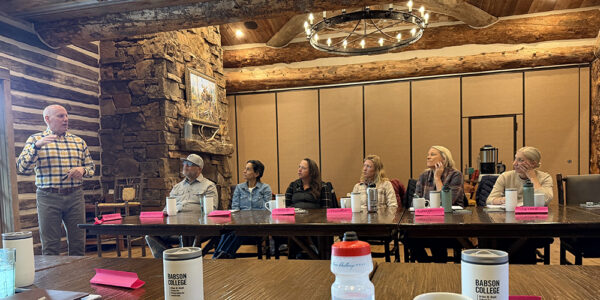
Inside the lodge, Babson management professors Wendy Murphy P’30 and Scott Taylor guided participants through conversations that were often as challenging as the activities waiting beyond its doors. Using leadership frameworks, peer reflection, and exercises focused on participants’ “best selves,” the curriculum explored resonant leadership, personal values, developmental networks, and the process of creating intentional change.
“I especially valued learning alongside nonprofit leaders from across the country, sharing ideas and challenging one another to look at our work through a different lens,” said Talli Dippold of the Hilton Family Holocaust Education Center, a project of the Arizona Jewish Historical Society.
Like Dippold, many participants left the classroom with a deeper understanding not only of how they lead, but also of the kind of leaders they aspire to become.
When Horses Become Leadership Teachers
One of the program’s most memorable experiences took place far from the classroom. During the reflective horse session, Nuttall divided participants into three groups focused on grooming, working in the round pen, and leading a horse through the arena.
Although each exercise involved working with horses, the underlying subject was leadership. In the round pen, participants first used a flag to guide a horse before setting it aside and attempting to have the animal follow without verbal commands.
“I learned a lot about patience, nonverbal communication, and the importance of confidence,” said Frederick Linton of the Atlanta Fire Rescue Foundation. “There are times when nothing needs to be said. Sometimes it is eye contact or a simple touch that creates the connection.”
“I especially valued learning alongside nonprofit leaders from across the country, sharing ideas and challenging one another to look at our work through a different lens.”
Talli Dippold of the Hilton Family Holocaust Education Center
Success depended not on force, but on presence, intention, body language, and trust. Participants quickly discovered that horses respond to confidence, consistency, and authenticity, many of the same qualities on which effective leaders rely.
The experience prompted participants to examine their behaviors and leadership styles. They reflected on how they communicate, how they build trust, and how they respond when something is not working. The horses provided immediate feedback. If an approach failed, participants had to adapt, try something different, and remain patient. Nuttall reminded the group that the day’s objective was to “think differently.”
“The round pen allowed me to put everything we were learning into practice: centering myself, connecting with the horse, motivating it to take action, and positively reinforcing the outcome,” said Taos Wynn of the Atlanta Fire Rescue Foundation. “There were so many parallels between that experience and the workplace.”
Leadership, One Cast at a Time
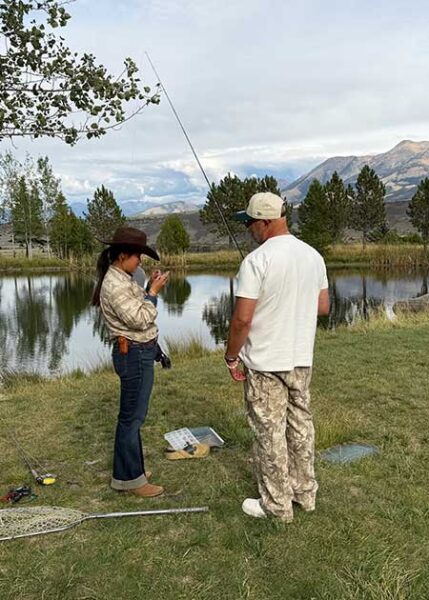
Standing beside a small pond at West Creek Ranch, new and experienced fly-fishers repeatedly cast their lines in hopes of landing a fish. For Akil Bektemba of the Southeastern Employment and Training Association and Vanguard Consulting Group LLC, the experience brought back memories of fishing with an uncle during childhood.
Like many of the outdoor activities at West Creek Ranch, however, the lesson extended far beyond fishing.
“As it applies to leadership, it’s about trying something new, leaving with something new, and being aware of what’s around you,” Bektemba reflected. “It’s about soaking up energy and information.”
Fly-fishing also required humility. Bektemba estimated that it took at least 150 casts before finally catching a fish. The fly came loose and had to be reconnected. Technique had to be adjusted, weight shifted, and patience maintained.
Through fly-fishing, participants discovered that leadership is often less about force and more about awareness, patience, and persistence. Much like guiding a team through uncertainty, success came from paying attention, adjusting course, and continuing to cast after repeated setbacks. Bektemba’s 150 casts became more than a fishing story. They became a reminder that leadership, like fly-fishing, rewards those willing to learn, adapt, and keep trying.
Carrying the Lessons Home
West Creek Ranch was never intended to be a one-time experience. To reinforce the program’s lessons, each participant will continue working with a Babson faculty coach through three follow-up sessions focused on reflection, accountability, and growth.
The lessons may have started in the classroom, but they came to life on trails, beside rivers, among peers, and in quiet moments of reflection that gave leaders space to see themselves differently. Now, supported by their coaches and one another, participants will carry those lessons home, continuing to practice, reflect, adapt, and grow long after leaving Montana.
Latest Stories
Posted in Entrepreneurial Leadership

Posted in Community

Posted in Entrepreneurial Leadership