Collaborative Global Student Challenge Creates Almost 1,000 New Business Ideas
The 2025 Babson Collaborative Global Student Challenge produced nearly 1,000 new business ideas addressing the world’s most important goals. The winners of the challenge included a solution to relieve women from chronic pelvic pain, and a solution to convert banana agricultural waste into biodegradable bioplastics for sustainable packaging.
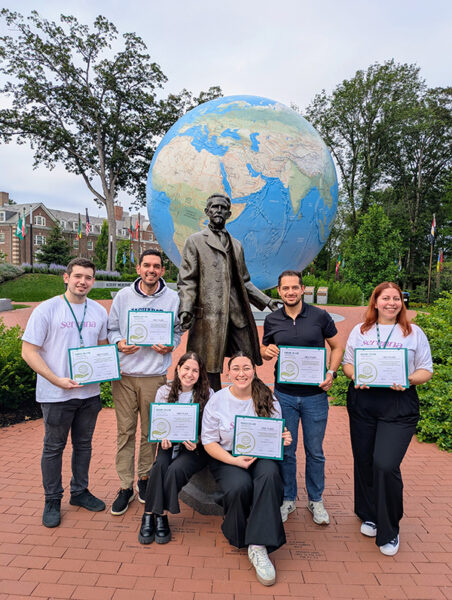
Each year, students across the Babson Collaborative member institutions are asked to create a positive change through business, creating and presenting a new venture designed to advance one or more of the 17 United Nations Sustainable Development Goals (SDGs). This year, 3,530 students from 30 Collaborative member institutions took part in the Global Student Challenge, representing 22 countries. Collectively, they presented 970 new business concepts addressing the U.N. global goals.
Both undergraduate and graduate Challenge winners were invited to Babson’s campus to attend Babson Build, a weeklong summer entrepreneurship bootcamp, where they gained skills and insights from Babson professors to help them advance their business concepts.
In addition to the Babson Build scholarship, this year’s winners received an award of $3,500, thanks to the sponsorship of Social Impact Patrons, Ramón Mendiola ’86, P’20 ’21 ’23, Business & Management from Sage, and Babson Global Center for Entrepreneurial Leadership. Patrons also sponsor cash prizes for runner-up teams between $2,000 and $2,750.
Undergraduate Winner: Serenna
The first-place winner of the Bachelor’s Challenge was Serenna, a non-invasive medical device for women with chronic pelvic pain who have lost their quality of life. The team is from the Universidad del Desarrollo in Chile. Serenna includes Karla Burgos, Francisca Morales, María Florencia Ramírez, Patricio Schuler, and Bárbara Véjares. The venture aligns with U.N. SDG No. 3 (ensure healthy lives) and No. 5 (achieve gender equality).
Undergraduate Runners-Up
2nd place (tie): Enerma (Link School of Business, Brazil). Team members: Melk Weyk Sousa Rocha, Mateus Henrique Ferraz Preis, Fabrício Borges Pereira, Diogo Martins de Moraes, Bruno Gustavo Krahn Jung, João Paulo Nogaroli Guioti
2nd place (tie): SERVIDRONE (Universidad Siglo 21, Argentina). Team members: Matías José Berti, Santiago Jose Berti, Maria Victoria Berti
3rd place (tie): Hush Husk (Bangkok University, Thailand). Team members: Wai Yan Thaw Zin, Myo Theain Kha Kyaw, Vannaxai Kommasith, Mya Yamone Wai, Supavadee Pukhongnin
3rd place (tie): OLA (EDEM Business School, Spain). Team members: Claudia Silvestre García, Irene Canals Esclapez
Graduate Winner: SENTA
The first-place winner of the Master’s Challenge was SENTA, which converts banana agricultural waste into biodegradable bioplastics for sustainable packaging solutions. The team from the Universidad Técnica Particular de Loja in Ecuador includes Diego Paolo Pazán Maldonado, Andrés Enrique Carrera Mazón, Josué David Mora Escudero.
The venture aligns with U.N. SDG No. 9 (build resilient infrastructure), No. 12 (ensure sustainable consumption and production patterns), and No. 13 (combat climate change).
Graduate Runners-up
2nd place: PackEm (ATLAS SkillTech University, India). Team members: Kashish Khimnani, Anuja Acharekar
Posted in Babson Briefs
Latest Stories
Posted in Insights


Posted in Community