Why Entrepreneurial Leadership Isn’t a Trait—and How Leaders Can Build It in Others
Volatile financial markets, widening geopolitical conflicts, and the persistent question of where generative AI belongs in the workplace make it a difficult and unpredictable time to lead, no matter the industry.
Dated leadership models can prove to be slow to adapt to rapidly changing times. That, according to groundbreaking Babson College research, is where entrepreneurial leadership can fill the void.
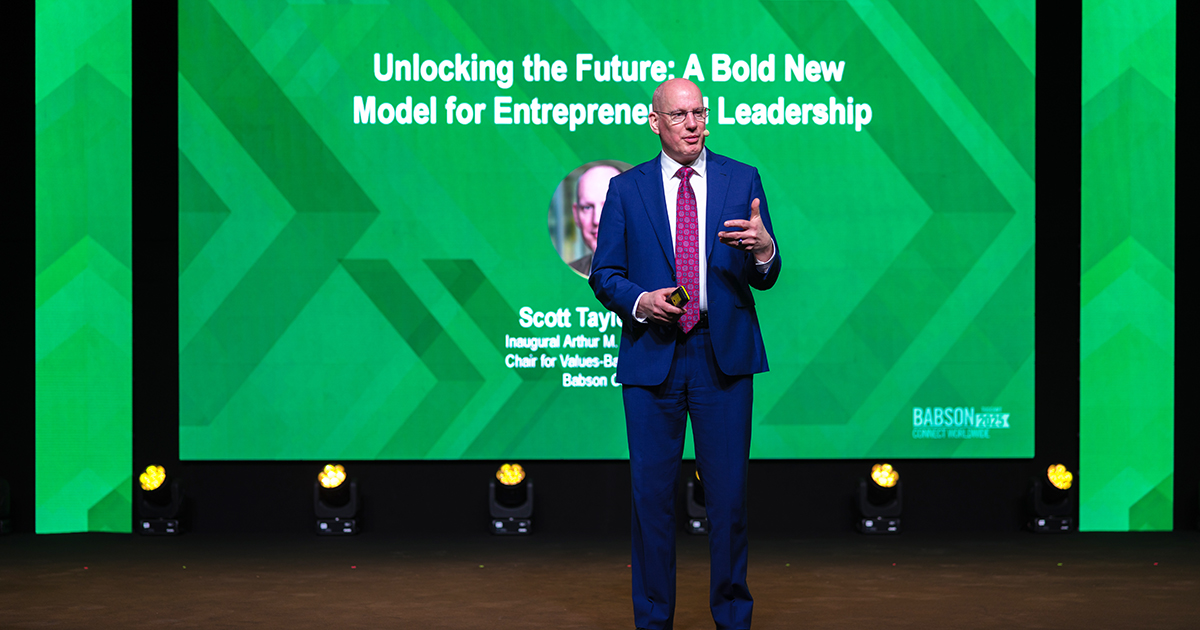
Babson Professor Scott Taylor—co-author of Babson’s entrepreneurial leadership research and the Arthur M. Blank Endowed Chair for Values-Based Leadership—now is teaching Foundations of Entrepreneurial Leadership, the introductory course of the College’s first Entrepreneurial Leadership Certificate through Babson On-Demand™.
CREATING 1,000 ENTREPRENEURIAL LEADERS: Learn how Babson is empowering new leaders through access to a new Entrepreneurial Leadership Certificate.
Babson Thought & Action sat down with Taylor to learn how leaders can empower others to succeed and impact change in an unpredictable world.
Your work and Babson’s seminal research on entrepreneurial leadership emphasize the idea of enabling others to act entrepreneurially. What can the best entrepreneurial leaders do consistently to unlock that capability in their teams?
“Entrepreneurial leaders are inherently intentional about the conditions they create for others, not just the direction they set for themselves. I’ve researched leadership for more than 20 years, and what consistently stands out is that entrepreneurial leaders focus on building relationships that make entrepreneurial action possible. That means giving people real autonomy—not abandoning structure but trusting them with meaningful ownership. It means investing in relatedness, so teams feel psychologically safe enough to challenge assumptions, share ideas, and take risks together. And it means developing competence, helping people build the skills and confidence to act even when they don’t have all the answers.
“When leaders do those things consistently, entrepreneurial behavior stops being sporadic. It becomes embedded in how teams work, learn, and move opportunities forward. That’s incredibly necessary for any leader navigating our uncertain, chaotic world.”
You have written and spoken about entrepreneurial leadership at length. What have you encountered lately that’s new?
“What’s been most interesting lately is seeing how different learners create their own personalized brand of entrepreneurial leadership instead of mirroring a single approach. Some lead through quiet influence; others through bold experimentation. But the strongest learners are very intentional about aligning the model with who they are and the context they’re in. They’re asking, ‘How do I create autonomy on my team? How do I build trust across differences? How do I help others feel capable in uncertainty? How do I more effectively demonstrate an entrepreneurial mindset in a way that encourages others to do the same, rather than just rely on mine?’ We didn’t necessarily see that even a few years ago.
“What’s new is the level of reflection and adaptability. People aren’t just learning the framework—they’re actively shaping their own version of entrepreneurial leadership based on their values, roles, and challenges. That’s encouraging, because it reinforces our core insight: Entrepreneurial leadership isn’t a personality type. It’s a set of relational practices that can look different—and still be effective—across individuals and settings.”
Entrepreneurial leadership can sound aspirational. How do you define it in a way that’s measurable or observable, so organizations can develop it intentionally rather than treating it as a vague trait?
“Babson’s research defines entrepreneurial leadership in terms of observable leader behaviors and relational outcomes, not personality or intent. In our model, it shows up in how leaders build relationships that consistently support autonomy, relatedness, and competence. It shows up in the intentional way they work to create an overall emotionally positive work environment. You can observe it in whether people have real ownership over their work, whether teams feel psychologically safe enough to share ideas, and whether leaders actively invest in others’ growth and capability.
BABSON MAGAZINE: Why Entrepreneurial Leadership Matters?
“When those conditions are present, you see more opportunity recognition, experimentation, and collaborative action. That’s what makes entrepreneurial leadership developable—it’s reflected in what leaders do and how others respond, not in lofty, abstract aspirations. It’s about real, tangible thought and action.”
Babson is launching its first‑ever Entrepreneurial Leadership Certificate through Babson On‑Demand™. For professionals and executives considering it, what should they expect to learn? And, why is a flexible, online certificate the right next step for expanding access to entrepreneurial leadership now?
“They should expect a very practical, research‑backed experience focused on how entrepreneurial leadership actually shows up in day‑to‑day work, no matter the profession. The certificate is grounded in Babson’s entrepreneurial leadership model, so learners build the mindset and relational skills needed to recognize opportunity, mobilize others, and act confidently in uncertainty. It’s not about abstract theory—it’s about applying frameworks immediately to real challenges in their organizations.
“The flexible format is pivotal, because entrepreneurial leadership is needed now, across roles, industries, and geographies. Leaders don’t always have the luxury of stepping away for a degree program. This approach allows us to expand access, meet people where they are, and help more leaders develop the capabilities to enable entrepreneurial action—at scale, and at the moment the world needs it most.”
Latest Stories
Posted in Insights

Posted in Entrepreneurial Leadership, Insights