A Doctor and Entrepreneur Reflects on His New Role at Babson
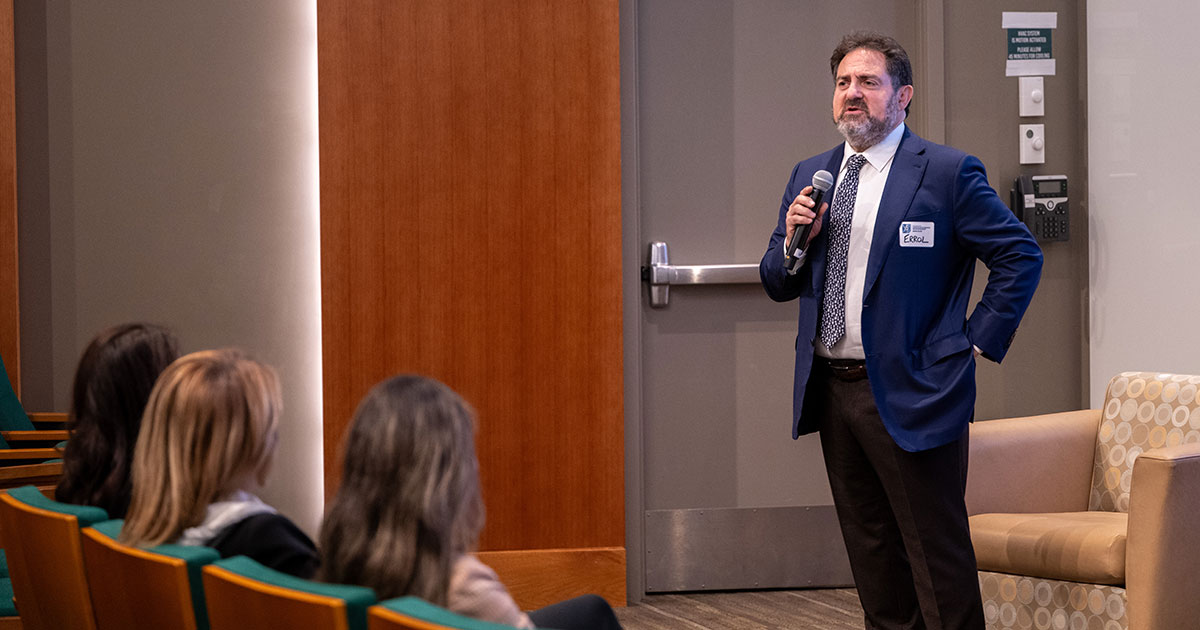
Health care needs entrepreneurship. That’s what Dr. Errol Norwitz believes.
Consider the creation of new medical technology. Clinicians may understand the health issues to be addressed, and engineers may go about producing a solution, but entrepreneurs provide a critical mindset. They’re concerned about business, about engaging with potential customers early and often.
“The businesspeople are the engine who take these ideas and bring them to the marketplace,” says Norwitz, who since September has served as executive director of Babson College’s Kerry Murphy Healey (KMH) Center for Health Innovation and Entrepreneurship.
Norwitz has had a lengthy career in health care, and his belief in the need for the entrepreneurial spirit in medicine is what brought him to Babson. “That mindset has been missing in the healthcare space,” he says. “You overlook entrepreneurship at your detriment.”
Now a few months into his tenure at the KMH Center, Norwitz reflects on his career journey, on the gut instincts, long-range planning, and entrepreneurial thinking that have guided him along the way, and on how he wants to bring entrepreneurs together with healthcare engineers and front-line providers. “I want to create a sandbox, a networking hub, for health care globally that will bring together those three elements,” he says.
Follow Your Instinct
With extensive experience as a doctor, administrator, and academic, Norwitz has held leadership positions at Yale University School of Medicine, at Tufts Medical Center and Tufts University School of Medicine, and, most recently, at Newton-Wellesley Hospital, where he served as president and CEO.
His medical specialty is in obstetrics and gynecology, and he remembers clearly the first time he assisted in a delivery. In his native South Africa, students enter medical school right after high school, so he was only 17 at the time. The moment moved him. “I thought, ‘This is what I want to do with the rest of my life,’ ” he says.
Often in life, people put more stock in decisions that are deliberated over time, as opposed to quick opinions delivered in an instant. Norwitz argues, however, that instinctual decisions, such as the one he made to pursue obstetrics and gynecology, can be just as valuable.
“Follow your instinct,” he says. “If it feels right to you, pay attention to that.”
Pivots in Life
As much as he pays attention to instinct, Norwitz also likes to plan far ahead, looking years into the future. “I am very strategic and intentional in my approach,” he says. “If you are not intentional, time passes. You wonder where it all went.”
He says that the traditional phases of a life—education, work, retirement—have broken down. People live long lives and need to be lifelong learners, picking up new skills and switching among multiple careers. In his own career, he typically likes to pivot to something new every decade or so. “I like to prove myself and go in a slightly different direction,” he says.
Perhaps not surprisingly, he’s already looking far ahead at the KMH Center, which is part of Babson’s Arthur M. Blank School for Entrepreneurial Leadership. “My intention is to be here 10 years at least,” he says. “Where do I want to take this center two years from now, five years from now, 10 years from now?”
Summer Plans
Norwitz plans to build on the KMH Center’s core focus of providing healthcare entrepreneurship research, educational opportunities for students, and entrepreneurial training for medical professionals.
This summer, as the College launches an extensive array of Summer at Babson programs, Norwitz and the KMH Center are implementing new initiatives. The course Exploring Careers in Business and Health Care is aimed at high school students who may be interested in the medical sector but have a limited idea of the wide array of nonclinical jobs available, from management to maintenance to patient support.
“The breadth of the field is so huge,” Norwitz says. “Yes, we need doctors and nurses and allied professionals. But what we really need are people who do finance in health care, marketing in health care. Behind the scenes, there is a lot that goes on.”
“Health care is in desperate need of bold solutions and disruptions. I want to be part of the solution.”
Dr. Errol Norwitz of the Kerry Murphy Healey Center for Health Innovation and Entrepreneurship
Another new program is Food as Medicine, which targets anyone who aims to live a healthier life. “It’s about helping people make small changes in their lives,” he says. Norwitz thinks of 60-year-olds with heart disease, and laments how they weren’t instructed decades earlier on alterations in diet, exercise, and lifestyle that could have prevented their ailments from happening.
Norwitz admits that this sort of program, not focused on business or entrepreneurship, is unusual for Babson. “This is a pilot. If it’s successful, we’ll scale it,” he says. “I am trying to bring new learners to Babson, to teach them what a special place this is.”
Part of the Solution
Norwitz so much believes in entrepreneurship that he is an entrepreneur himself. He is the co-founder and chief innovation and impact officer at CognitiveCare, a health care technology company harnessing the power of artificial intelligence.
Among other things, CognitiveCare addresses an issue that’s close to Norwitz’s heart: maternal health. It uses AI to assess pregnancies, so that resources can be properly allocated, with more extensive (and costly) care reserved for higher risk pregnancies. “It is a responsible way to spend limited resources,” Norwitz says.
Norwitz knows that making wholesale changes to maternal care won’t be easy in a healthcare system that is big, unwieldy, and dysfunctional. Entrepreneurship, though, gives him the means to try.
“Health care is in desperate need of bold solutions and disruptions,” Norwitz says. “I want to be part of the solution.”
That entrepreneurial attitude fits in perfectly with the culture and people of where Norwitz now works. He has taught at institutions around the world, and he finds the students at Babson to be different. “They want to make an impact,” he says. “They want to make a difference in the world.”
Latest Stories

Posted in Insights
Posted in Community, Entrepreneurial Leadership
Posted in Entrepreneurial Leadership