The Women Who Shaped Babson’s Frank & Eileen™ Center for Women’s Entrepreneurial Leadership
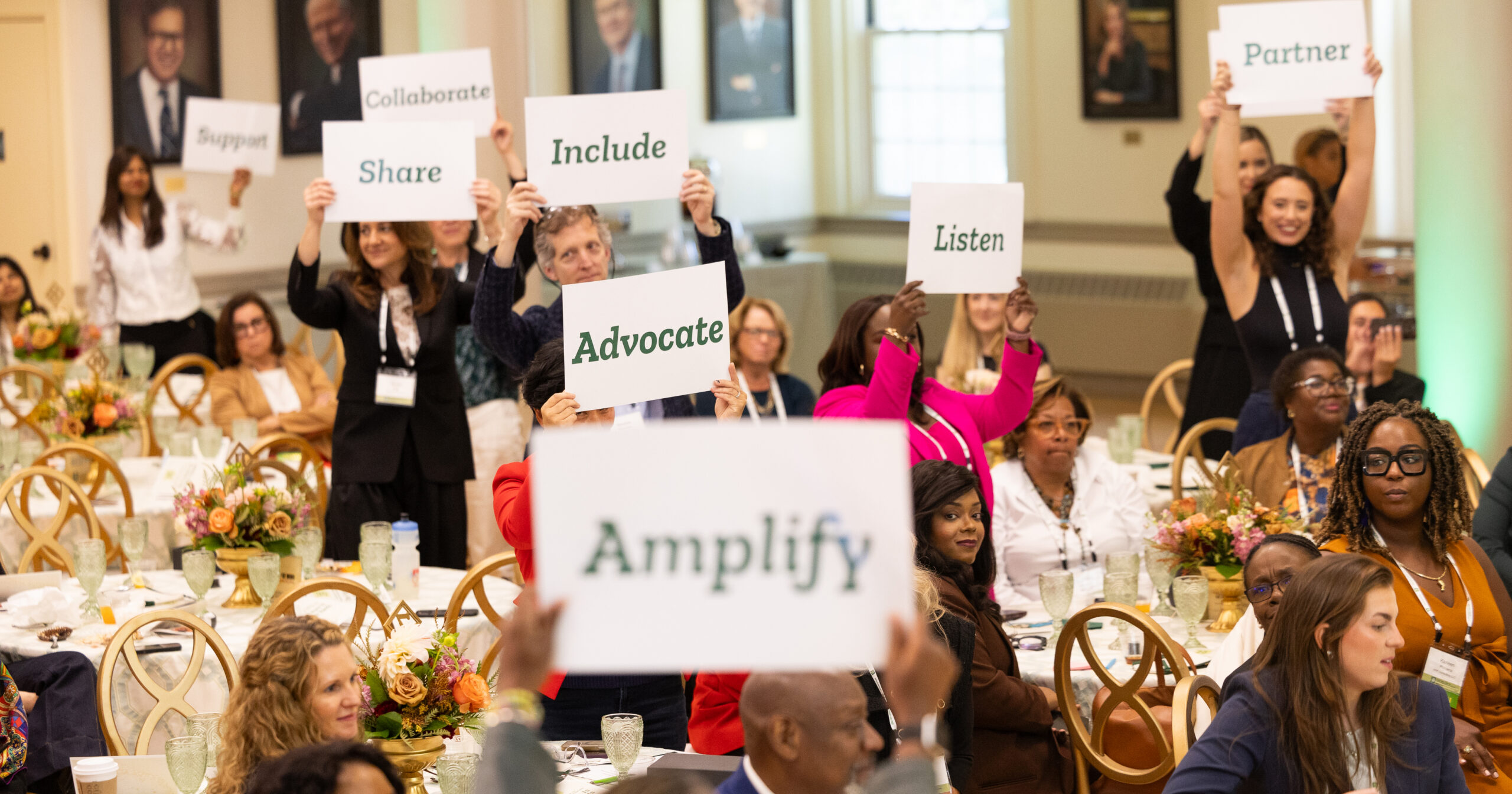
The theme for this year’s Women’s History Month—Leading the Change: Women Shaping a Sustainable Future—could not be more appropriate in describing the history of Babson College’s Frank & Eileen™ Center for Women’s Entrepreneurial Leadership (F&E CWEL) and its executive directors, past and present.
The five women who have helmed the center over its first 25 years each found ways to plant seeds for the other, pushing the center forward with each passing year and shaping its future.
These visionary executive directors took up the charge and found a way to carve out that space in society, making a lasting impact that continues today. With the center part of the Arthur M. Blank School for Entrepreneurial Leadership, the future looks bright.
Here are the executive directors’ reflections on the center’s impact over the past quarter-century. Their stories are an example of how to build that sustainable future being celebrated this month and how that could be a blueprint for others.
The Difference Maker
Nan Langowitz, founding executive director (2000–2007)
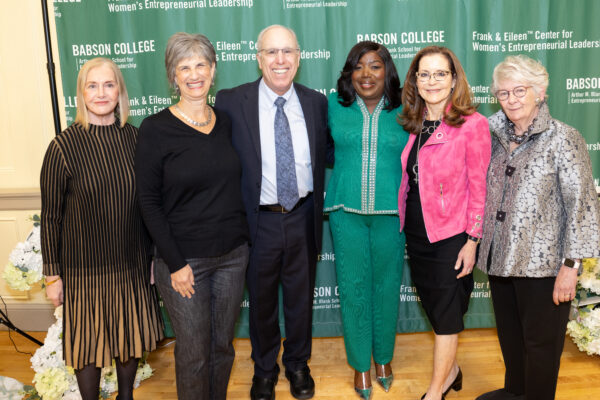
In 2000, Nan Langowitz took the first step in creating the nation’s first center for women in business and entrepreneurship at a four-year business school. As the founding executive director, Langowitz launched the first Global Entrepreneurship Monitor special report (now known as GEM Women’s Entrepreneurship Report), as well as the digital presence of the center.
But, most importantly, she was focused on increasing female enrollment in the College’s undergraduate and graduate programs. It’s also worth noting that her impact goes beyond the center, as a longtime professor of management and the inaugural faculty director for the Center for Engaged Learning and Teaching (CELT). She retired in 2024.
“Our task force had developed an exciting plan to build the first-ever center focused on women in business and as entrepreneurs at a leading school of business, so there were multiple avenues to explore,” Langowitz said.
“The highest goal in my mind,” she continued, “was to develop the center so that it would be a magnet to attract talented women to Babson, as students, faculty, and staff. Our female enrollment was a low 34% undergrad and 24% MBA. We wanted to change that through developing the Women’s Leadership Scholarship program, campus-wide programming, and partnering with admissions.”
The Energizer
Susan Danish, executive director (2001–2002)
Susan Danish worked closely with Langowitz to bring the center into reality and energized the community around the center’s mission during her tenure. To this day, this is something Danish continues to do in her career.
“Babson was the leader in seeing the value in women’s entrepreneurial leadership and dedicated time, talent and funds toward making it a focus,” Danish said. “I was energized at the prospect of being in the one-of-a-kind educational environment that is Babson. The school’s focus on entrepreneurship and leadership is unique. I couldn’t think of anything more exciting than being able to learn from the faculty, staff, students, and alums.”
Developing the ‘Tribe’
J. Janelle Shubert, executive director (2007–2011)
The center’s community, which J. Janelle Shubert lovingly called the “Tribe,” started to build. Shubert saw the power of that community and what it could accomplish as the center started to look further into the future during her tenure.
“The word tribe carries with it a back story, a cast of characters, a history, a timeline that urges us to not just look at the here and now or the future, but to also look back with gratitude and, yes, even awe, and honor what came before us,” Shubert said. “The word tribe vibrates with color and fierceness and ceremonies and celebration. Its core is belonging.”
“I wanted F&E CWEL to be a space where historically marginalized communities felt seen, supported, and celebrated. A place where inclusion wasn’t just a value—it was a practice.”
Shakenna Williams ’94, executive director
Being Entrepreneurial and Transformative
Susan Duffy, executive director (2011–2021)
According to Shubert, it was Susan Duffy who coined the term “Tribe, “and it’s clear she, too, saw the power of that community. She harnessed that power and added the focus of “Entrepreneurial” to the title of the center. Her tenure also wasmarked by the creation of Women Innovating Now Lab, known today as the WIN Lab.
“My vision for the center was to build on the foundation laid by the former directors to create a suite of high impact, transformative learning and development experiences that met women where they were from 15 to forever,” Duffy said. “We served high school students, undergraduates, graduate students, professionals, and founders as they translated their impact potential into reality.” Duffy spoke of creating the WIN Lab, a new venture accelerator by women, for women. “The WIN Lab redefined entrepreneurship to include a broad spectrum of ventures—social enterprises, service-based businesses, and mission-driven for-profits,” she said “It prioritized strong business fundamentals as the foundation for long-term success and, most importantly, cultivated a community that built entrepreneurial self-efficacy—that gut-level confidence that says, ‘I can do this.’ ”
The Future Is in Her Hands
Shakenna Williams ’94, executive director (2021–present)
It’s safe to say that the center’s current executive director took on the role during one of the most uncertain times in history. In the aftermath of the pandemic and societal strife, Shakenna Williams ’94 kept her eyes on the present and the future, knowing how actions today can ripple later on. Bringing on Frank & Eileen as a main donor for the center is yet another example of how F&E CWEL continues to evolve as it looks to a sustainable future.
“I wanted F&E CWEL to be a space where historically marginalized communities felt seen, supported, and celebrated. A place where inclusion wasn’t just a value—it was a practice,” Williams said.
She saw women’s entrepreneurial leadership as meaning more than launching ventures. It means cultivating mental equity, building intergenerational networks, and creating ecosystems of mentorship, sponsorship, and belonging. It means leading with empathy, strategy, and courage.
“I was most eager to dismantle the myth that entrepreneurial leadership looks one way, comes from one background, or follows one path,” Williams said “I wanted to ensure that F&E CWEL was not just for some, but for all.”
Posted in Community
Latest Stories
Posted in Community

Posted in Insights
Posted in Community