How Babson’s Newly Named Writing Center & AI Literacy Lab Evolved for the AI Era
The first time Lily Stambouli ’28 visited Babson College’s Writing Center, she brought a paper she was proud of and a problem she did not know how to solve.
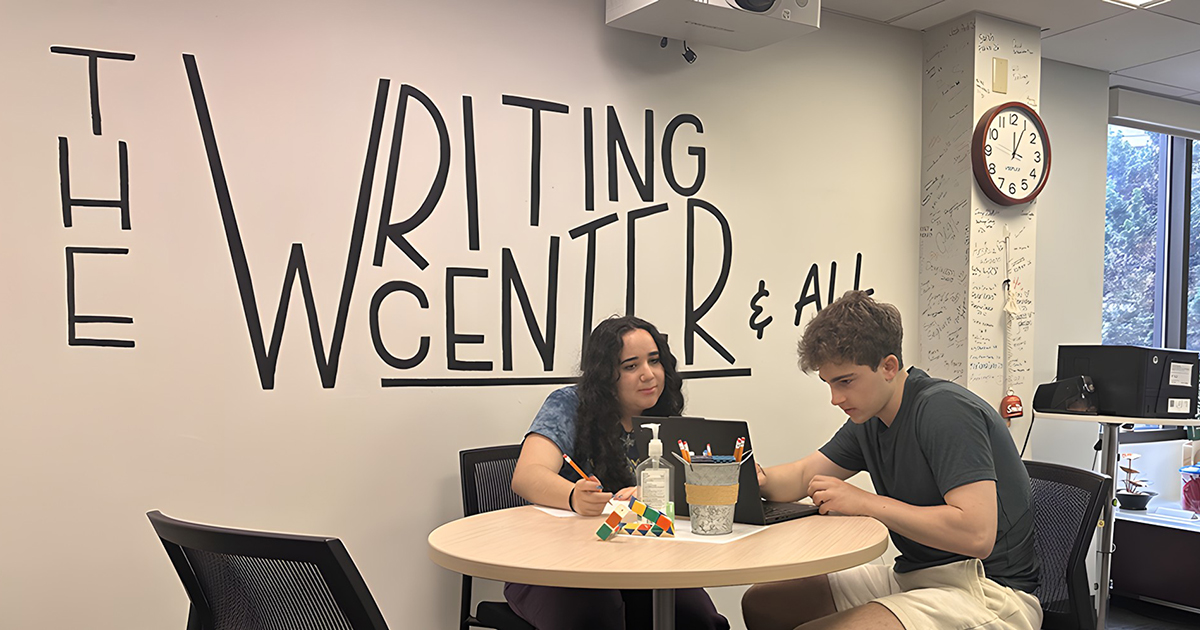
Her professor liked her writing, but the paper did not follow the assignment. A student writing consultant helped Stambouli step back from the piece, which felt personal and vulnerable, talk through the expectations, and see her work from a different perspective. The experience was so valuable that she became a writing consultant herself.
“It was the most incredible experience,” Stambouli said. “I never really knew I wanted to be a writing consultant, but I really like editing and meeting new people and helping them talk through their work.”
That kind of human exchange remains central to Babson’s writing center, but the realities around it have changed. Students can now receive instant feedback, generate ideas, summarize readings, and produce polished prose through artificial intelligence, all without making an appointment or speaking to another person.
Rather than treat AI as competition, writing center director Kristi Girdharry decided to expand the center’s mission, renaming it the Writing Center & AI Literacy Lab. The change acknowledges that students already are using AI and gives them a place to discuss how to use it without surrendering their voice or allowing the technology to replace critical thinking.
“We’re not the AI police,” said Weston Miller, an adjunct lecturer in the Arts and Humanities Division who has worked as a faculty consultant at the Writing Center for several years. “We want to meet you where you are. We’re not judging your use of AI.”
At the same time, Miller said, the center is not promoting AI as the answer to every writing problem. Its consultants can help students consider where the technology may be useful, where it may create ethical or academic concerns, and whether it is supporting or short-circuiting the learning process.
“We are not anti,” Miller said. “We are also not cheerleaders.”
Preserving the Value of Struggle
As a consultant at Babson’s writing center, Stambouli encourages students to use AI more like a study buddy or brainstorming partner than a substitute author.

“You’re not going to go to your classmate and say, ‘Write this for me,’ ” she said. “But you could be like, ‘Hey, let’s brainstorm.’ ”
Used that way, she said, AI can help students without replacing their own thinking. Miller, however, worries less about today’s college students than about what could happen if younger students grow accustomed to outsourcing that struggle.
“If this has just been integrated into middle school and high school curricula, and we’re still asking students to think critically, to go out on a limb with their analysis, and they just don’t know how to do that, they’ve never exercised that muscle,” he said. “That concerns me.”
Miller already encounters AI writing even in daily communications.
“I’ll get emails that read, ‘Most esteemed professor, I hope you are having a wonderful day,’ ” he said. “It might be doing the job, but it’s not effective. It’s not giving me a connection to you, and it makes me immediately understand I’m talking to a computer.”
In his classes, Miller permits students to use AI for idea generation but not to write their papers.
“I want to hear your voice. I want to hear what you have to say,” Miller said. “And, frankly, I want you to struggle through this process.”
Meeting Students Where They Are
For Pam Yaibuates MBA’27, AI already is an integral part of learning and working.
Yaibuates, whose concentration is business analytics and machine learning, used the Writing Center for an internship application essay and a team assignment. She also uses AI because English is not her first language. Reading a 30-page case can take her two or three times longer than it might take a native English speaker, she said.
For more substantive assignments, Yaibuates treats the technology as what she calls a “dumb intern.” She remains responsible for providing direction, evaluating the output, and revising it with her own ideas.
“I will never actually say, ‘Hey, please guide me through stuff,’ ” she said. “I will always be the one who guides it.”
Keeping the Conversation Human
As the use of AI expands, the Babson Writing Center & AI Literacy Lab’s evolving approach hopes to make AI a subject that students can discuss openly rather than something they feel compelled to conceal.
Consultants have received training built around different AI-use scenarios. The center also asks students about AI during its appointment intake process, giving them options to indicate whether they want to use it, whether their professor expects or prohibits AI, or whether they simply prefer not to use it. For Stambouli, that openness sends an important message.
“We just want to help you use AI in a way that isn’t compromising your individuality and perspective,” she said.
Posted in Community
Latest Stories
Posted in Community

Posted in Community