The Web of Humanity: How a Babson Alumnus’ Foundation Transforms Lives Around the World
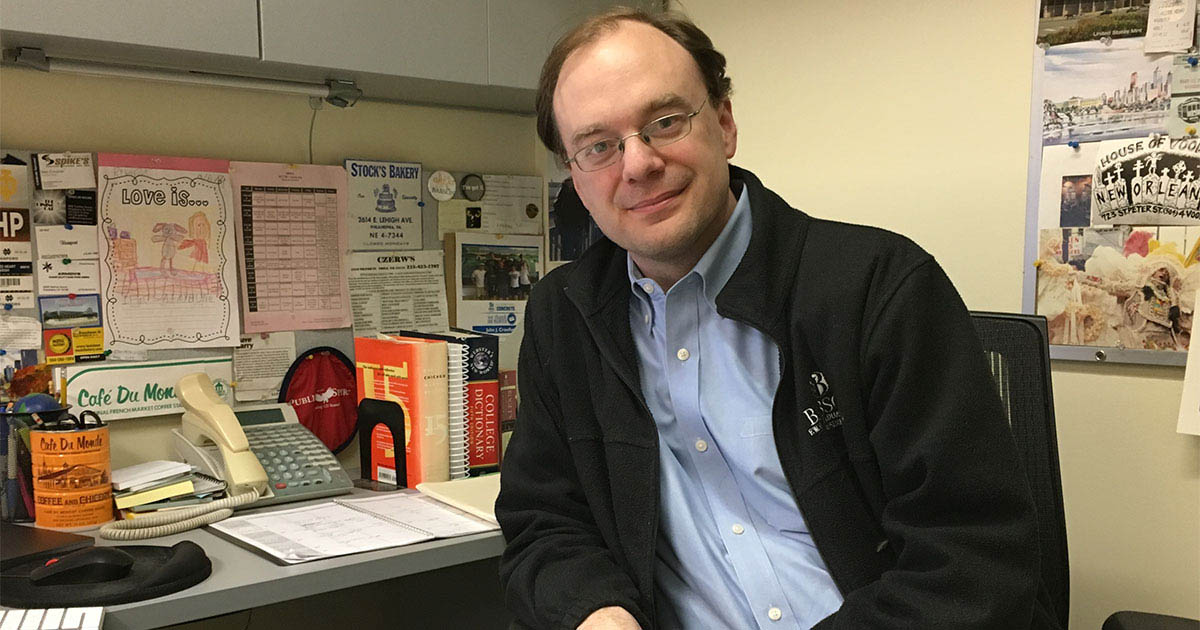
Joe Hoffman ’75 still thinks about Santiago.
Santiago, who lives in Bolivia, was born with a bilateral cleft lip and palate. In his early 30s, he wore a handkerchief every day to hide his face.
Hoffman’s nonprofit, the KNL Foundation, helped arrange a surgery for Santiago and others in Bolivia. Hoffman was there in the recovery room when a nurse handed Santiago a mirror. His face was bruised from the surgery, but it had been transformed.
“He stared, and he stared, and he stared, and then he began crying,” says Hoffman, who also began to cry. So did all the nurses and aides gathered in the room. “No one could not cry. We were all crying together with Santiago. It was such a profound moment of shared humanity,” Hoffman says. “I will never forget it as long as I live.”

Launched in 2001, the KNL Foundation seeks to provide humanitarian aid and educational opportunities for impoverished people around the world. A lawyer in San Francisco and Fountain Valley, California, specializing in civil litigation, Hoffman started the foundation using attorney’s fees after a large case settlement. “I started the foundation to try to help the poorest of the poor,” Hoffman says.
The foundation’s reach can be felt far and wide. Among many other projects, it has helped fund a hospital for women in Ethiopia, provided medical supplies for hospitals in Malawi and a clinic in China’s Tibetan region, paid for the refurbishment of an airplane so a surgeon could conduct surgeries throughout Zambia, distributed thousands of reading glasses in Mexico and countries in Africa, Central and South America, and helped fund cleft palate repair missions in Bolivia, Guatemala, Venezuela, India, and China.
In the foundation’s work, Hoffman relies on what he calls the “web of humanity.” As an entrepreneurial leader, he is bringing people together for a common good. There are “so many wonderful people all around the world,” he says, who want to make an impact.
“It is the universal web, the web of humanity,” he says. “It takes a lot of effort to do the mundane things, such as arranging visas and passports. But finding people with open hearts to help us, it is effortless.”
Story of a Remote Village
The KNL Foundation is a lean operation with just an unpaid three-person board, so it’s dependent on that web of humanity that Hoffman referenced. To illustrate how a network of people with open hearts can be employed to help someone, he tells a story of a remote village in the Southern African nation of Malawi.
Some years back, a hyena had attacked the village, leaving the faces of two children severely maimed. Hoffman was asked if his foundation could help them.
Seemingly unrelated (at least at first), Hoffman was invited to a lunch in Oakland, California, for the first lady of Zambia, which borders Malawi. At the lunch, he met the first lady’s secretary and, thinking of those children in Malawi, he asked if she could deliver a message to the first lady. She agreed.
“It takes a lot of effort to do the mundane things, such as arranging visas and passports. But finding people with open hearts to help us, it is effortless.”
Joe Hoffman ’75, KNL Foundation
To help the children, Hoffman worked with a French nun in Malawi, who went to their village and transported them by a six-hour bus ride to the Zambia border. There, the first lady arranged for the children to cross the border without passports and be taken to a hospital in Lusaka, Zambia’s capital. That’s where they were seen by a friend of Hoffman’s, a plastic surgeon from Serbia. “We paid for the expenses, and he performed the surgeries for free,” Hoffman says.
The story serves not only as an example of the web of humanity, but also of the type of people that the KNL Foundation helps. The foundation is there for people who Hoffman comes across who don’t have other options. “If they cross my path, and I feel like this is a person who needs help, I try to help,” Hoffman says. “It’s that simple.”
Appreciate Life’s Blessings
While the foundation has eased off its international work a bit in recent years, instead supporting need-based scholarships for American college students, as well as foreign students in medical school, Hoffman still finds people from the around the world who require more elaborate assistance.
One such case is that of Nam Nguyen, a young man from Vietnam. With Hoffman’s wife having fled Vietnam as a refugee at 19, the KNL Foundation has been particularly focused on that country. In Vietnam, it has established a childcare center, helped fund medical missions, bought a cow for fresh milk at an orphanage, and funded a mobile health clinic for cataract surgeries.
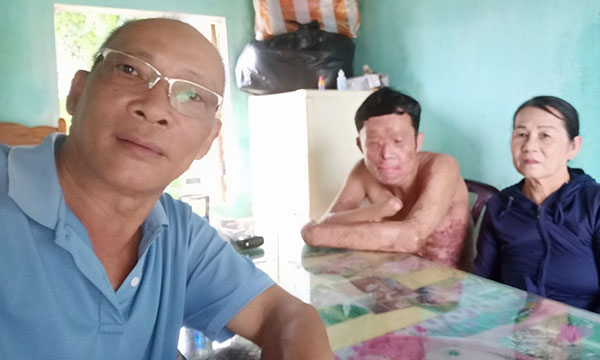
Instead of going to his job as a bus driver one day, Nguyen stayed home to help his parents clear the garden. That’s when he came upon a leftover bomb from the Vietnam War, still lethal even though the conflict ended 50 years ago. The bomb exploded. “The explosion burned him horrifically, blew off both his hands, and blinded him,” Hoffman says.
Now, the case of Nguyen has come to the foundation, and Hoffman, as he always does, is relying on the web of humanity for help. Through a friend of a friend, he has connected with an eye surgeon in California, who has agreed to perform a cornea transplant on Nguyen. “Nam is my main priority right now because, if he can be helped, he must be,” Hoffman says.
Having grown up in a Maryland home with an outhouse, picking crops and working at a canning factory as a child and later coming to Babson College on a scholarship, Hoffman has long sensed the importance of giving back to others. His foundation work has enriched his life. It also makes him appreciate what he has.
“Be mindful of your blessings,” he says. “There is no day in our lives when we awaken and should not be mindful, I can breathe. I can see. I can move. I can feel. I can think. Physical and mental health is among the greatest blessings afforded us.”
Latest Stories
Posted in Community

Posted in Insights
Posted in Community