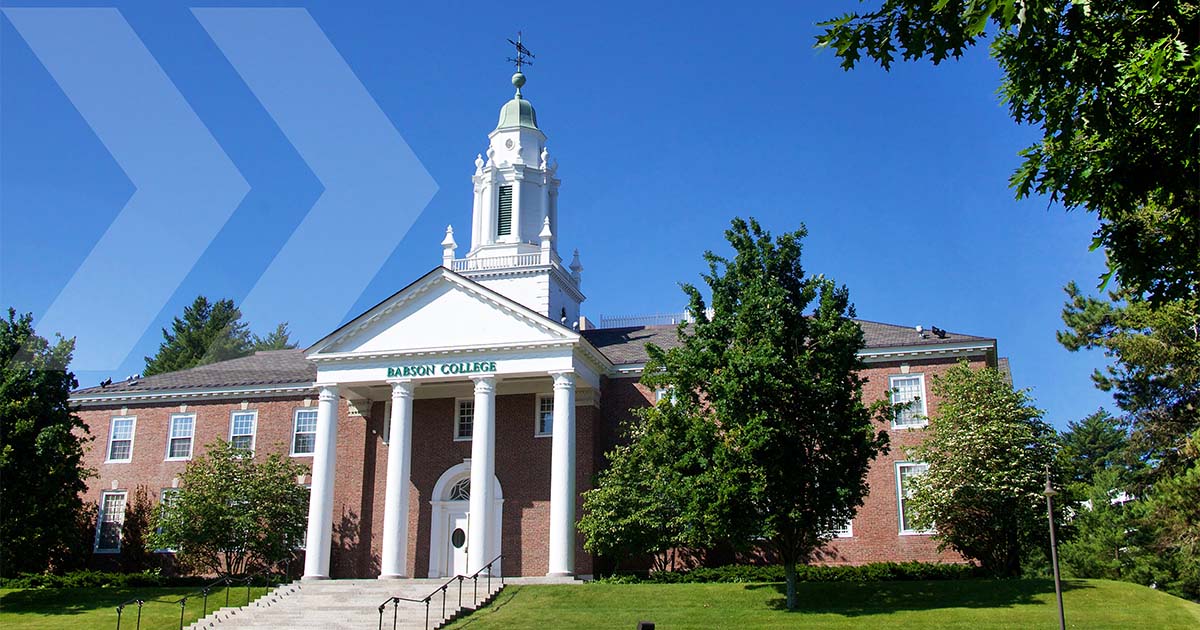
How Babson Teaches the World’s Entrepreneurship Educators

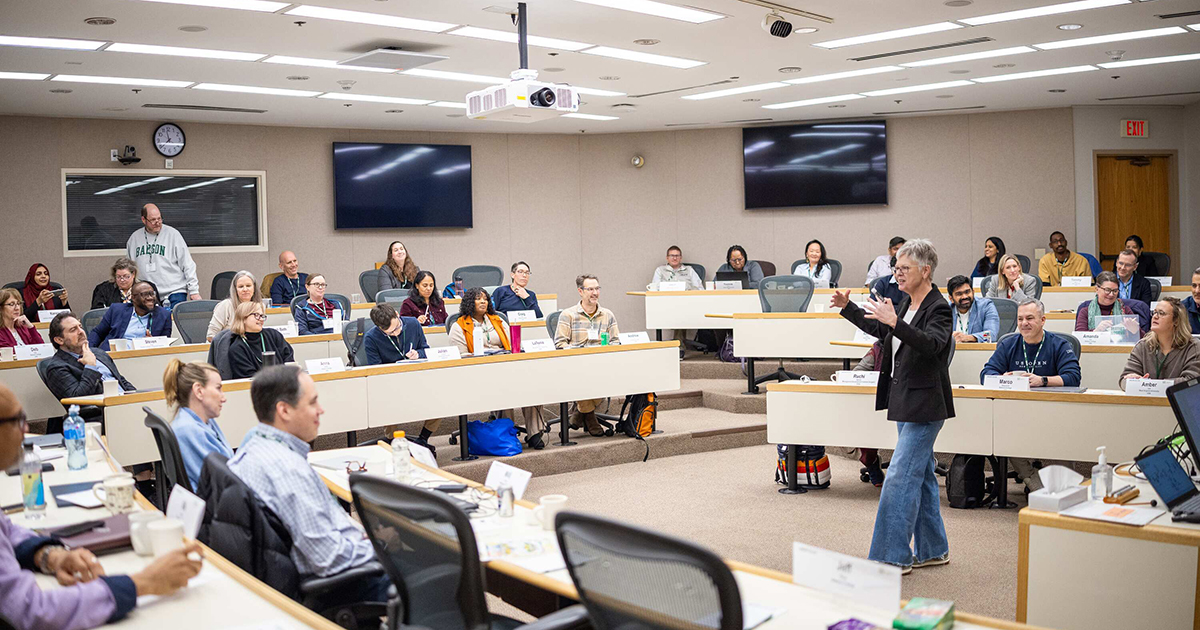
On an early Monday morning inside Babson’s Executive Conference Center, 43 participants in the Price-Babson Symposium for Entrepreneurship Educators (SEE) were holding brightly colored, hand-made construction paper boats above their heads—and the sea below them was raging.
Heidi Neck, a Babson entrepreneurship professor who has directed the symposium since 2008, paced the room as she narrated an imaginary storm. At her urging, participants became the weather—howling winds, crashing waves, shrieking gulls—while their paper boats were ripped apart piece by piece. First the hull. Then the stern. Finally, the mast. One by one, the vessels sank. But, the tattered ruins were transformed, Neck showed the class as she unfolded the wreck, the former boat had become a T-shirt. The captain’s shirt.
At the close of the exercise, Neck posed a question central to the week’s events.
“What does this have to do with entrepreneurship?”
Carefully piecing together the answer from participants, Neck underscored that the first exercise set the tone for the rest of the symposium. Like entrepreneurship, it required constant engagement, acting during uncertainty, and vulnerability. Just as importantly, it was a demonstration of how entrepreneurship can be taught, not through slides or lectures, but through carefully designed moments that force participation, discomfort, and meaning-making.
“You don’t do an exercise like this and let people sit passively,” the Jeffry A. Timmons Professor of Entrepreneurship emphasized. “That’s the message you’re sending to your students.”
That answer—and the method behind it—helps explain why Babson College remains the top destination for entrepreneurship educators.
“Babson is the standard around the world for entrepreneurial education,” said Luciana Cualheta, an entrepreneurship professor at FGV-Eaesp São Paulo School of Business Administration in Brazil and one of last week’s SEE participants. “I’ve known Heidi’s work since my PhD—I used her papers in my thesis—but I wanted to learn in practice.”
A Multiplier Effect
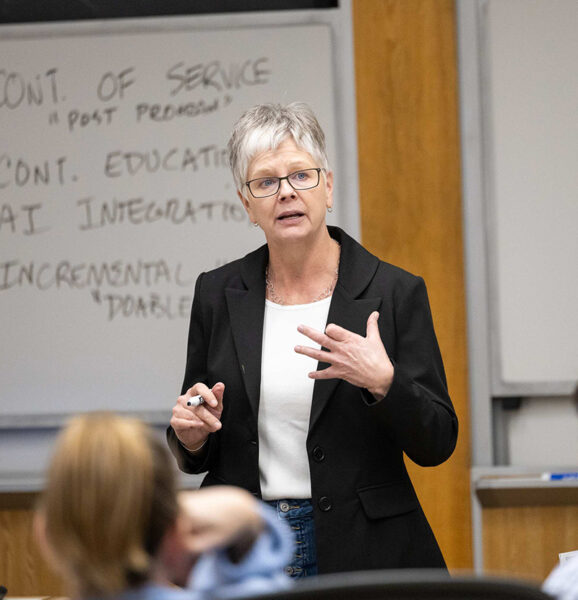
For nearly four decades, the SEE has served as a multiplier for Babson’s impact. Part of Babson Academy, where Neck serves as the academic director, the program has welcomed more than 6,000 educators from 75 countries—faculty who return home to shape entrepreneurship education in universities, business schools, and innovation ecosystems worldwide. Babson doesn’t just teach entrepreneurs; it teaches the people who teach entrepreneurship.
In her opening session, Neck emphasized a distinction that defines Babson’s approach: educators don’t come for a playbook to copy. They come to experience, firsthand, a teaching philosophy that treats entrepreneurship not as a body of content, but as a way of thinking and acting.
“This program is not about the content of entrepreneurship,” Neck told participants. “It’s about how we teach.”
That philosophy is grounded in decades of research on entrepreneurial thinking, including effectuation theory, which shows that entrepreneurs approach uncertainty differently—and that this way of thinking can be learned. Throughout the symposium, educators repeatedly shift roles, becoming students themselves as Neck pauses sessions to unpack the pedagogical choices behind each exercise.
Educating the Educators
For Cualheta, attending the symposium was both professional and personal.
“I wanted to bring more action into my classes, and I knew that’s what I would get here,” she said. Cualheta, director of FGV’s accelerator program, also wanted to reconnect with her motivation as an educator at a moment when technology, particularly AI, is rapidly reshaping teaching.
“With AI, things have changed so fast,” she said. “I needed to be around my people—to see what educators around the world are thinking and to learn from each other.”
One idea from the symposium stood out to her in particular: Neck’s challenge to stop trying to be the best and instead aim to be the only one.
“Babson got here by being unique,” Cualheta said. “Instead of looking at competitors, we should be looking at students and the market and asking how we can be the only ones offering something meaningful.”
Built to Evolve
That mindset mirrors entrepreneurship itself—and helps explain Babson’s sustained leadership. Rather than chasing trends, the College has built a distinctive culture rooted in experimentation, reflection, and continuous renewal.
“Babson is the standard around the world for entrepreneurial education.” Luciana Cualheta, entrepreneurship professor at FGV-Eaesp São Paulo School of Business Administration in Brazil
Neck said she deliberately changes roughly 20 percent of the symposium each year to ensure it evolves alongside the world that educators are preparing students to enter. “The worst thing someone can say,” she noted, “is, ‘This is what I’m already doing.’ ”
As the 54th Price-Babson Symposium gets underway, that commitment remains unchanged. By teaching educators how to help students think and act entrepreneurially under conditions of uncertainty, Babson extends its impact far beyond its campus—one classroom, and one educator, at a time.
Latest Stories


Posted in Community