Babson’s New Undergraduate Dean on Preparing Students for What’s Next
For Poonam Arora, welcoming the Class of 2030 to Babson College has been a joyous first.
The new dean of Babson College’s undergraduate school arrived on campus in February, just in time to bid farewell to the graduating class of 2026. Now, as the new academic year begins, she has greeted the first incoming class she will know from its first day on campus through Commencement.
“It’s like your first kid or your first job,” Arora said. “They are my first class.”
She is looking forward to meeting the newest members of the Babson community and building relationships as they navigate their undergraduate experience. “I am looking forward to that experience of interacting, connecting and really partnering with them,” she said.
That emphasis on partnership reflects Arora’s broader vision for undergraduate education. She sees a world in which students need more than a prescribed academic pathway and believes Babson is uniquely positioned to help them shape their own.
“We are moving into a world where education has to be co-created,” she said. “There’s such ability to customize, and that customization comes from the co-creation that Babson can allow and encourage.”
Arora spoke about her path to Babson, what drew her to the College, her vision for the undergraduate school, and how she hopes to prepare students for a rapidly changing world.
Where did you grow up, and how did that shape you?
“My father worked for the U.N. I was born in India and left when I was quite young, and I grew up moving from country to country, including experiencing civil war breaking out and seeing Food for Work sites in action, before landing in Rome where I did my undergraduate degree. My father worked for the World Food Program, which is headquartered in Rome, so I spent most of my coming-of-age years there.
“I went to John Cabot University, which, as of fall 2027, will be one of our Babson Begin locations. It’s wonderful to me that it’s sort of come full circle all these years later. After undergrad, I worked for a year for the International Fund for Agricultural Development, before moving to the U.S. for my MBA at Northwestern’s Kellogg School of Management.”
What prompted your transition into academia?
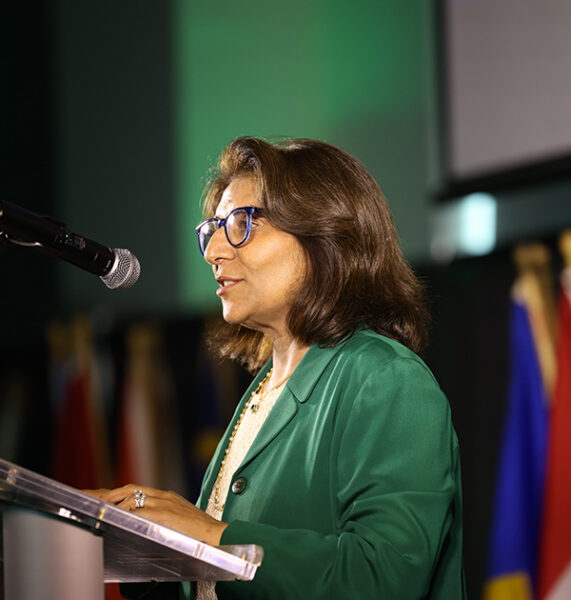
“I worked for about 10 years in the corporate world, including consulting and investment banking, and then decided that it was time for career number two, which also, at a personal level, dovetailed with becoming a mother. I often say that I don’t have two kids, I have three. I have a son, a PhD, and a daughter, in that order.
“The birth of my son prompted the question: What do I really want to do that will let me have meaningful impact? The answer led to a PhD from Columbia, and my second career as an academic. Since then, I’ve been in higher education. I started as faculty at what is now Manhattan University in 2010, eventually becoming the Capalbo professor and department chair where I had the opportunity to have impact on more than just my classes by revamping the entire management major. I later moved from Manhattan to Quinnipiac University to be associate dean, and now I’m thrilled to be here at Babson.”
What have your early months at Babson been like?
“A lot of interesting and exciting conversations. Anyone who has wanted to meet with me, I met with them. My first couple of months, I would go through six, seven, eight meetings a day with people also just stopping by. I spoke to as many people as I could. These conversations grounded the potential of a Babson undergraduate education for me. They have also helped me envision the central role of experiential and immersive learning in a Babson lived experience. I want to continue them with students and faculty this year. Maybe it’s ‘Tea on Tuesday’ or ‘Walk-in Wednesdays,’ or lunch at Trim on a Thursday. I did that with groups of students and faculty last year, and I want to do that a lot more. These community conversations and partnerships are, for me, an important part of how we uncover our synergistic advantages and innovatively strengthen them.”
AI is obviously a major part of the conversation around higher education. What is your perspective on AI at Babson?
“Babson students have always been prepared to create value in a world of uncertainty, and AI can be thought of as the latest and most consequential version of that challenge. The durable skills that are central to our focus on immersive learning experiences, such as judgment, adaptability, knowing what’s worth doing for and by whom, matter even more now. AI is remarkable at execution, but it cannot tell you what is worth executing. It is a tool and whether it is good or bad for learning depends entirely on whether you’’re using it to go deeper into a topic or just to go faster and reduce cognitive burden that is essential to learning. We want students using AI to increase their cognitive load, not offload it, to learn deeper rather than faster, because there’’s no real learning without the struggle.
“The hardest question to work through is how to help students build genuine capability while also preparing them to work fluently with AI from day one. That tension is real, and anyone who claims to have solved it is not being honest. What gives me confidence is that the Babson community are entrepreneurial leaders with the capacity to figure it out.”
Another initiative you’re working on is a competency inventory for students. What is the idea behind it?
“In attending student presentations in the Advanced Experiential learning group, I was struck by how much our students learn outside of the classroom that is also connected to their curriculum. When you’re working on a consulting project with a partner, it isn’t just about the retailing strategies or the AI dashboard you curate. It is also all of the durable skills that you learn through that experience outside the classroom. Being on a sports team or a peer tutor similarly leads to many important competencies that are connected but not limited to the curriculum and our learning goals.
“I wanted to create a way for students to showcase their integrated learning curricular, co-curricular, and extra-curricular endeavors while at Babson. I learned that there was work being led by the Office of Campus Life evaluating whether NACE competencies could be mapped to student extracurricular activities, and we started to ask how we could expand this process across the holistic Babson experience to showcase all the competencies gained by the students as we prepare them for jobs of the future and lives in an uncertain world.
“We started by looking at all the competencies that our students are going to need in the future, resulting in a giant list of competencies and skills from many sources, including the World Economic Forum, Skills on the Rise, CEOs of the Future, and other inventories. We have narrowed over 80 to about 13 right now and have definitions as well as behaviors associated with those competencies. We are convening a Competency Inventory Working Group consisting of faculty and staff to determine how they can be converted into an individual competency inventory for each student.”
How is a competency different from having a skill?
“The ultimate goal for me is that every student should be able to say, ‘Here’s my transcript that tells you what courses I took and grades I got, and here are the integrated competencies that I have learned across my Babson experiences both inside and outside the classroom.’”
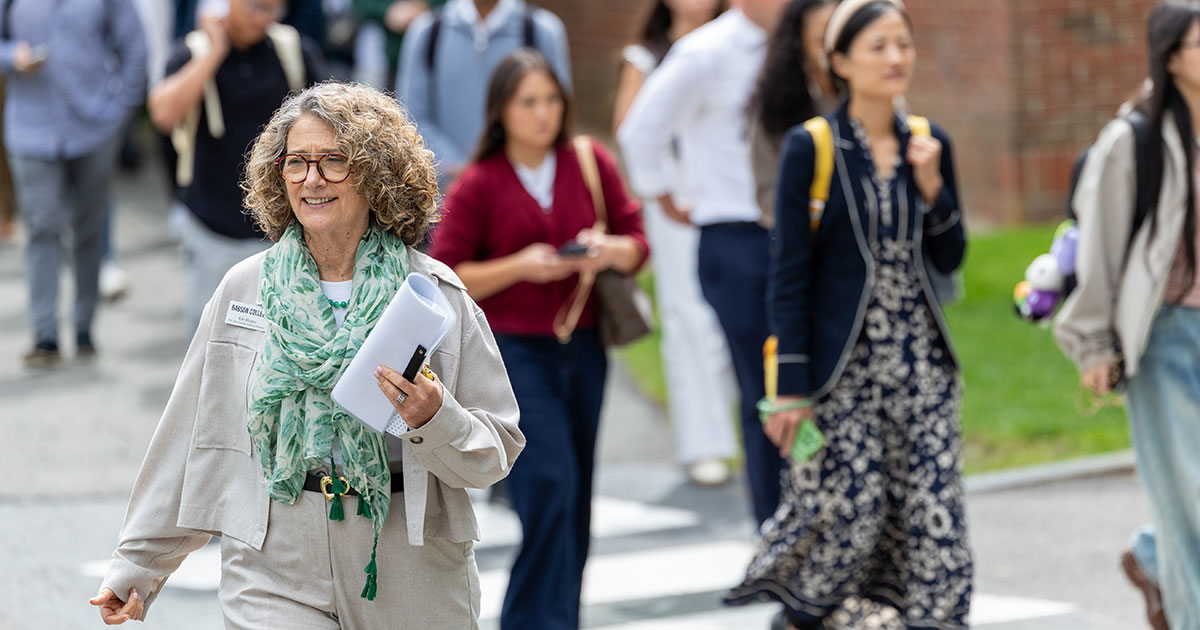
Babson Undergraduate Dean Poonam Arora
“Competency includes how you use the skill to translate to impact. It has a knowledge component, a behavioral component, and a skill or ability component. Take decision-making under uncertainty. It’s not just, ‘I can run a model, I know how to calculate expected value, and I choose the option with the highest expected value.’ Decision-making under uncertainty includes: Do you know how to ask good questions to make sure your assumptions are correct? Do you know when not to use the model because the human side counts more than the actual numerical elements that you can measure? Combining ability, knowledge, and behavior creates a competency, which can consist of both technical and durable or what used to be referred to as hard and soft skills.”
Ultimately, what do you hope students will be able to do with the competency inventory?
“The ultimate goal for me is that every student should be able to say, ‘Here’s my transcript that tells you what courses I took and grades I got, and here are the integrated competencies that I have learned across my Babson experiences both inside and outside the classroom.’
“Having the inventory, though, is not the comparative advantage. Our real competitive advantage lies in the lived experience of a Babson student that is more than the requirements of a set of courses or the grades received. Whether you’re here as a transfer student or you came in the fall or January, however long you were with us, you had curated 360-degree curricular, co-curricular, extracurricular experiences that resulted in integrated learning that prepare you to go out into the world. That is really what I’m hoping this can showcase. That is how Babson students stand out.”
Posted in Community
Latest Stories
Posted in Community
Posted in Community